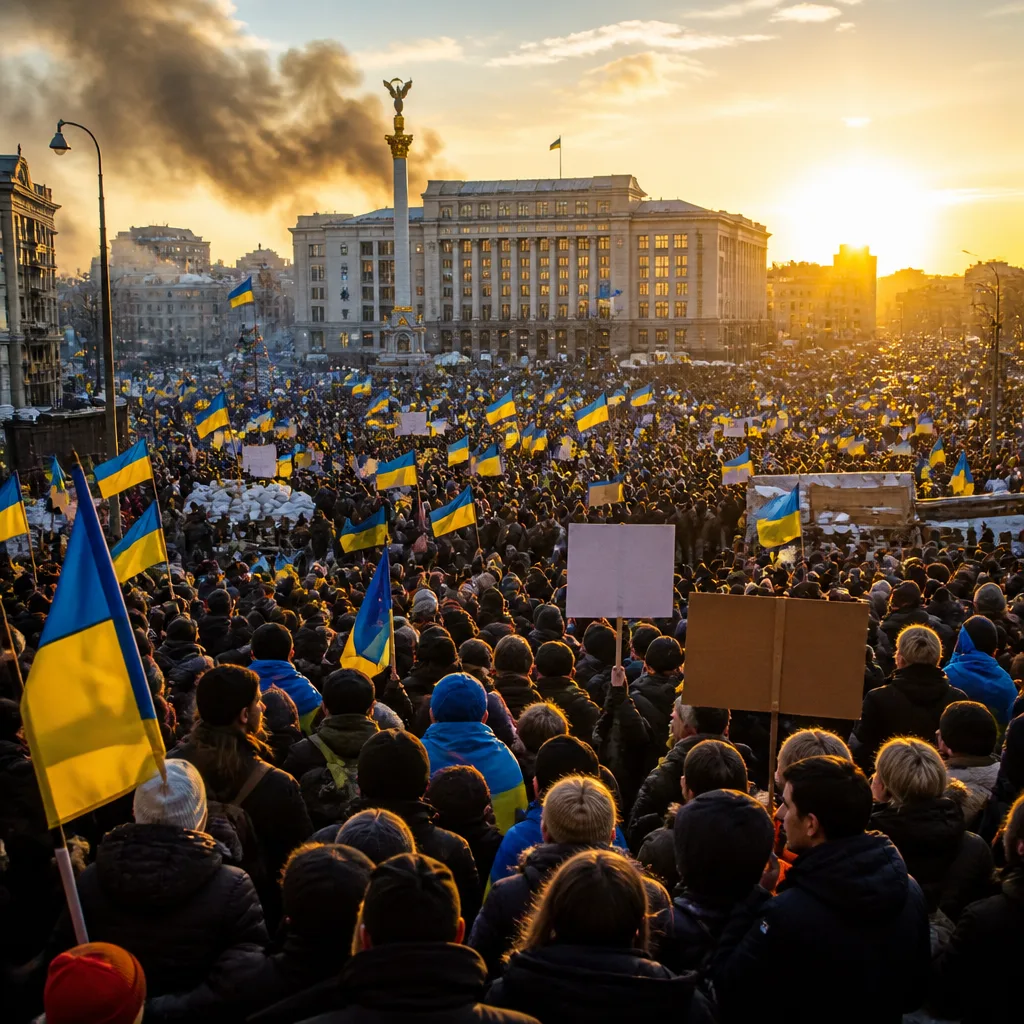
Thousands of demonstrators continued to assemble in Kyiv on Monday for a fifth consecutive day of protests sparked by the dismissal of reform-minded defence minister Mykhailo Fedorov, intensifying a political crisis that challenges President Volodymyr Zelensky's effort to maintain unity while Ukraine remains at war.
Standoff between reformers and military leadership
The demonstrations, which began spontaneously last Thursday, are directly related to tensions over defence leadership and reform. Protesters have rallied in support of Fedorov, a tech-savvy figure noted for pushing modernisation within the armed forces and for frequent clashes with the military's senior command. Attendance peaked in earlier days and remained substantial on Monday, though organisers reported a slight drop following a weekend of Russian attacks.
"You can ask everyone here -- we will not leave,"
said 25-year-old Anastasiia Starodubtseva, one of the protesters, reflecting the determination voiced by many in the crowds who sang the national anthem and held makeshift placards.
Decisions looming for Zelensky
President Zelensky has been engaged in repeated consultations with senior advisers and the military hierarchy as he seeks a resolution that can satisfy competing factions and avoid internal divisions during the invasion. Ukrainian media and analysts identify two central decisions on the agenda: whether to reinstall Fedorov and what to do about commander-in-chief Oleksandr Syrsky, who has come under public pressure and whom demonstrators now regularly call to be removed.
In a forceful post-dismissal statement, Fedorov accused Syrsky of presenting Mr. Zelensky with an ultimatum to secure his ouster; Fedorov in turn demanded Syrsky's dismissal. Those developments deepened the rift between a reformist camp and elements of the military leadership, with crowds responding on the streets and on social media.
Public unrest and political stakes
Observers say the episode represents one of the most politically acute moments of the conflict because it links domestic governance disputes directly to wartime leadership and public morale. Oleksandr Salizhenko, an expert with the Chesno movement, warned that the "list of demands" from protesters was already expanding, signalling the potential for wider political ramifications if authorities fail to chart a clear path forward.
- Five days — length of sustained demonstrations related to the dismissal.
- Key figures — Mykhailo Fedorov (dismissed defence minister); Oleksandr Syrsky (commander-in-chief under pressure); Volodymyr Zelensky (president managing the crisis).
- Immediate choices — whether to reinstate Fedorov and the future of Syrsky's command.
| Item | Detail |
|---|---|
| Start of protests | Thursday prior to report (spontaneous) |
| Duration | Five days at time of report |
| Primary demand | Reinstatement of Fedorov / dismissal of Syrsky |
The trajectory of this crisis will hinge on Zelensky's ability to broker a compromise acceptable to reformist political forces, the military high command and an increasingly mobilised public. Any decision carries operational as well as political consequences: it could influence military cohesion, public confidence in wartime governance and Ukraine's position as it continues to face external military pressure.
As of the latest reports, the presidency indicated that no decision was expected on Monday, signalling ongoing deliberations at the highest level. The coming days will test whether Kyiv can reconcile internal divisions without detracting from the broader war effort.