
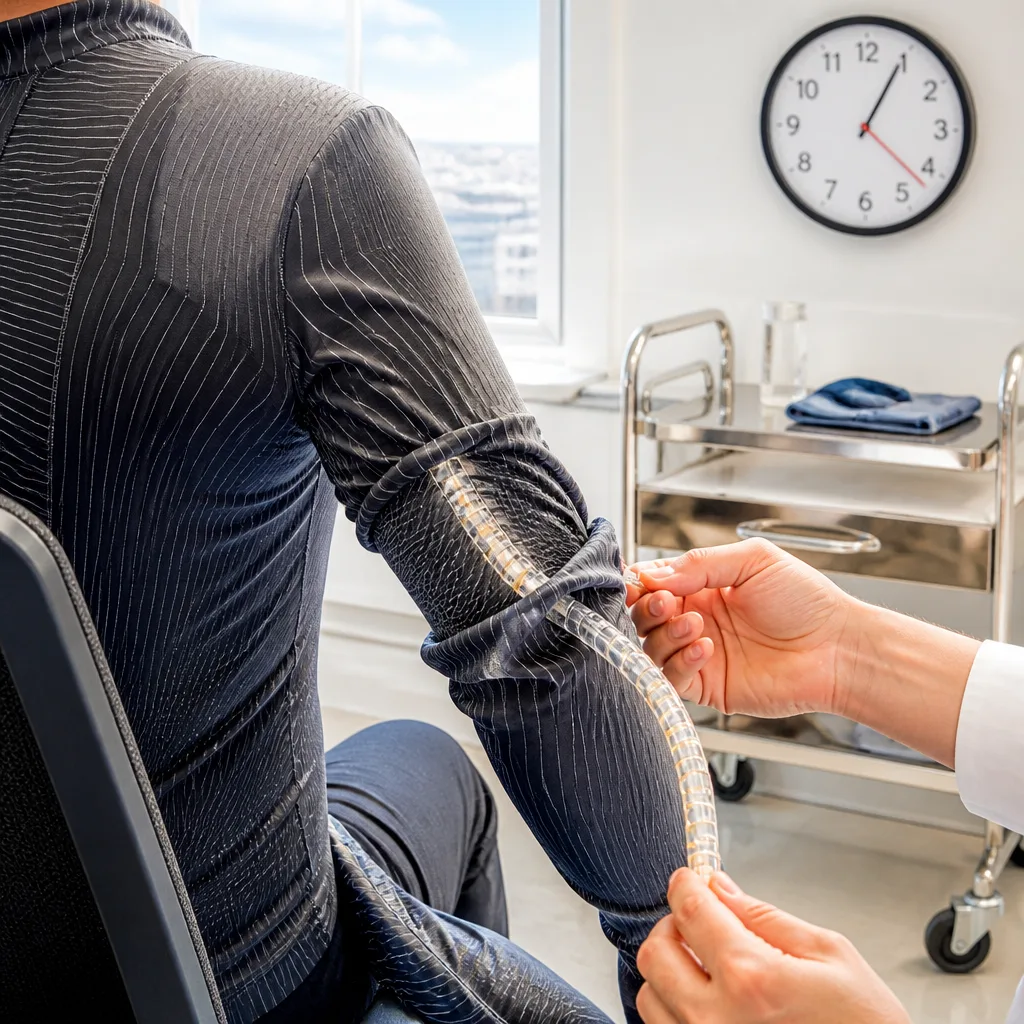
A new soft robotic system can put a suit on a person without hands or outside assistance, according to researchers at South Korea’s KAIST and Stanford University. The team says the device—built from flexible, air‑powered “vines” embedded in clothing—can draw fabric up and close to a wearer’s body even if the person is not standing still.
How it works
The design takes inspiration from ivy: instead of sliding its whole body, the vine‑like actuator grows at its tip and pushes fabric along the wearer’s contours. Researchers report the mechanism enables stable movement over curved surfaces and through narrow gaps, and can complete a full suit in about 10 seconds.
"The vine robot stays close to the person and dresses them by turning the clothing inside out as it moves, allowing it to climb stably along the shape of the body,"
That description was offered by Kim Nam Gyun, a KAIST postdoctoral researcher and lead author on the study. Professor Ryu Jee‑Hwan, also at KAIST, highlighted the vine’s ability to traverse slippery or sloped surfaces and to adapt to the surrounding shape.
Potential uses and practical appeal
The researchers emphasise several practical settings where hands‑free dressing could be valuable:
- Care and accessibility: helping elderly or mobility‑impaired people put on clothing with less reliance on caregivers.
- Cleanrooms and manufacturing: rapid donning of suits in semiconductor facilities where strict contamination control is required.
- Emergency response: enabling first responders to put on protective gear quickly without using their hands.
The team also noted that the system does not require a complex control algorithm or that the user remain motionless—features that increase its real‑world practicality compared with many laboratory robots.
Where the research stands
The work was published in IEEE Robotics and Automation Letters. The published paper presents the concept, demonstrations and engineering details of the pneumatic vine actuators. Researchers emphasised the mechanical engineering achievement at a time when much attention in tech research is focused on software and AI, suggesting physical systems like this can complement intelligent control.
| Characteristic | Reported detail |
|---|---|
| Typical donning time | ~10 seconds |
| Operating principle | Air‑pressurised soft “vines” that grow at the tip |
| Main research groups | KAIST (South Korea) and Stanford University (U.S.) |
For lifestyle readers, the appeal is immediate: imagine a raincoat that self‑deploys while you ride a bicycle, or a quick‑on protective suit in a hazardous scene. The research team cited such everyday and specialised scenarios when discussing the concept.
Next steps and limitations
As with any lab demonstration, there are hurdles before widespread consumer or workplace use. The current demonstrations show feasibility and novel mechanics, but further work is needed on durability, user comfort, safety certification and integration into commercially viable garments. The researchers have highlighted the system’s strengths—adaptability, speed and minimal control complexity—while leaving open how the technology will scale for mass production or regulation in health and safety contexts.
The study adds to a growing wave of soft robotics that focus on human‑centric applications. For anyone curious about the near future of dressing, caregiving and quick‑response gear, this is a practical example of how mechanical design may soon reshape everyday routines.