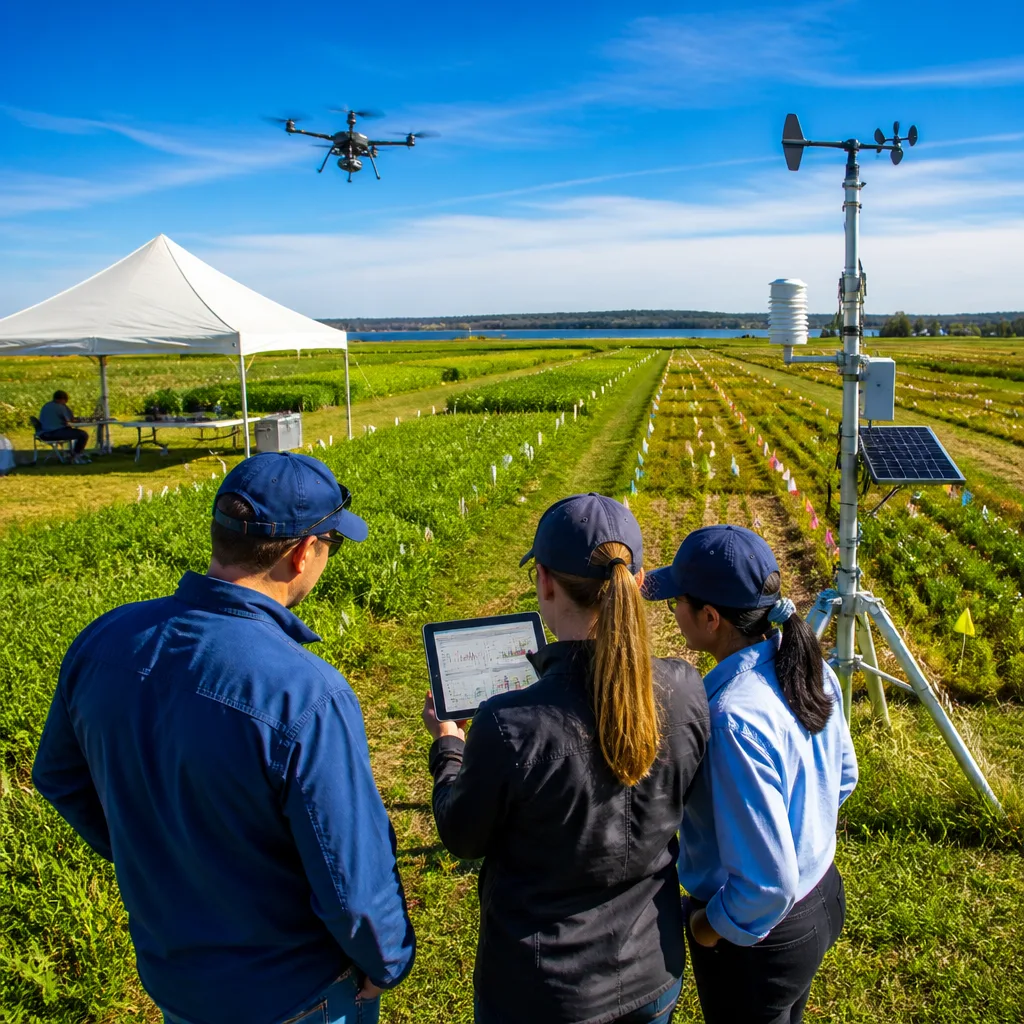
The federal government is directing $3.5 million to the Enterprise Machine Intelligence and Learning Initiative, known as EMILI, to expand testing and commercialization of digital agriculture tools, officials announced at EMILI’s Field Day in Grosse Isle, Man.
What the funding will do
The investment is designed to help more technology companies move from pilot projects into real-world farm deployment by increasing the capacity of EMILI’s innovation sites and by supporting trials under authentic growing conditions. EMILI — now marking its 10th anniversary — works with startups and established firms to validate sensors, machine-learning models and other precision-agriculture systems on working farms.
- 24 innovators are currently engaged with EMILI in this year’s program.
- Those companies are running 33 projects across EMILI-managed trial plots.
- Trials span roughly 10,000 acres at sites in Grosse Isle and MacGregor, Manitoba.
Why it matters
Canadian producers face higher input costs, unpredictable weather and fierce global competition. Practical digital systems — from machine vision for crop monitoring to data-driven nitrogen management — promise productivity gains, lower environmental footprints and more resilient operations. Federal support aims to reduce the gap between promising innovations and reliable, scalable products farmers can adopt.
Scaling beyond Manitoba
The announcement also highlights EMILI’s role as a co-founder of the Agriculture, Innovation, Validation and Adoption Network (AIVA), a cross-provincial effort linking validation capacity in Alberta, Saskatchewan, Manitoba and Ontario. That network is intended to spread testing resources and improve the pace at which validated tools become commercially available across the Prairies and into Ontario.
| Metric | Value |
|---|---|
| Federal investment | $3.5 million |
| Years operating | 10 |
| Innovators engaged (this year) | 24 |
| Projects | 33 |
| Acres under trial | 10,000 |
Officials framed the funding as part of broader federal efforts to support innovation, green economic development and Canada’s long-term food security. By channeling resources into field validation, the program seeks to shorten the time it takes for digital agriculture tools to move from lab prototypes to systems that deliver measurable benefits on Canadian farms.
For technology companies, the main challenges remain proving reliability at scale and demonstrating clear economic returns for producers. EMILI’s field sites aim to supply that evidence by subjecting new systems to real operational conditions across multiple seasons and soil types.