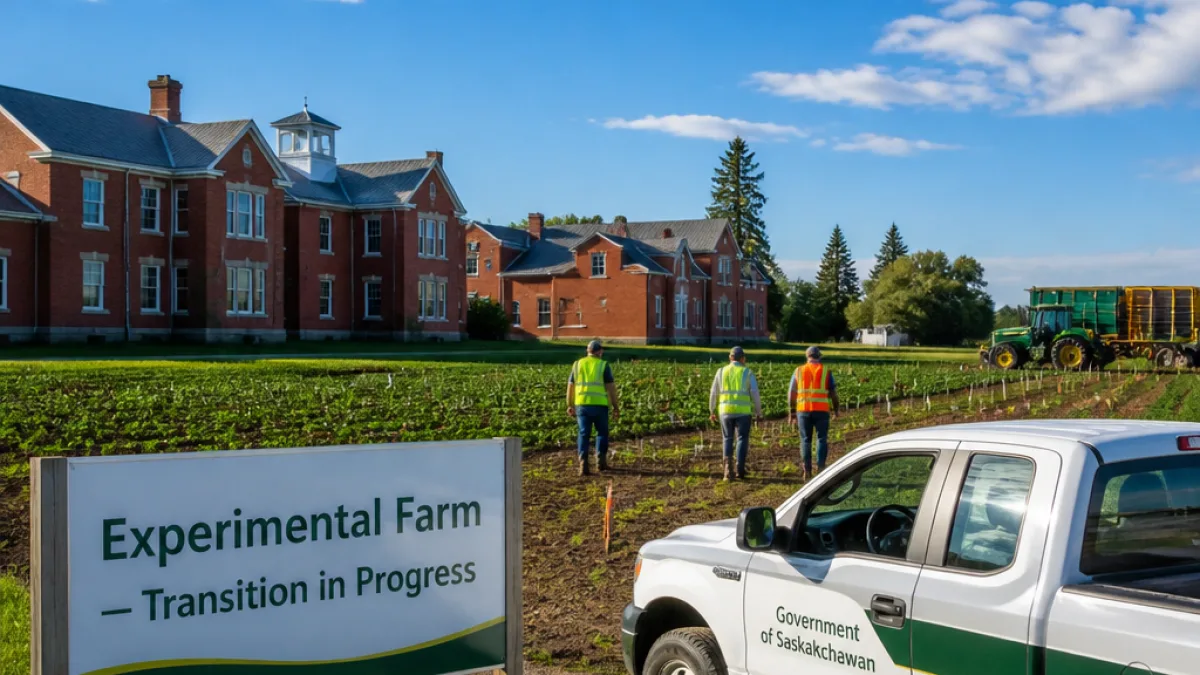
The Saskatchewan government has agreed to take over two satellite experimental farms previously operated by Agriculture and Agri‑Food Canada, averting planned closures that had alarmed farmers and municipal leaders across the province.
Province to assume operations
A memorandum of understanding between provincial and federal authorities sets out that the Saskatchewan Ministry of Agriculture will assume responsibility for the research sites in Indian Head and the town of Scott. The two locations were among seven research operations the federal government had announced it intended to close earlier this year.
Indian Head’s facility is of particular historical and practical importance. It was the second experimental farm established in Canada and has been used for field trials and testing that benefitted producers across Western Canada. Local leaders and academics cautioned that the agreement marks a beginning, not a conclusion — significant work remains to transfer programs, staff and infrastructure.
“There's a lot of excitement going on and happiness that a research farm that's been here for 140 years is going to remain open and still stay part of our community,” said Indian Head Mayor Steve Cole.
Local reaction and concerns
The announcement drew swift praise from municipal officials who had mobilized to oppose the closures. Mayor Steve Cole described the effort as a community endeavour that brought stakeholders together to find a way to preserve the site.
Academic voices emphasised the wider consequences of potential closures. Richard Gray, professor of agricultural and resource economics at the University of Saskatchewan, warned that losing the Indian Head site would have been damaging to agricultural research productivity and to the effectiveness of regional testing programs.
What remains to be decided
The memorandum signals that the land and facilities will be retained under provincial oversight, but it does not resolve operational details. Officials have not yet published a timetable or set out how research programs, staffing, funding and ongoing experiments will be managed during the transition.
- Sites involved: Indian Head and Scott research farms.
- Federal action avoided: Closure plans announced earlier this year for seven federal research operations nationwide.
- Next steps: Negotiations and implementation work to transfer responsibilities and ensure continuity of research.
Local farmers and industry groups had reacted strongly after the federal closure announcements, arguing the experimental farms play a central role in developing crop varieties and husbandry practices suited to prairie conditions. The provincial takeover is likely to reassure producers who rely on local testing and extension services, but stakeholders will be watching for concrete plans to sustain research capacity.
| Research farm | Location | Notes |
|---|---|---|
| Indian Head | Indian Head | Historic site; second experimental farm established in Canada; slated to remain open under provincial care |
| Scott | Scott | Satellite research location to be transferred to Saskatchewan Ministry of Agriculture |
For community leaders, the announcement represents a victory after months of advocacy. For researchers and producers, it buys time to secure continuity of trials and to clarify long‑term governance and funding. Officials from the provincial ministry and Agriculture and Agri‑Food Canada will need to publish further details to guide the transition and to reassure partners who depend on the farms’ services.
The outcome in Saskatchewan contrasts with the federal decision earlier this year that prompted plans to shutter multiple sites nationwide. Local stakeholders had flagged the potential loss of regional testing capacity as a threat to innovation and to the practical needs of prairie agriculture.
As the provincial ministry begins the handover process, municipal officials and agricultural researchers say they will remain engaged to protect the continuity of experiments and the community benefits associated with the research farms.