
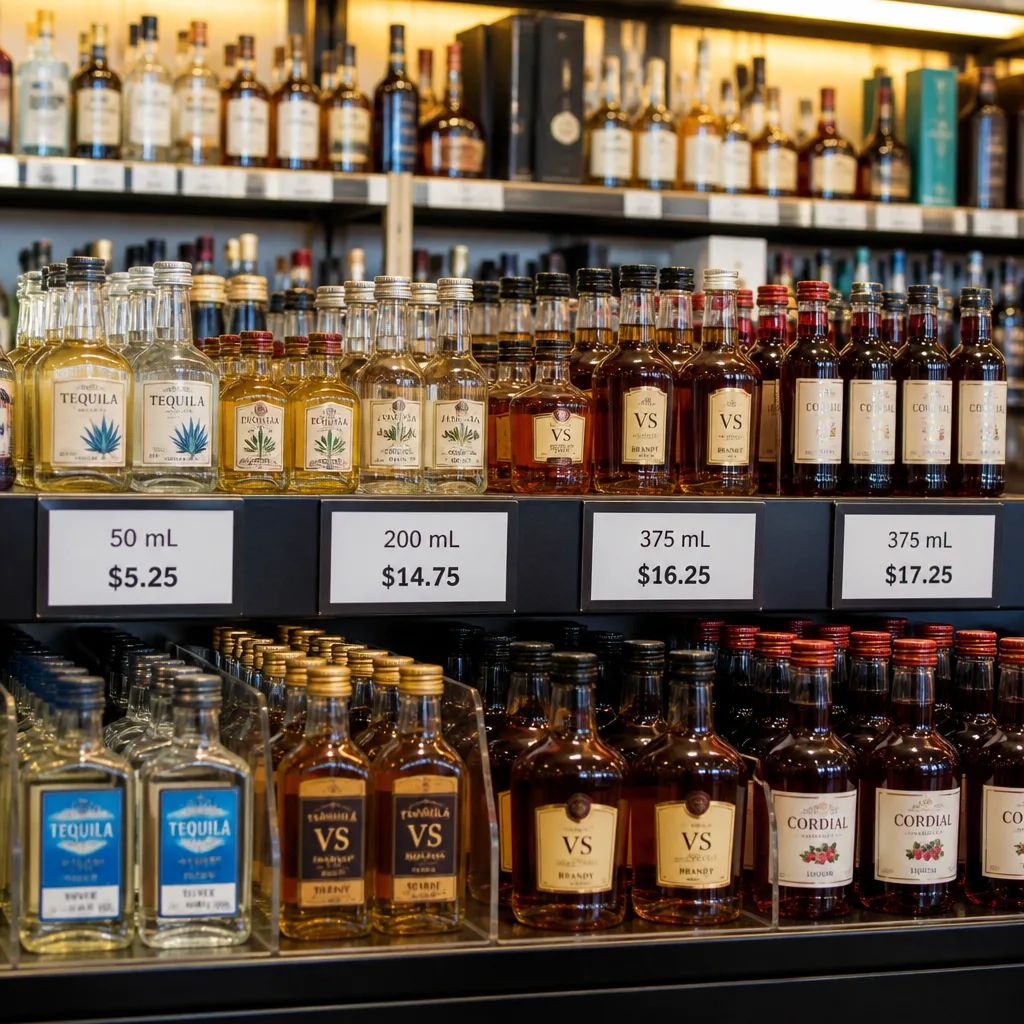
Global spirits companies are betting that smaller bottles will keep consumers loyal to their favourite labels as household budgets tighten. Makers of Jameson, Patrón and other premium brands are rapidly expanding mini formats ranging from 50 millilitres up to 375 millilitres, responding to buyers who are trading down in size rather than in brand.
Consumers opt for portioned spending over brand switching
Industry data shared with CNN by Bump Williams Consulting shows that the fastest gains in the first quarter came from 50 mL bottles of brandy and tequila — the volume of a single shot — and from 375 mL bottles of tequila and cordials. A typical bottle sits around 700 to 750 mL, so the trend marks a notable swing to smaller packages while maintaining premium preferences.
That shift aligns with what analysts describe as a focus on managing discretionary income without abandoning higher-end tastes. As Dave Williams, president of Bump Williams Consulting, put it:
“We still see high-end brand interest, though perhaps frequency and pack size have become bigger parts of the purchase decision lately as consumers manage their discretionary income.”
Big brands resize to hold share
Pernod Ricard, the Paris-based owner of Absolut and Jameson, has leaned into the move. The company recently introduced a 100 mL bottle of Malibu rum liqueur, broadening a portfolio that already includes smaller formats for Skrewball peanut butter whiskey and Absolut vodka. In the United States — a key market — the company reported a 12% sales decline in the third quarter, and is using pack-size variety to attract cost-conscious shoppers looking for more affordable and portable options.
Colin Kavanagh, chief marketing officer for Pernod Ricard North America, said the company is observing a clear pattern of size-based trade-down among its own customers:
“What’s reassuring for us is people are not trading out of our brands, per se, but they are maybe taking a decision to switch from a larger size into a smaller size.”
Over the past year, more of its shoppers have moved from 1.75-litre bottles into 750 mL, and from the 750 mL “fifth” into 375 mL sizes. Pernod Ricard’s push into minis accelerated after the success of its small-format Skrewball launch.
Why size matters for retailers and drinkers
For households, smaller bottles can lower the upfront cost of a purchase, support moderation and offer variety without committing to a full-size bottle. For retailers and producers, the format shift can reshape shelf allocation and packaging decisions, with more single-serve and half-bottle options geared to trial, gifting and convenience-driven occasions.
- Affordability: Smaller formats reduce the cash outlay per purchase, keeping premium brands within reach when budgets are tight.
- Portability and occasions: Minis suit on-the-go and limited-quantity occasions without sacrificing brand preference.
- Assortment strategy: Producers are widening size ranges to defend brand loyalty across price points.
Packaging landscape at a glance
| Format | Typical volume | Role in market |
|---|---|---|
| Mini | 50 mL | Single-serve; rapid share gains in tequila and brandy |
| Small | 100 mL | New entries (e.g., Malibu) targeting portability |
| Half | 375 mL | Downsizing from fifths; growth in tequila and cordials |
| Standard | 700–750 mL | Baseline size for most spirits |
| Large | 1.75 L | Value for frequent buyers; some shift to smaller sizes |
What to watch next
As more brands diversify their packaging, expect marketing to spotlight portability, trial and value messaging around smaller formats. The early momentum in 50 mL and 375 mL sizes suggests companies will keep investing in these options to sustain brand loyalty amid cautious spending. For shoppers, the practical outcome is a broader range of price points on familiar labels — and more choice in how much to buy at once.
The underlying theme is clear: rather than exiting premium categories, many consumers are recalibrating how they buy. For global producers navigating uneven demand — including a 12% quarterly drop for Pernod Ricard in the US — smaller bottles offer a way to meet customers where their budgets are, without forcing a compromise on brand.