Ancient predator’s relative identified from campground find
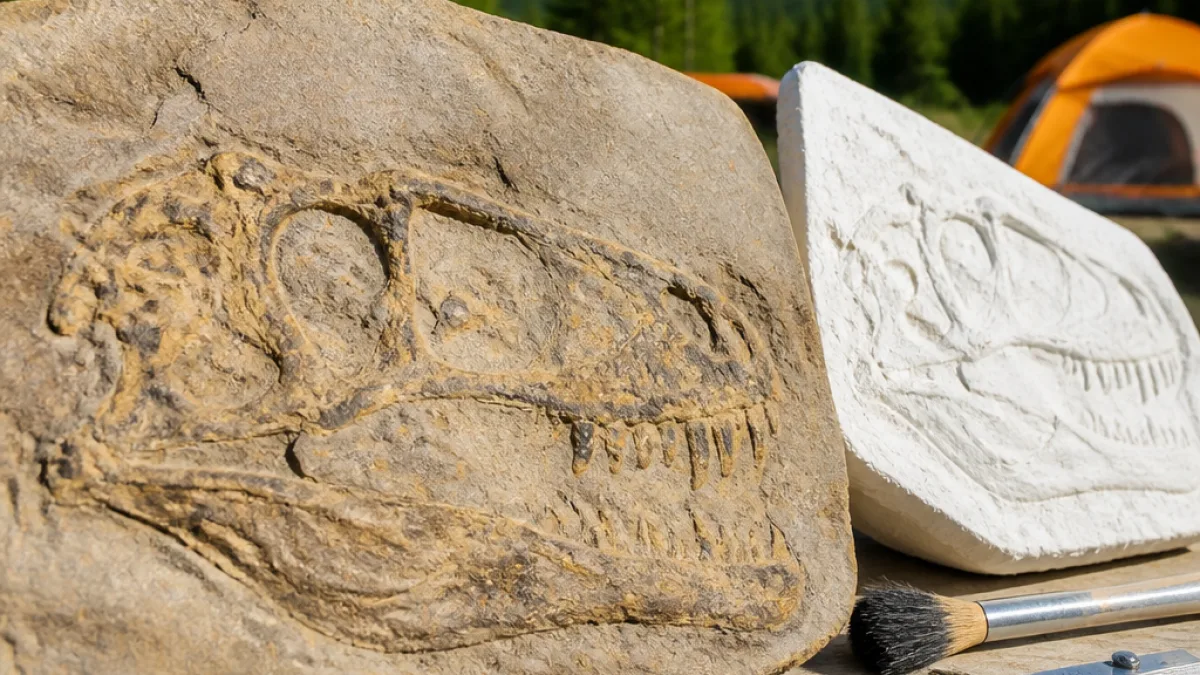
A fossilized skull impression discovered at a Tumbler Ridge campground has been identified as belonging to a nimble, earlier member of the tyrannosaur lineage, according to a new study. Researchers say the animal was lighter and faster than its famed descendant, the Tyrannosaurus rex, placing the British Columbia specimen closer to the front end of the lineage that culminated in the Late Cretaceous apex predator.
The specimen—preserved as a partial skull impression in a block of sandstone—was first noted in 2017 and later examined in detail. A cast of the impression, shown in a handout image, captures structural features that helped scientists pin the fossil to an earlier tyrannosaur relative rather than to T. rex itself. While not a complete skull, the preserved contours provide enough comparative data to suggest a more lightly built hunter that relied on speed.
Why this matters for B.C.’s fossil record
British Columbia’s dinosaur body fossils are comparatively scarce, making this identification especially significant for understanding the region’s prehistoric ecosystems. The find adds to a fragmented but growing picture of carnivorous dinosaurs that once moved through what is now the province’s northeast. By situating the Tumbler Ridge fossil within the tyrannosaur family tree, the study offers evidence that earlier, more agile predators ranged through the area long before the emergence of bulkier, late-surviving relatives.
Researchers say the identification broadens the geographic and ecological context for tyrannosaurs in western Canada. The sandstone matrix indicates the remains were preserved in sediments that captured enough fine detail to record a skull impression rather than bone, a preservation window that can still reveal important anatomical information when complete specimens are lacking.
From campground discovery to research insight
Fossils do not always appear in remote badlands or active quarries; in this case, the initial clue emerged from a campground setting frequented by residents and visitors. The 2017 observation ultimately led to closer scrutiny and a detailed comparison with known tyrannosaur features. The authors of the new study conclude that the animal represented by the impression would have been more gracile than T. rex, favouring speed and maneuverability over massive build.
| Year | Location | Find |
|---|---|---|
| 2017 | Tumbler Ridge, B.C. | Partial skull impression in sandstone; later cast for study |
Public stewardship and visiting fossil sites
The identification underscores the role that chance observations can play in science. Campgrounds, trails and riverbeds can occasionally expose ancient material when erosion or construction reveals buried layers. Authorities and researchers generally remind the public that potential fossils should be left in place and reported to local officials or site operators. Removing objects can damage scientific context and, in many jurisdictions, is restricted or prohibited without proper authorization. Visitors who encounter suspicious rock impressions or bone-like textures should document the location, take photographs if safe to do so and seek guidance before attempting any collection.
For Tumbler Ridge and neighbouring communities, the study’s findings add scientific depth to the area’s reputation for rugged geology and periodic fossil discoveries. As research teams analyze the cast and related materials, the work could inform exhibits, educational programming and guided outings that highlight how everyday landscapes can conceal significant pieces of natural history.
What the study contributes
- Positions the Tumbler Ridge specimen as an earlier relative of T. rex, indicating a more agile predator.
- Demonstrates how partial impressions, not only bones, can yield anatomical clues.
- Expands the known range and diversity of tyrannosaurs in western Canada.
Although the fossil does not rewrite tyrannosaur evolution, it narrows gaps in the record by anchoring an agile form to northeastern British Columbia. That, in turn, strengthens the case for careful protection of exposed strata in public spaces, where seemingly ordinary slabs of stone may preserve the outlines of predators that once dominated Cretaceous food webs.