Quick, custom rigid lenses targeted to address local access gaps
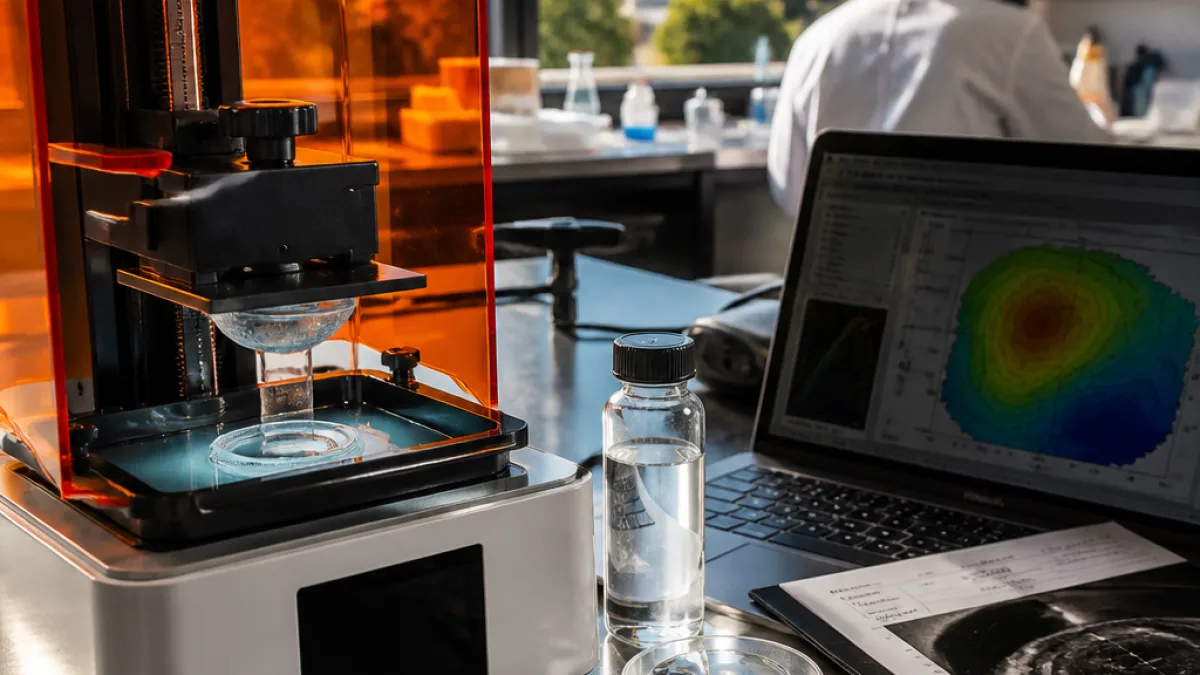
Researchers at the University of Waterloo have developed a 3D-printing process that can produce custom rigid (hard) contact lenses in roughly 20 minutes, using a specially formulated silicone material. The team says the method is intended to help patients with irregularly shaped corneas who currently face long waits and high costs for bespoke lenses.
The project is led by Dr. Shirley Tang, a chemistry professor at the university, who discussed the work in an interview on CBC K-W. The new technique combines advanced additive manufacturing with corneal-scan-based lens design, allowing a lens to be printed to an individual's shape rather than relying on mass-produced geometries.
"With 3D printing, the most significant advantage is the ability to customize design,"
Dr. Tang said customization is crucial because many people with irregular corneas cannot be fitted with soft lenses and require rigid lenses fitted by specialists. In the Waterloo region, those specialists are scarce; the university's School of Optometry is currently an important local centre for rigid-lens fitting.
Potential cost and care delivery impacts
The research team estimates the 3D-printing approach could sharply reduce the price of rigid lenses—potentially to about one-tenth of current costs—by moving production into an optometrist's office and avoiding lengthy, centralised manufacturing. Faster production also raises the possibility of issuing a personalised lens during a single clinic visit.
- Target patients: people with highly irregular corneas who cannot wear soft lenses.
- Expected time to produce a lens: about 20 minutes.
- Potential cost reduction: as much as 90 per cent compared with current rigid-lens prices, per the researchers' estimates.
What comes next
Researchers said the work builds on roughly eight years of silicone-material development in their labs. They identified lens production as a practical application for those materials and are now focussed on further testing, regulatory steps and partnerships with eye-care providers to move the process toward clinical use.
| Feature | Reported detail |
|---|---|
| Production time | ~20 minutes |
| Primary benefit | Customization for irregular corneas |
| Estimated cost change | Potentially down to one-tenth of current rigid-lens costs |
If the technique clears additional testing and regulatory review, it could change how specialised contact lenses are delivered in Waterloo and beyond, reducing travel and wait times for patients who now have few local fitting options.