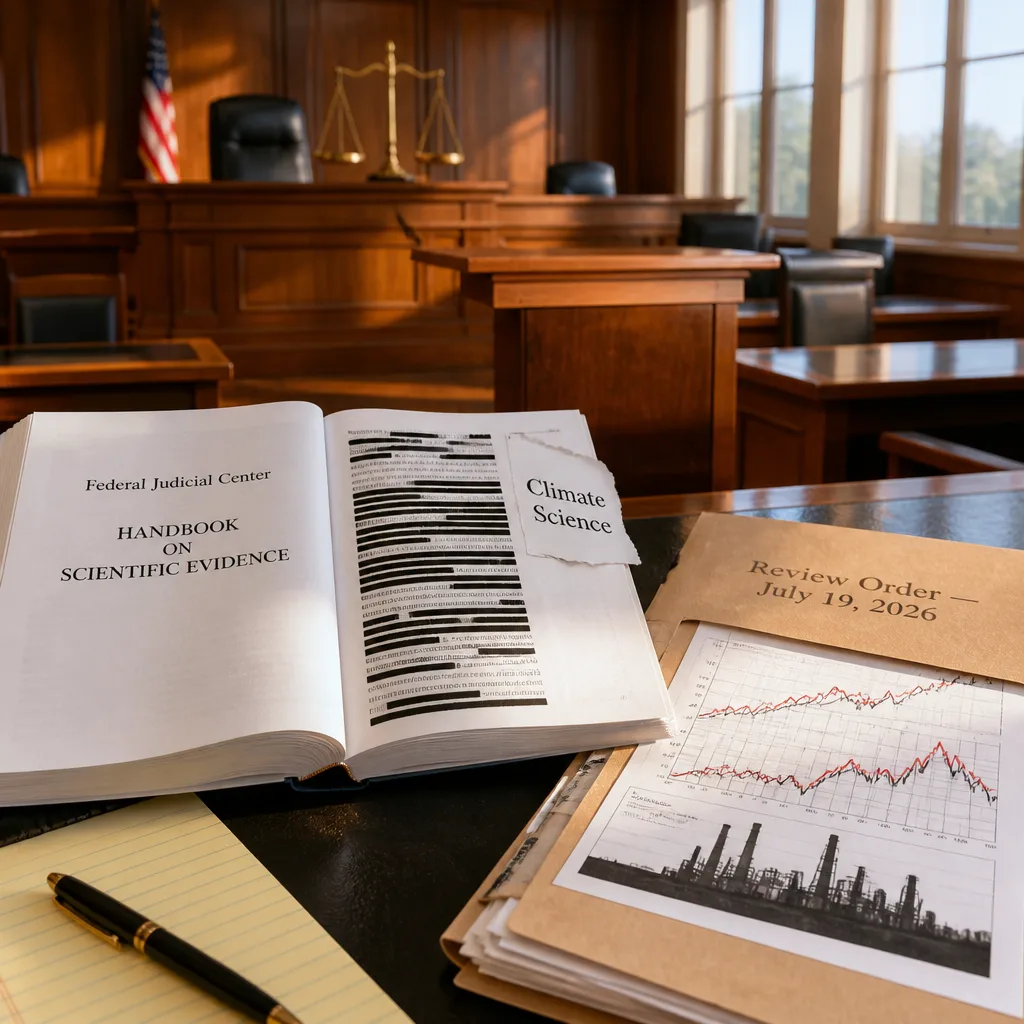
U.S. President Donald Trump has ordered federal agencies to re-examine the use of climate science materials in American courtrooms, focusing scrutiny on the Federal Judicial Center’s Handbook on Scientific Evidence after a climate chapter was dropped from its latest update. The move, flagged in a statement dated July 19, 2026, raises fresh questions about the accuracy, impartiality and future admissibility of expert climate evidence before U.S. judges.
Directive targets climate guidance used in court
The directive urges a review of how the handbook is applied in climate-related cases, asserting that elements of the material are outdated or misleading and have caused harm. The White House has not provided an official comment beyond the statement. The order lands amid an ongoing debate over the role and framing of scientific documentation in litigation over climate impacts and responsibility.
“Our country’s federal judges deserve facts and science, not political fraud and fake science about the climate. With this truth, I order federal agencies to review this conduct.” — Donald Trump
Climate chapter removed after pushback
Earlier this year, the federal judiciary removed a climate-change section from the handbook’s new edition following objections from prosecutors in several partner states, who argued the language exhibited bias against oil companies. The climate section had been prepared by Jessica Wentz and Radley Horton of Columbia Law School to help judges evaluate the admissibility and weight of climate-science testimony and documentary evidence.
Produced by the Federal Judicial Center (FJC) in collaboration with the National Academies of Sciences, Engineering, and Medicine, the handbook is widely referenced by judges to navigate complex scientific and technical evidence. The fourth edition update was released in December of the previous year, with the climate section later withdrawn.
What the review could mean
- Evidence standards: Revisiting the handbook’s guidance could influence how courts assess climate models, attribution studies and expert methodologies.
- Perceptions of bias: The dispute centres on whether the materials unduly favour or disfavour particular parties, including fossil fuel defendants.
- Judicial practice: Any changes may ripple into pre-trial motions, admissibility hearings and the weight accorded to scientific exhibits.
Handbook at a glance
| Document | Handbook on Scientific Evidence |
|---|---|
| Publisher | Federal Judicial Center (FJC) |
| Partner Institution | National Academies of Sciences, Engineering, and Medicine |
| Edition | Fourth edition |
| Update Released | December (previous year) |
| Removed Section | Climate change |
| Section Authors | Jessica Wentz; Radley Horton (Columbia Law School) |
| Purpose of Section | Guide judges on admissibility and weight of climate-science evidence |
Contest over “what counts” as science
At issue is the boundary between scientific synthesis and advocacy in materials relied upon by courts. Supporters of the now-scrapped chapter argued it distilled established climate findings to assist judges. Critics contended it risked steering courts toward conclusions seen as unfavourable to oil companies. The president’s directive adds a political layer to a methodological dispute that had already prompted the judiciary to remove the chapter.
In clarifying remarks, the statement indicated the review would consider the conduct of agencies involved in oversight steps such as suspension or disqualification of officials who shaped or vetted the materials. While the contours of that inquiry remain unspecified, the outcome could shape how federal entities interface with the judiciary on science guidance going forward.
Why this matters beyond one chapter
The handbook functions as a practical reference for judges managing technical records across areas from forensics to engineering. Climate litigation often hinges on expert reports, long historical datasets and probabilistic attribution. Adjustments to guidance—even the removal of a single chapter—can affect how judges structure hearings, qualify experts, and scrutinize scientific claims under prevailing evidence rules.
With no further details from the White House yet released, the review’s scope and timeline remain unclear. For courts, scientists and litigants, the central question is whether any revisions will bolster clarity and neutrality—or deepen contention over who defines authoritative climate science in the courtroom.