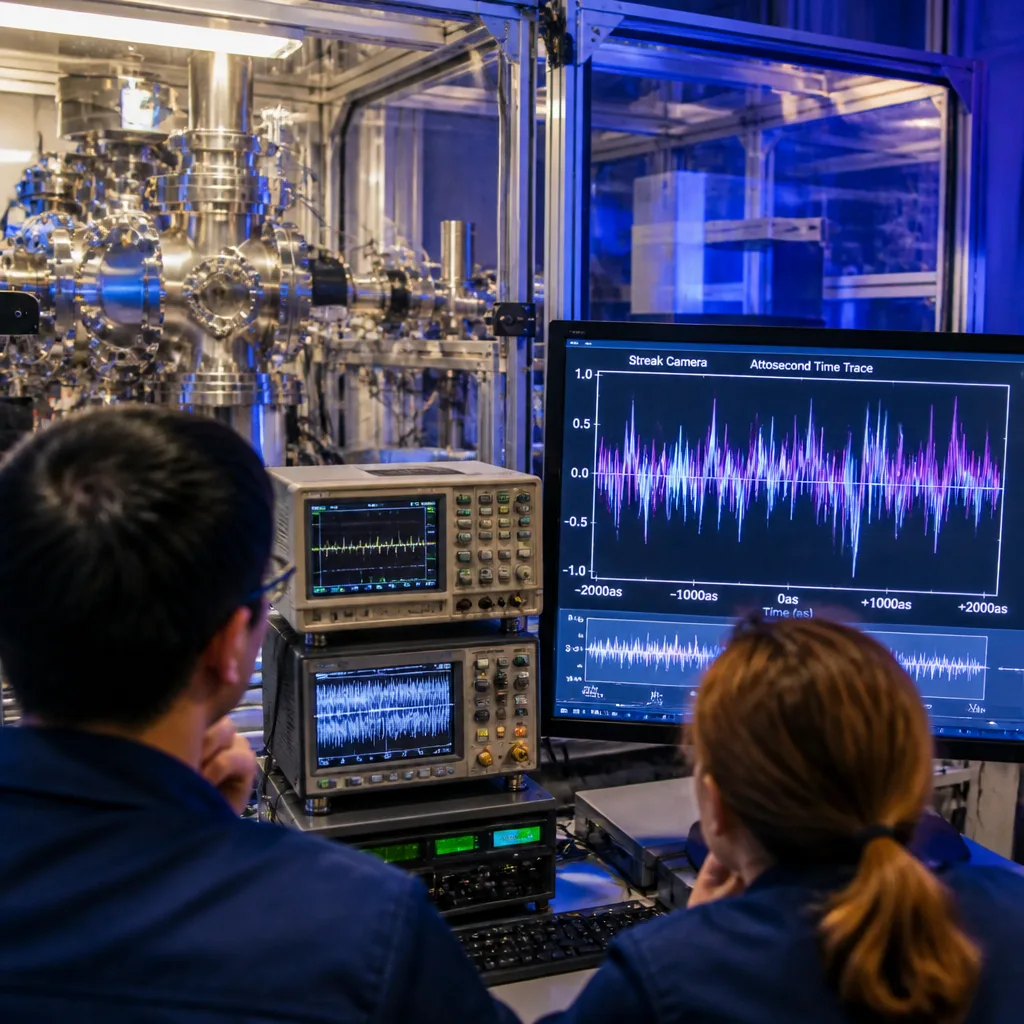
Scientists at the Department of Energy’s SLAC National Accelerator Laboratory have recorded the opening moments of a chemical reaction by imaging electron motion on the scale of attoseconds — billionths of a billionth of a second. The results, published in Nature Physics, map the ultrafast steps that follow an abrupt removal of an electron and identify two electronic processes that had not previously been observed in real time.
Watching electrons start chemistry
Using SLAC’s X‑ray laser, researchers applied an extremely fast ionizing pulse to a molecule — a method known as impulsive ionization — and then made a sequence of measurements that capture how the remaining electrons respond. Each frame in the experimental sequence represents changes that occur on attosecond timescales. The team reports direct observation of Coster‑Kronig decay and of quantum electron coherence as part of the early evolution following ionization.
Theory and experiment in dialogue
The SLAC measurements did not match predictions from leading computational models. That discrepancy prompted theorists working with the experimenters to add additional complexity to their simulations to better account for the observed behaviour. The work therefore illustrates how state‑of‑the‑art experiments can expose limits in theoretical descriptions and drive improvements in predictive modelling of photochemical events.
- Technique: X‑ray free‑electron laser imaging of impulsively ionized molecules.
- Timescale: attoseconds per frame (billionths of a billionth of a second).
- Newly observed processes: Coster‑Kronig decay and quantum electron coherence in real time.
Why this matters
All chemical change begins with electrons redistributing and breaking or forming bonds. By resolving the very earliest electronic rearrangements, the SLAC team provides a direct view of the initial push that leads to bond breaking and formation. The paper points to potential implications across areas where high‑energy photons interact with matter, including medical X‑ray exposures and the chemistry triggered by cosmic rays in the upper atmosphere.
| Aspect | Reported detail |
|---|---|
| Laboratory | Department of Energy’s SLAC National Accelerator Laboratory |
| Publication | Nature Physics |
| Key observations | Coster‑Kronig decay; quantum electron coherence |
| Model response | Theorists added complexity after experiments contradicted leading simulations |
The research advances experimental capability to track electronic motion on its natural timescale and underscores the necessity of close interplay between measurement and theory. Refinements in modelling prompted by such observations are essential if scientists are to predict how molecules behave when struck by X‑rays or other high‑energy particles.
While the report conveys a significant experimental achievement, it also highlights that familiar computational approaches may miss crucial ultrafast phenomena unless they incorporate additional quantum detail. That feedback loop — experiment revealing unexpected dynamics, theory adapting, and then new predictions being tested — is central to building reliable descriptions of photochemical processes.