Global business leaders and United Nations officials are urging companies and governments to intensify collaboration to meet the 2030 Sustainable Development Goals, warning that progress is falling behind schedule. The push came at the 2026 SDG Business Forum, held alongside the UN High-level Political Forum on Sustainable Development in New York this week.
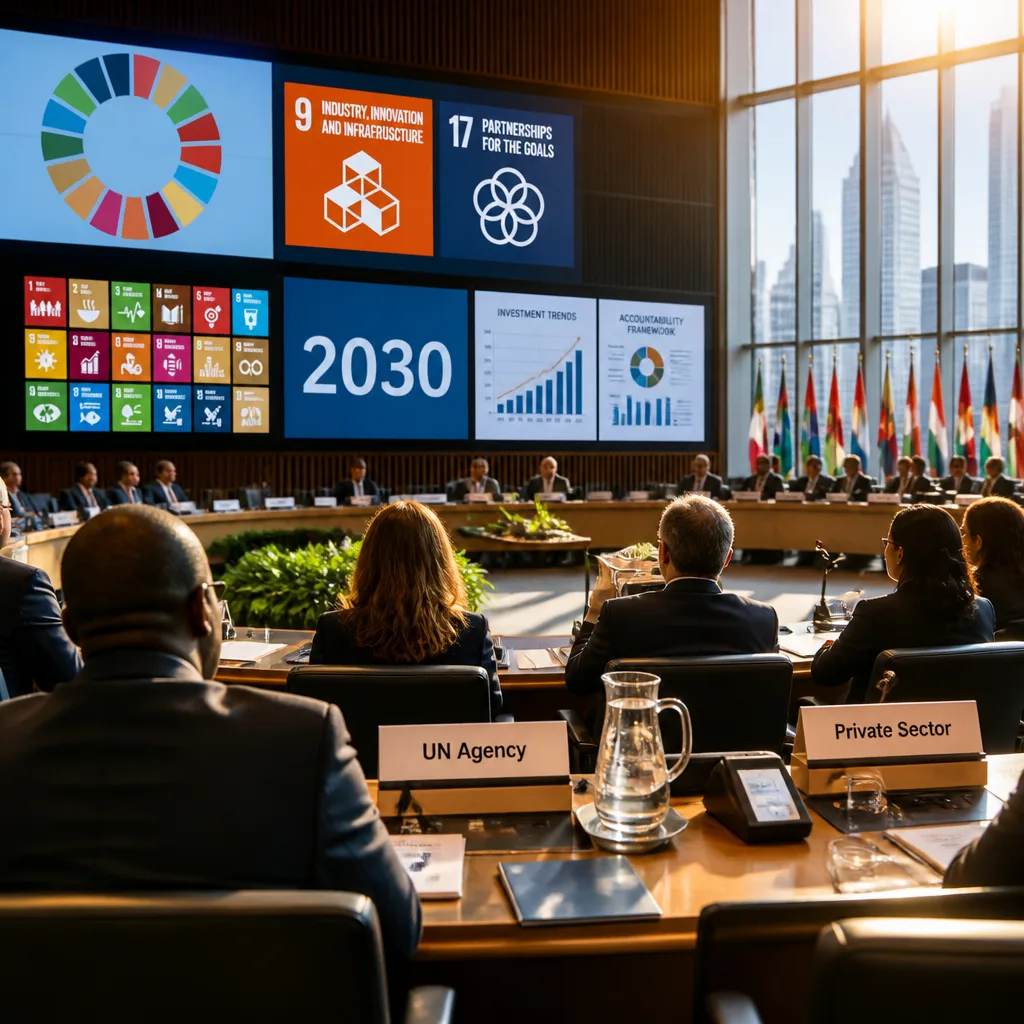
The gathering, co-convened by UN DESA, the UN Global Compact and the International Organisation of Employers, with UNIDO as co-organizer, focused on how public–private partnerships can accelerate action on SDG 9 (Industry, Innovation and Infrastructure) and SDG 17 (Partnerships for the Goals). The discussions also intersected with this year’s global review of SDG 6 (Clean Water and Sanitation), SDG 7 (Affordable and Clean Energy) and SDG 11 (Sustainable Cities and Communities).
“Business has never been more important to achieving the Sustainable Development Goals. Around the world, companies are demonstrating that sustainability is not only good for people and the planet, it is fundamental to competitiveness, resilience and long-term value”
That message, delivered by Sanda Ojiambo, CEO and Executive Director of the UN Global Compact, underscored a central theme: corporate strategy and public policy need to align more closely if capital and innovation are to be mobilized at sufficient speed and scale. Executives including Umut Shayakhmetova of Halyk Bank and Samaila Zubairu of the Africa Finance Corporation joined the discussion on how responsible business practices can unlock investment and strengthen resilience.
Why the call matters for Canadian companies
For Canadian boards and investors, the signal is direct: achieving the SDGs will hinge on measurable partnerships, transparent accountability and targeted investment. The forum’s emphasis on infrastructure, innovation and energy systems maps onto areas where Canadian firms are already active—from grid modernization and clean generation to advanced manufacturing and urban development. Tighter collaboration with public agencies can shape procurement pipelines, de-risk large projects and broaden access to blended finance.
In practical terms, the asks translate into three near-term priorities for the private sector:
- Partner with purpose: Structure projects with clear SDG outcomes, governance and reporting aligned to public-sector objectives.
- Invest in enabling infrastructure: Focus capital on industrial innovation, resilient supply chains and clean-energy assets consistent with SDG 9 and SDG 7.
- Disclose and improve: Link sustainability metrics to competitiveness—cost of capital, risk management and long-term value—as highlighted by forum leaders.
Where momentum is expected
Participants framed stronger public–private cooperation as essential to closing execution gaps. For companies operating across borders, that includes aligning with multilateral development institutions and employer groups on standards and project pipelines, especially in infrastructure and urban systems. The framing around SDG 17 positions partnerships not as philanthropic add-ons but as core to investment-grade delivery.
| SDG | Forum focus |
|---|---|
| SDG 9 | Industry, Innovation and Infrastructure |
| SDG 17 | Partnerships for the Goals |
| SDG 6 | Clean Water and Sanitation (under review this year) |
| SDG 7 | Affordable and Clean Energy (under review this year) |
| SDG 11 | Sustainable Cities and Communities (under review this year) |
Accountability and capital
Speakers stressed that no single actor can meet the SDG financing and delivery challenge in isolation. The framing is overtly economic: sustainability is linked to competitiveness, resilience and long-term value. That linkage is material for Canadian issuers navigating investor expectations on climate and sustainability, where credible transition plans, water stewardship and urban resilience strategies increasingly influence access to capital and cost of funding.
The forum’s message converges on execution: partnerships backed by transparent targets, shared risk frameworks and investment vehicles designed to accelerate adoption. For households and small businesses, the downstream effects show up in infrastructure reliability, energy affordability and city services—areas tied to the SDGs under review. For large enterprises, the imperative is to convert high-level commitments into project-level delivery with measurable outcomes by 2030.
As global stakeholders regroup after the New York meetings, the bar for corporate participation is rising. The expectation is not only that companies will commit to the SDGs, but that they will co-design and co-finance solutions with the public sector and civil society—and report progress in a manner decision-makers can trust.