
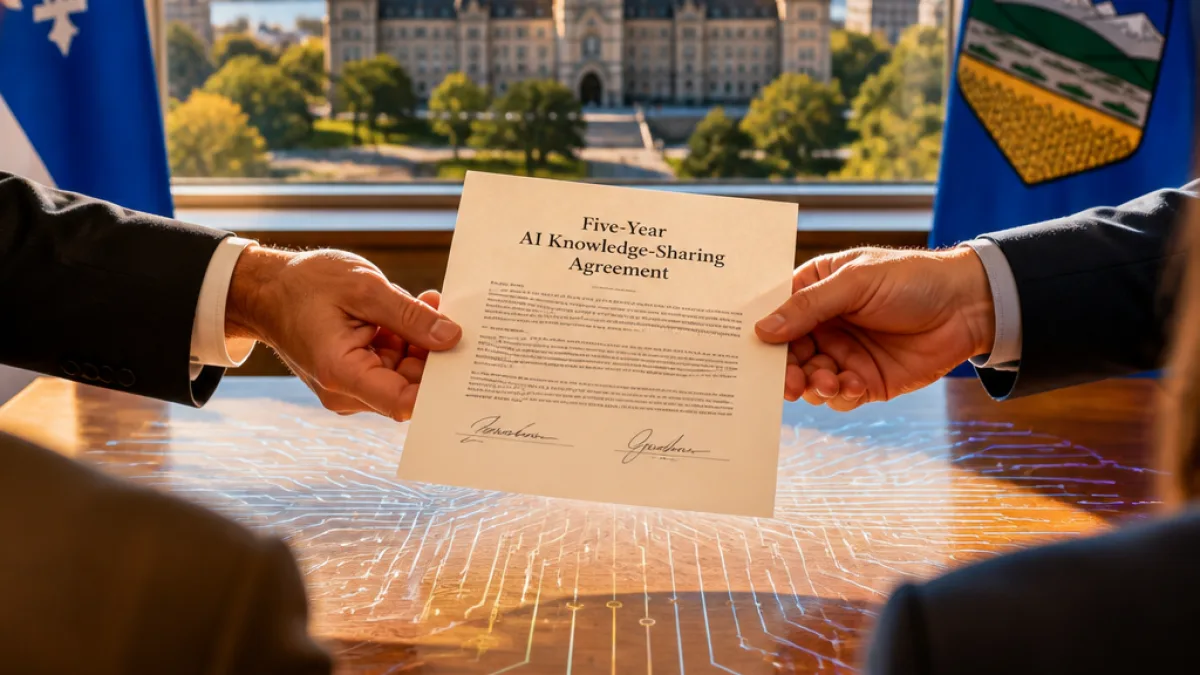
The governments of Quebec and Alberta announced a formal five‑year arrangement on Tuesday to cooperate on integrating artificial intelligence across public administration, with officials describing the deal as a no‑cost, knowledge‑sharing partnership.
What the agreement covers
Quebec’s minister of cybersecurity and digital technology, France‑Élaine Duranceau, and Alberta’s minister of technology and innovation, Nate Glubish, made the announcement in a joint statement. The accord does not include any financial commitments; rather, the provinces will exchange expertise and lessons learned as they each pilot and scale AI tools in government operations.
“We’re all moving forward on AI, it’s new, and it changes at a phenomenal speed,” Duranceau said. “So why start from scratch, each on our own? We chose to work together and exchange freely to learn from what the other jurisdiction is doing.”
Officials said discussions between the two provinces date back to 2022, and the new memorandum formalizes a relationship that has been developing for several years.
Why provinces are pairing up
Ministers framed the partnership as a pragmatic response to rapid technological change. By sharing policy frameworks, procurement approaches, security practices and operational experience, both administrations expect to accelerate responsible adoption while reducing duplication of effort.
- Agreement length: five years
- Financial terms: none — knowledge sharing only
- Main focus: public administration — policies, tools and safeguards for AI use
The announcement also drew attention to Alberta’s growing role in Canada’s AI infrastructure landscape. Recent academic research and corporate investments have highlighted Alberta as a hub for data centres; the announcement noted Meta’s planned multi‑billion‑dollar investment to build a major data centre in the province.
| Item | Detail |
|---|---|
| Duration | 5 years |
| Cost | No financial commitment |
| Primary activity | Knowledge and experience exchange |
For provincial public services, the collaboration could shape how AI is governed in areas such as cybersecurity, citizen services and internal operations. Officials say learning from another jurisdiction’s pilots and frameworks can inform procurement rules, risk assessments and transparency measures without each province having to repeat initial experiments.
Observers will be watching whether the partnership produces shared standards or interoperable tools that other provinces might adopt, and how it addresses privacy, bias and security risks that accompany government use of AI.
Reporting from Quebec City and Edmonton contributed to this story.