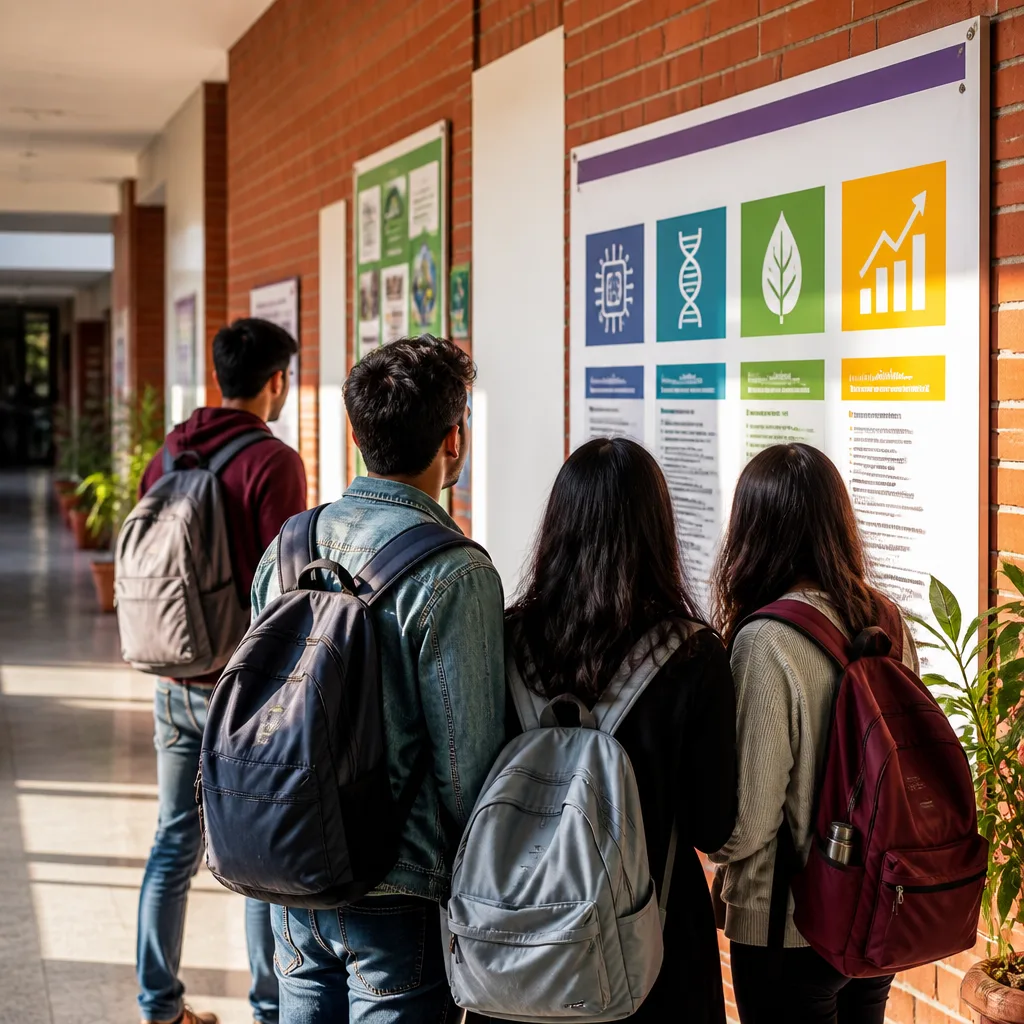
The TERI School of Advanced Studies (TERI SAS) in New Delhi is reconfiguring undergraduate learning around flexible, interdisciplinary pathways, mirroring a broader shift in higher education as industries demand graduates who can connect ideas across fields. The university, a UGC-recognised Deemed-to-be University established by The Energy and Resources Institute (TERI), says today’s careers increasingly span multiple domains—from artificial intelligence and biotechnology to sustainability and data analytics—and that programs must adapt.
For generations, undergraduates typically chose a single subject and pursued a linear path. That model is giving way to structures that allow students to build depth in one area while adding breadth in another. According to the university, the goal is to align academic preparation with the reality that many emerging roles do not sit neatly within one department or discipline.
Flexible pathways built around majors and minors
TERI SAS describes a design that lets students combine a Major with a Minor to shape a more tailored program. The approach is presented as research-led and grounded in TERI’s longstanding work in sustainability research and policy. The university says it is preparing students to tackle real-world issues across science, business, technology, public policy and the environment.
Advocates of interdisciplinary structures argue the model serves both industry and public-sector needs by cultivating analytical range, adaptability and problem-solving skills. In this framing, the Major provides the disciplinary spine, while the Minor introduces complementary methods or sectoral knowledge that can widen a graduate’s options.
Examples of combined study areas
The university points to several pairings that reflect how roles are evolving across sectors:
- Economics paired with data analytics for evidence-driven decision-making.
- Environmental studies combined with economics to bridge ecology and policy trade-offs.
- Management with sustainability to embed climate and resource considerations into operations.
| Major | Minor | Intended edge |
|---|---|---|
| Economics | Data analytics | Quantitative insight for markets and policy |
| Environmental studies | Economics | Balancing ecological goals with economic tools |
| Management | Sustainability | Strategy aligned with climate and resource constraints |
What this means for students and families
For prospective undergraduates—and the parents advising them—the message is that program architecture matters. If career paths are blurring across disciplines, it becomes important to understand how a degree enables both specialisation and breadth. A Major–Minor structure can help students signal depth in a core field while adding skills that are valued across sectors, such as data literacy or sustainability frameworks.
Students considering options abroad or at home can compare how institutions structure flexibility. Key questions to ask include:
- Does the program allow a defined Major with a complementary Minor?
- Is the teaching described as research-led and connected to real-world challenges?
- How do course sequences build cumulative skills across more than one domain?
- What examples does the university provide of interdisciplinary outcomes?
Broader context: skills across sectors
The university’s positioning reflects a trend across higher education to move beyond rigid disciplinary silos. As described by TERI SAS, the intent is to prepare graduates for roles that cut across industry, research and the public sector. Interdisciplinary degrees are one way institutions are attempting to keep pace with shifts driven by technology, climate imperatives and data-led decision-making.
For families planning applications, the takeaway is practical: map degree structures to the skills employers increasingly expect, confirm there is room to combine fields meaningfully, and consider how a program’s research orientation can translate into stronger problem-solving capabilities over the length of the degree.