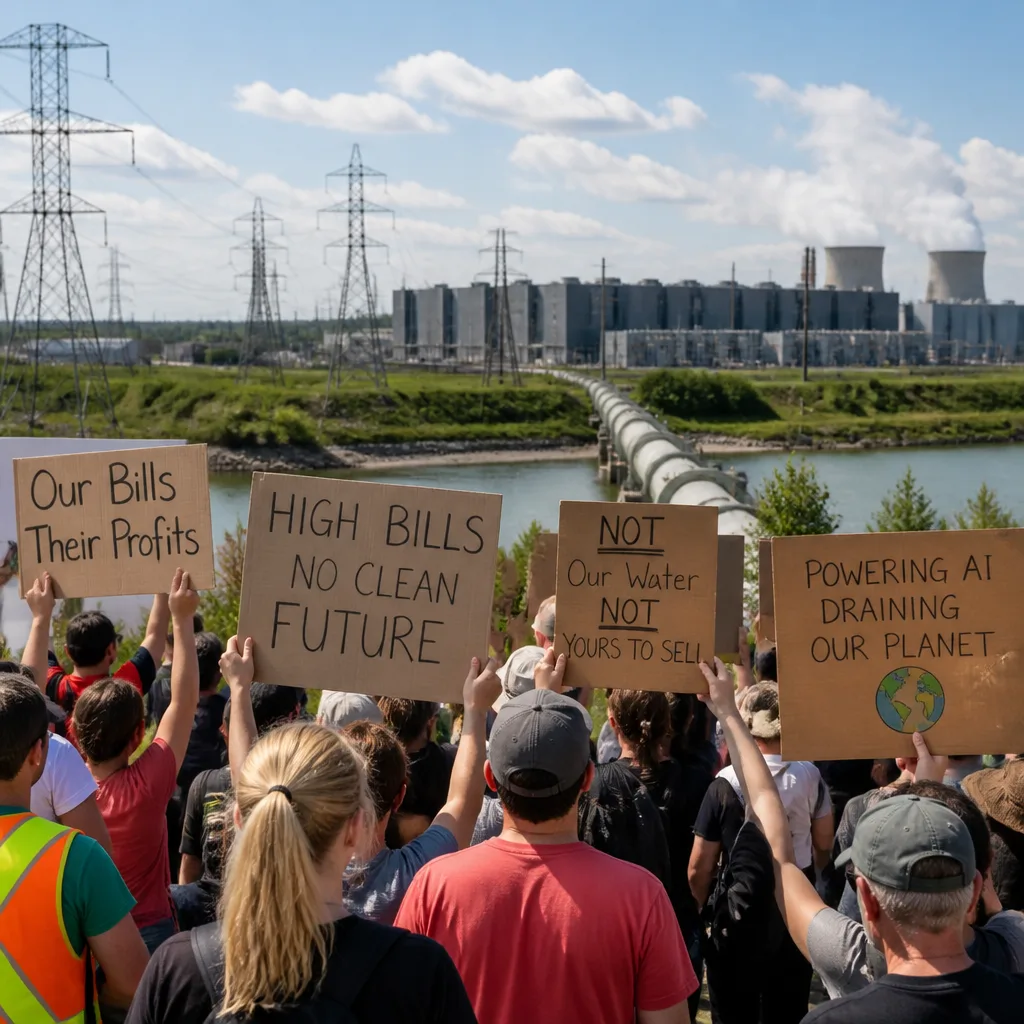
When residents in Vancouver and other Canadian cities took to the streets this month to protest new artificial-intelligence facilities, they reflected a wider national unease. A Leger poll of 1,505 Canadians, conducted July 10–13, shows deep public concern that AI data centres could push up household electricity costs and harm the environment.
Energy, water and environment top public worry list
According to the survey, 81 per cent of respondents said they were concerned about the prospect of data centres driving up electricity bills. Nearly as many, 79 per cent, said they worried about environmental impacts — including the heavy use of electricity and water and related greenhouse-gas emissions.
| Issue | Share of respondents |
|---|---|
| Concern about higher household electricity bills | 81% |
| Worry about environmental impacts | 79% |
| Have heard of data centres | 62% |
| Support building to keep data in Canada | 46% |
| Oppose building to keep data in Canada | 37% |
| Would support an AI data centre in their province | 44% |
| Would oppose an AI data centre in their province | 42% |
| Prefer provincial utilities supply electricity | 58% |
Divided on hosting, somewhat supportive of domestic control
Canadians are not uniform in their views about hosting the facilities. While slightly more supported building centres to back Canadian-based AI services than opposed it — 46 per cent versus 37 per cent — opinion was split on whether such a facility should be in respondents' own province: 44 per cent said they would support it, and 42 per cent said they would oppose it.
"We're seeing evidence that there is a bit of a divided opinion amongst Canadians regarding the construction of these data centres around the country," said Andrew Enns, Leger's executive vice-president for Central Canada.
Policy and planning implications
The survey also asked who should supply the electricity for AI data centres: a majority, 58 per cent, said provincial governments or power providers should do so. Just under a third said electricity should be provided only if companies pay the full cost.
- High public concern about household bills could complicate provincial approvals for new data-centre projects.
- Environmental worries may increase demands for clearer rules on water use, carbon accounting and energy sources for large computing facilities.
- Divided local support points to potential conflicts between municipalities seeking investment and residents worried about local impacts.
The poll also found general awareness of data centres at 62 per cent. Leger’s online survey methodology was noted by the Canadian Research Insights Council, which cautions that online polls cannot be assigned a traditional margin of error because they are not based on random probability sampling.
As provinces and cities weigh hosting AI infrastructure, the survey suggests governments will face public pressure to balance economic benefits with energy planning, environmental safeguards and local consent. Clear policies on utility commitments and company contributions to system costs may be central to whether communities accept these projects or resist them.