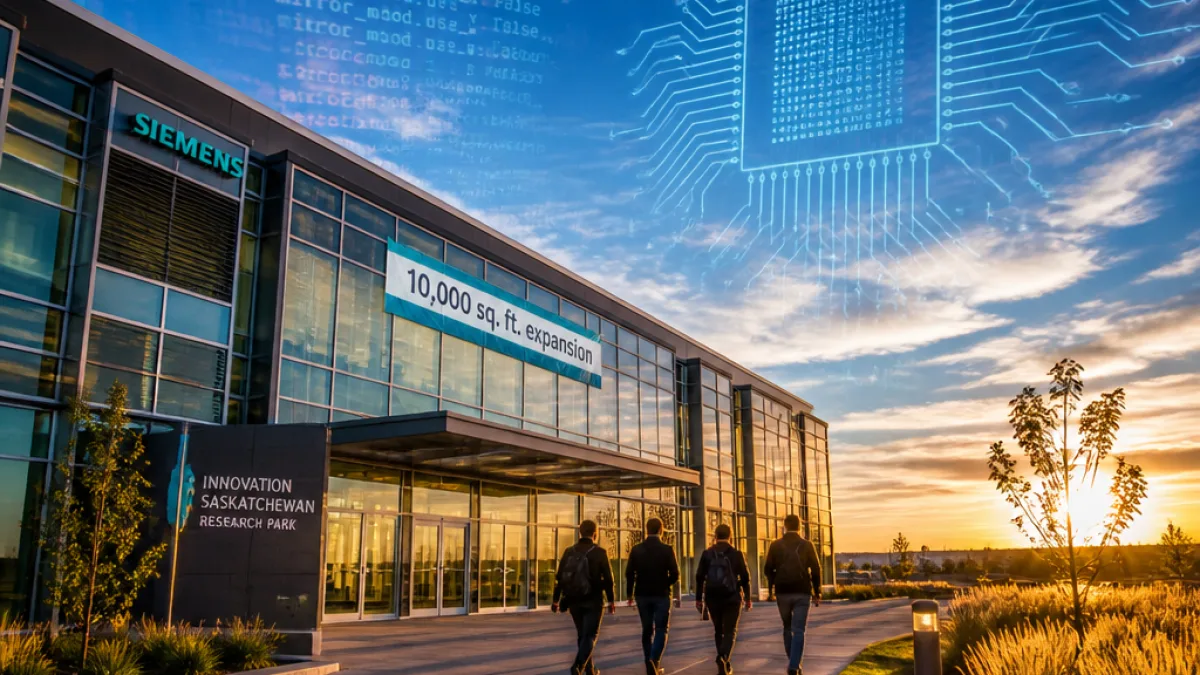
The multinational engineering company Siemens is expanding its research and development presence in Saskatoon, adding 10,000 square feet to its facilities and signalling plans to hire more than 100 workers over the next two years.
Expansion details and workforce growth
The company will occupy a total of 45,000 square feet in the Innovation Saskatchewan research and technology park beside the University of Saskatchewan after the expansion. Siemens says the local workforce will grow from about 300 to 400 employees, with the new roles concentrated in software development and customer application expert positions tied to its electronic design automation (EDA) operations.
- Added space: 10,000 sq. ft.
- Total occupied space in Saskatoon: 45,000 sq. ft.
- Current staff: 300 → After expansion: 400
- Primary recruitment targets: graduates in engineering, computer science, physics and math from the University of Saskatchewan
"It’s allowing chip manufacturers to design, test and verify chip design in the virtual world before they even build it and that dramatically reduces the time to market," said Faisal Kazi, president and CEO of Siemens Canada.
Why Saskatoon?
Siemens says Saskatoon’s hub will support work on electronic design automation — the software used to design semiconductor chips that power devices from smartphones to vehicles — and help keep pace with rapid developments in artificial intelligence and the expanding semiconductor market. Executives framed the city as a growing centre for chip-software work and talent.
Amit Gupta, senior vice-president of Siemens EDA and chief AI strategy officer, noted the company already draws heavily from the University of Saskatchewan: about 80 per cent of Siemens’ local hires are university graduates. Gupta, who founded the chip design software company Solido in 2005 that was acquired by Siemens in 2017, said the expansion offers opportunities for Saskatchewan-born graduates to build careers locally rather than leaving the province.
Local context and implications
The expansion is sited in the research and technology park adjacent to the University of Saskatchewan, positioning Siemens close to academic talent and research collaborations. For Saskatoon, the announcement strengthens the city’s profile in advanced technology and semiconductor design and may influence student and employer decisions in engineering and computer science programs.
| Metric | Before | After |
|---|---|---|
| Workforce | 300 | 400 |
| Office/R&D space | (part of) 35,000 sq. ft. | 45,000 sq. ft. |
Provincial leaders and company officials marked the announcement with a ribbon-cutting event in Saskatoon. The move underscores how global firms are increasingly anchoring advanced software and chip-design capabilities outside traditional technology centres.
Siemens says the new positions will be recruited over the next two years and will mainly target graduates from the University of Saskatchewan’s engineering, computer science, physics and mathematics programs. The company describes the expansion as part of a broader strategy to scale its EDA operations and support faster time-to-market for semiconductor customers through virtual testing and verification tools.
For Saskatoon residents, the expansion could mean increased demand for university-trained graduates, potential for local partnerships with the campus and a higher profile for the city in semiconductor-related research and development.