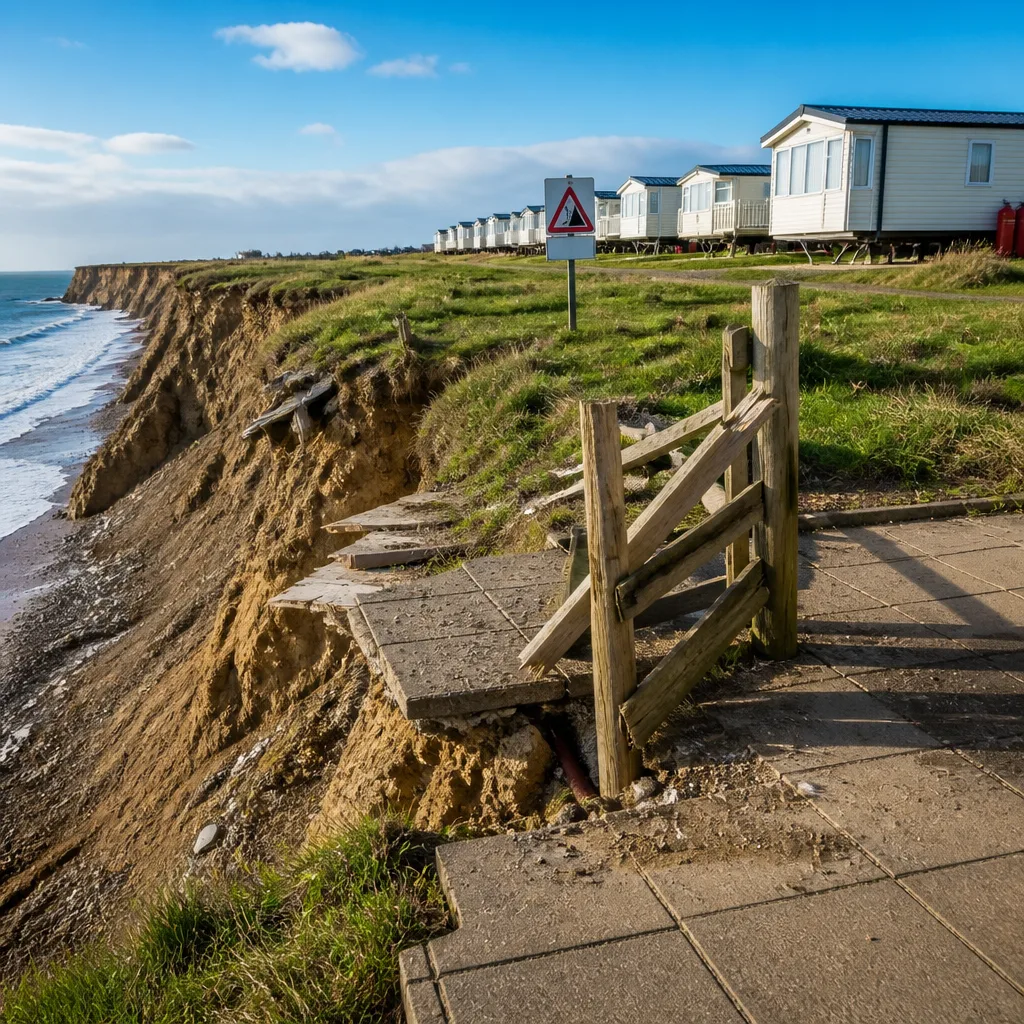
On a remote stretch of England’s Suffolk coast, where a back garden once looked out over fields, there is now only open air and the hiss of surf below. The house is gone. So are others. After watching the cliff edge creep closer for decades, a local family has stopped trying to resist the water and started planning for its steady advance instead.
Since the 1920s, the family of Anne Jones has seen the sea take more than two-thirds of their 400‑acre estate at Easton Bavents, near Southwold. Along the way, five homes have been lost. The British government warns that rising seas linked to climate change are likely to accelerate erosion in many places—an assessment visible here in real time. Once a thriving village and, historically, England’s most easterly point, Easton Bavents saw its church slip beneath the waves in the 17th century. The coastline has been edging inland ever since.
“It’s very tough, for the people who live there and tough for us as owners to have to take them down and just accept that nature take its course and we have to adapt with it,” Jones says. “But we’ve recently decided to stop fighting nature and work with it.”
That pivot has reshaped how the family uses what remains. Instead of sinking money into defences on sandy cliffs—an approach they say would be a losing battle with both the sea and the law—they now rent moveable holiday cabins under an agreement with the local council. The structures can be rolled further inland as the cliff line recedes, buying time and reducing the risk of abrupt loss.
From demolition to a plan for movement
Jones spoke from what used to be the back garden of a pink house—one of a row the family demolished before they toppled into the sea. The pink home was taken down in February 2020, a stark marker in a generational story. The choice to remove buildings pre-emptively was wrenching, Jones says, but it was also a way to wrest some control from the elements and protect residents.
The family’s new approach, hammered out with planners, embeds the expectation of inevitable change into local decision-making. That shift required persistence. As Jones puts it:
“It’s inevitable this coastline will erode and that can be reflected in planning, and that’s been hard work but we feel good that we’ve managed to achieve that now.”
What a sliding shoreline teaches
For communities far beyond Suffolk, the scene at Easton Bavents underscores the nuts-and-bolts reality of living with climate risk. The themes are universal even if the shore is not: what to protect, what to relocate and how to plan fairly when the ground is literally moving.
- Accepting risk: Building policies and permits around known erosion, rather than assuming it can be halted.
- Prioritizing safety: Removing at‑risk homes before collapse to reduce hazards for residents and first responders.
- Designing for mobility: Using relocatable structures that can be shifted inland as the cliff retreats.
These trade-offs are not theoretical on this coast. They are written into the cliff face, which has been working inland long enough to erase a church and transform a village. A century after Jones’s great‑grandfather, Herbert Boggis, used his life savings to buy the land, the family is negotiating with time instead of attempting to hold it back.
Land lost, lessons kept
In the span of living memory, the estate has been reduced dramatically. What remains is being used differently, with a planning framework that anticipates more loss and aims to reduce harm as it unfolds. The strategy is not triumphalist. It is pragmatic—born of years watching the tide work its slow geometry on a soft coast.
| Marker | Detail |
|---|---|
| Estate purchased | 1920s; 400 acres |
| Land lost since | More than two‑thirds |
| Homes lost | Five |
| Notable demolition | Pink house, February 2020 |
Jones’s description of the place—“stunning,” “beautiful”—is not nostalgia. It is the context for a hard choice: to let nature take its course and focus on what can still be done “while the land is still here so people can enjoy it.” For places facing similar pressures, the lesson is not that retreat is easy. It is that planning for movement may be the only way to make staying possible, even if only for a while.