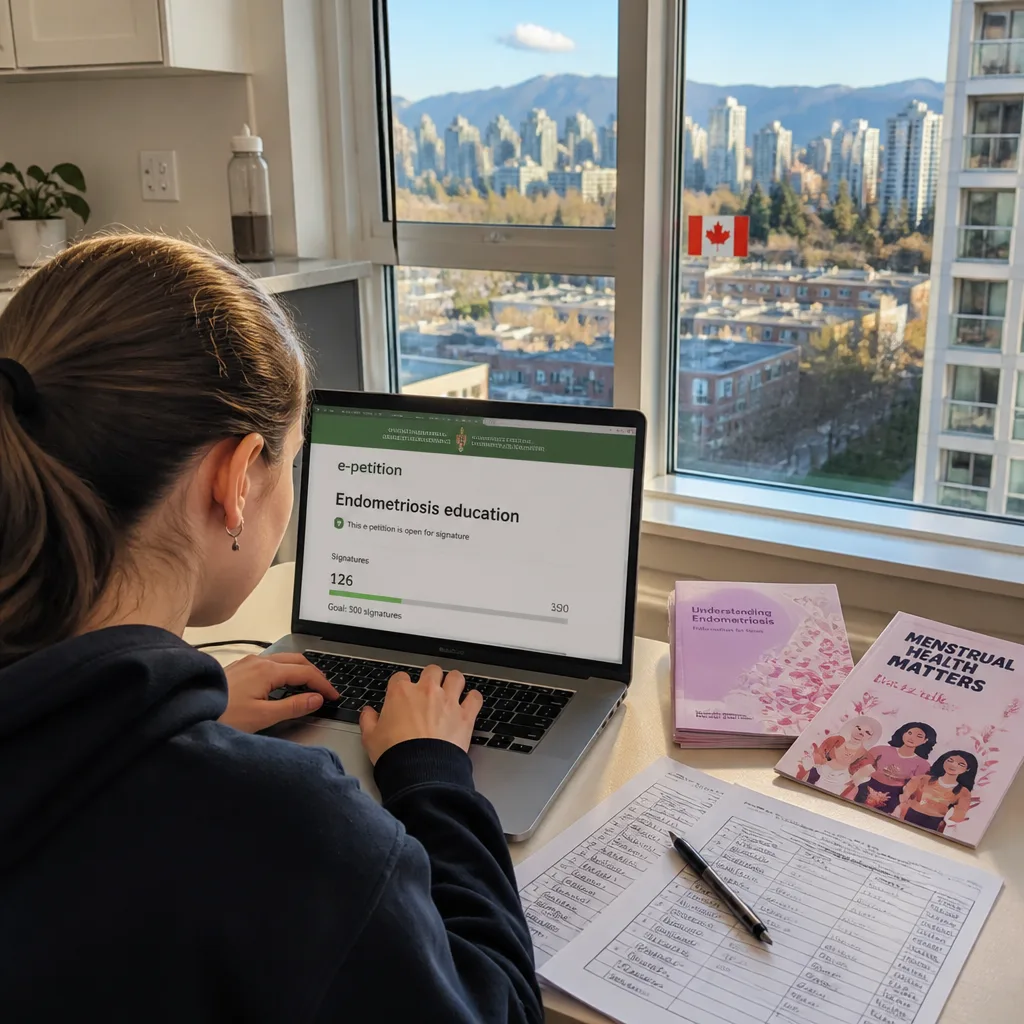
A 16-year-old Vancouver student has launched a federal e-petition urging the government to support national education about endometriosis, a condition that affects roughly one in 10 people assigned female at birth — about two million Canadians.
What the petition asks
The student, Elize Nocente, is requesting federal funding to create a national advisory board to develop an evidence-based lesson plan on endometriosis and to work with provinces and territories so the material can be introduced in age-appropriate classrooms. The petition has gathered more than 600 signatures so far. If those signatures are validated, Jenny Kwan, NDP MP for Vancouver East, will present the petition in the House of Commons after it closes on Oct. 14, 2026.
Why proponents say classroom education matters
Endometriosis occurs when tissue similar to the uterine lining grows outside the uterus — commonly on the ovaries, bowel or bladder — and it can cause severe, sometimes debilitating, pain. According to the material circulated with the petition:
- About 90 per cent of people with symptoms experience severe cramps.
- Roughly 30 per cent of people with endometriosis have difficulty conceiving.
- In extreme cases, complications can include kidney failure, bowel obstruction, painful bowel movements and blood in stool or urine.
Proponents argue that because pain often tracks with the menstrual cycle, symptoms are frequently dismissed as "normal" period pain by family members and health-care providers, delaying diagnosis and treatment.
“Some discomfort and pain is normal, but when it gets to the point where some girls can’t even get out of bed because they’re in so much pain, then that’s not normal at all,” Nocente told The Tyee.
Consequences for students and schools
Advocates say early, accurate education could reduce stigma and encourage young people to seek medical advice sooner. They contend that embedding an evidence-based lesson within health or science curricula would help teachers recognise concerning symptoms and give students language to describe their experience to parents and clinicians.
Implementation would require cooperation across jurisdictions. Education in Canada is primarily a provincial and territorial responsibility, so a federal role would likely be limited to funding, advisory work and incentives to encourage uptake. The petition proposes federal funding for a national advisory board as a starting point for cross-jurisdictional collaboration.
Key figures at a glance
| Statistic | Figure |
|---|---|
| People affected in Canada | ~2 million |
| Prevalence among those assigned female at birth | 1 in 10 |
| Report severe cramps | 90% |
| Reported fertility challenges | 30% |
Parents and students interested in supporting the petition can find it online; if validated, it will be tabled in Parliament by the sponsoring MP after the petition's closing date. Any curricular changes would still require provincial and territorial approval and classroom adaptation.
The petition highlights a broader discussion about health education in schools: how to make information medically accurate, age appropriate and responsive to conditions that disproportionately affect young people’s daily lives and learning.