Coordinated response after coastal discovery
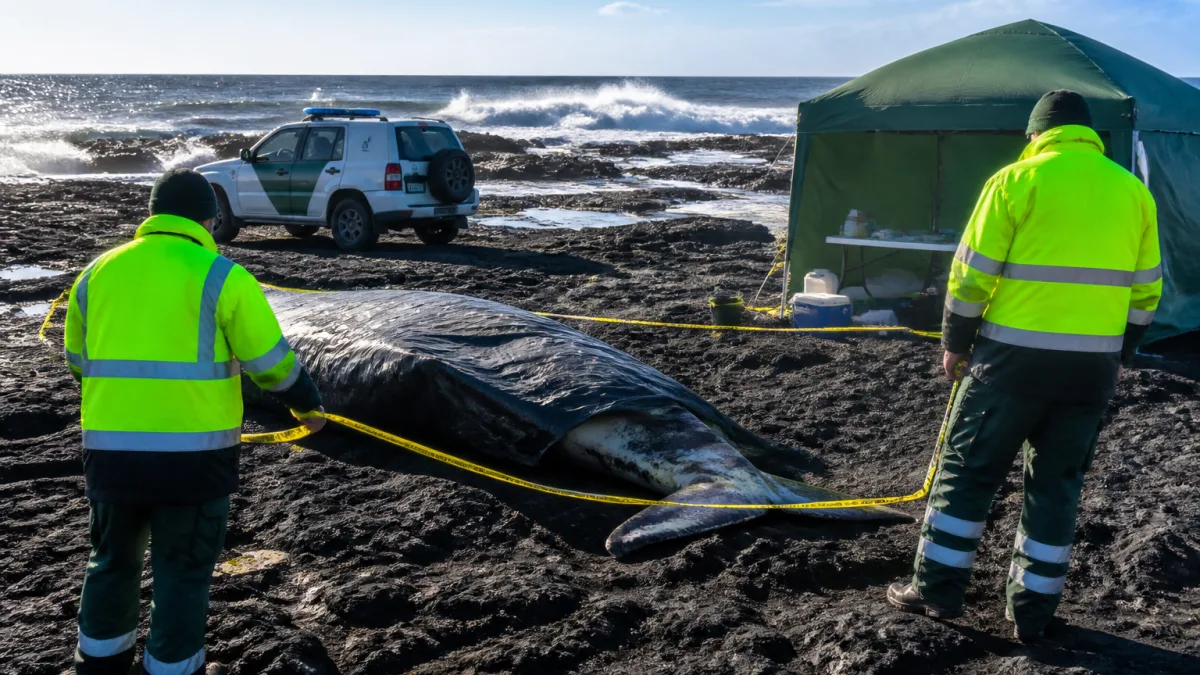
Authorities on the Spanish island of Lanzarote recovered a dead Blainville’s beaked whale from the shoreline at Caleta de Caballo on Monday morning, after a passerby alerted officials to the animal on the island’s northern coast. Environmental officers from the Lanzarote Cabildo, volunteer firefighters, rescue personnel and the Guardia Civil mobilized to secure the area and recover the carcass, according to local officials.
Specialists on site arranged for a post-mortem examination the same day. The president and scientific director of the Society for the Study of Cetaceans in the Canary Islands (SECAC), Vidal Martín, confirmed that a necropsy was conducted to determine what led to the animal’s death. Results have not been released.
Clarifying the name for Blainville readers
Despite the familiar name, the species involved is not connected to the city of Blainville. The common name “Blainville’s beaked whale” refers to the marine mammal species and not to any local institution or event in Quebec. The incident took place thousands of kilometres away, but the coordinated work by emergency and environmental services will be recognizable to any community that relies on structured responses to protect shorelines, gather data and preserve public safety.
Who responded on Lanzarote
- Environmental officers from the Lanzarote Cabildo oversaw handling of the animal and site management.
- The Lanzarote Volunteer Fire Department and rescue teams assisted with recovery operations.
- Guardia Civil personnel supported the coordinated response on the coastline.
- SECAC scientists arranged and conducted the necropsy examination.
What is known about the species
Blainville’s beaked whales are described as elusive, typically forming small social groups often led by a dominant male. They inhabit tropical and temperate waters and are not known for long-distance migrations, tending to remain within a general area rather than roaming widely. Scientists estimate they reach sexual maturity at around nine years of age. Females typically have a single calf, and adults reach several metres in length and up to about a tonne in mass.
| Attribute | Details (from officials/scientists) |
|---|---|
| Distribution | Tropical and temperate waters worldwide |
| Social structure | Small groups; often a dominant male |
| Migrations | Not known for long-distance migrations |
| Adult size | Up to about 4.6 metres; roughly one tonne |
| Sexual maturity | Estimated at around nine years |
| Calving | Single calf; about two metres and approximately 50 kilograms |
Why the necropsy matters
Necropsies can clarify whether a stranding results from illness, injury or environmental factors, and they help authorities refine preparedness and shoreline protocols. In this case, officials have completed the examination and are expected to share findings once available. Until then, the focus remains on accurate documentation of the incident and the safe handling of the remains.
For residents here, the key takeaway is twofold: the species name is a coincidence, and the Lanzarote response underscores the role of coordinated public services in managing wildlife incidents on busy coasts. The swift involvement of environmental officers, firefighters, rescue teams and police illustrates a structured approach that jurisdictions rely on to protect people, collect scientific evidence and maintain environmental standards.