
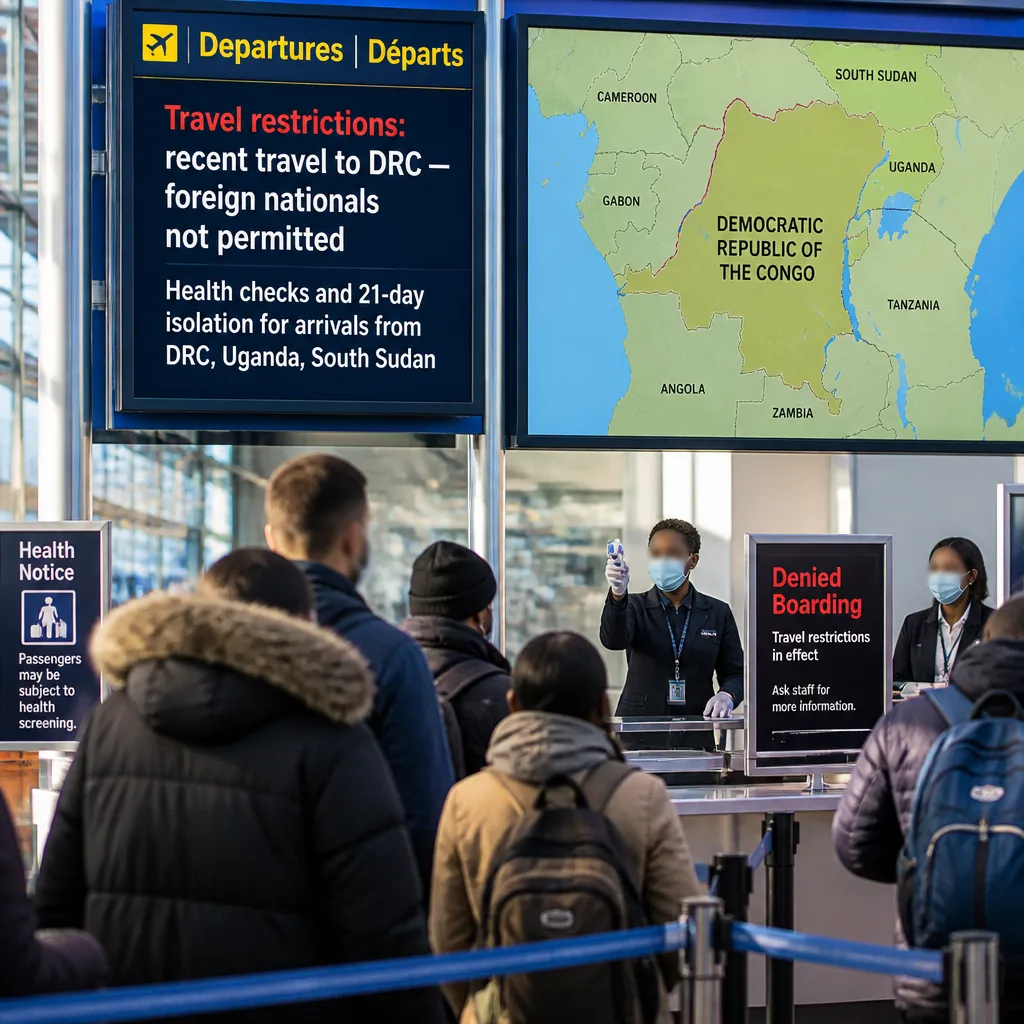
Canada will temporarily deny entry to foreign nationals who have been in the Democratic Republic of Congo (DRC) within the past 21 days, the Public Health Agency of Canada (PHAC) announced Sunday, in a bid to limit the risk that Ebola reaches this country. The measure takes effect Monday at 11:59 p.m., applying to both commercial and private air travel.
Under the new order, air carriers must not allow foreign nationals who have visited the DRC within the 21-day window to board flights bound for Canada. Canadian citizens, permanent residents and persons registered under the Indian Act are exempt from the entry bar but will face on-arrival health assessments and be required to self-isolate for 21 days if they have recently been in the DRC, Uganda or South Sudan.
“Limiting entry of foreign nationals who have been in the the DRC in the previous 21 days may reduce public health risks for Canadians and is intended to increase the effectiveness and sustainability of border measures that can safely process travelers arriving in Canada, including our returning humanitarian workers,” the agency said in a news release.
Shift from earlier measures
Sunday’s announcement marks a change from the approach first introduced in May, when Ottawa required travellers arriving from Ebola-affected areas to isolate for three weeks but stopped short of a targeted entry prohibition. That earlier policy applied to the DRC, Uganda and South Sudan. The latest step focuses the entry restriction on those with recent travel to the DRC only, while maintaining health screening and isolation requirements for returning Canadians and permanent residents from all three countries.
PHAC framed the action as a way to keep border screening manageable while safeguarding humanitarian operations. The agency noted that most travellers from the affected region are Canadians or permanent residents, who would continue to be processed with health checks and follow-up. Prior to the May measures, federal officials estimated an average of about 350 travellers per week arrive in Canada from the DRC, Uganda and South Sudan, with the majority landing in Toronto, Montréal and Vancouver airports. About 60 per cent of those passengers are Canadian citizens or permanent residents, and roughly 40 per cent are foreign nationals.
What the rules mean at the border
As of late Monday, carriers and border services will apply the following framework:
| Traveller category | Recent travel | Entry to Canada | On-arrival measures |
|---|---|---|---|
| Foreign nationals | Visited DRC within 21 days | Not permitted | Not applicable |
| Foreign nationals | Visited Uganda or South Sudan within 21 days | Permitted (no entry ban) | Carrier/border screening as per standard protocols |
| Canadian citizens, permanent residents, persons registered under the Indian Act | Visited DRC, Uganda or South Sudan within 21 days | Permitted | Health assessment on arrival; 21-day self-isolation |
PHAC’s directive also binds private aviation, closing an avenue sometimes used by business or charter flights. The agency says concentrating restrictions on non-resident travellers from the DRC is intended to make border processing more sustainable while keeping essential movements — including the return of Canadian aid workers — under close public health oversight.
Why focus on the DRC now
The Democratic Republic of Congo has been managing an Ebola outbreak in its eastern region, with case counts and response efforts drawing international attention in recent weeks. Canadian authorities had already advised self-isolation for travellers from affected areas earlier this spring. The new threshold — an outright bar for some travellers — is meant to align border controls with the evolving risk profile while maintaining capacity to monitor those who are exempted from the ban.
PHAC did not detail the duration of the temporary measure. The agency’s statement underscores two priorities: reducing the chance of importation and ensuring “effective and sustainable” border operations as international travel continues through major hubs. The focus on the three-week period reflects the known 21-day observation window used by public health authorities when monitoring for potential Ebola exposure.
What travellers should expect
- Airlines will conduct enhanced pre-boarding checks for recent travel to the DRC and deny boarding to ineligible foreign nationals.
- Returning Canadians and permanent residents coming from the DRC, Uganda or South Sudan will undergo health assessments at the border and must self-isolate for 21 days.
- Humanitarian and medical personnel returning to Canada remain subject to screening and monitoring but are not barred from entry.
Officials emphasized ahead of the spring announcement that Canada’s weekly arrivals from the region are relatively limited and largely composed of residents returning home. Concentrating resources on screening and post-arrival follow-up for those travellers is intended to help detect potential illness promptly and support public health management, while minimizing disruption to the broader flow of international travel.
Canadians with imminent travel plans that include the DRC or neighbouring countries should check the latest federal advisories and airline policies before departure. Anyone who has been in an affected area and is already en route to Canada should be prepared for health screening on arrival and to comply with isolation requirements if applicable.