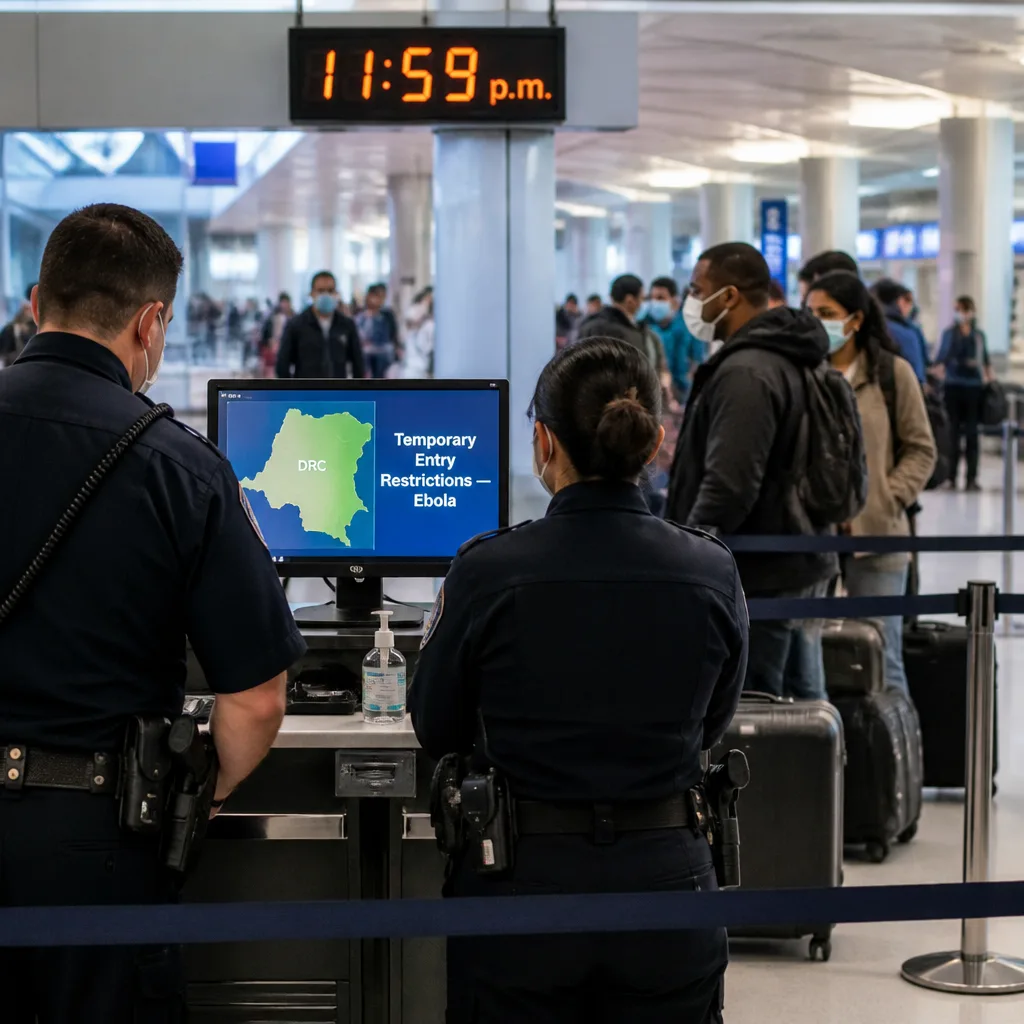
At Toronto’s Pearson airport on Monday night, some travellers will find plans upended as Canada imposes new safeguards against Ebola. The federal government says that, starting at 11:59 p.m. ET, foreign nationals who have been in the Democratic Republic of the Congo within the previous 21 days will be denied entry — a temporary step officials say is about reducing risk and keeping border processing manageable.
What changes at the border
In a statement, the Public Health Agency of Canada (PHAC) said the measures will remain in place until Aug. 29. The move targets a narrow group: non-Canadians who recently spent time in the DRC. Authorities describe the decision as a precautionary approach intended to limit the chance of importation and to support safe processing of all arrivals.
“Limiting entry of foreign nationals who have been in the the DRC in the previous 21 days may reduce public health risks for Canadians, and is intended to increase the effectiveness and sustainability of border measures that can safely process travelers arriving in Canada, including our returning humanitarian workers.”
PHAC also underscored that the assessed risk to people in Canada remains low, and that there have been no travel-related cases reported in this country.
Risk level and travel advice
Canada’s travel health notice for the DRC currently sits at an orange advisory — Level 3 on a four-point scale — meaning the government advises avoiding non-essential travel. While officials say the overall domestic risk is low, the heightened advisory reflects caution around movements to and from affected regions.
| Measure | Details |
|---|---|
| Effective time | Monday, 11:59 p.m. ET |
| End date | Aug. 29 |
| Affected group | Foreign nationals with travel in DRC within past 21 days |
| Risk advisory for DRC | Orange (Level 3) – avoid non-essential travel |
Why this matters now
Images from eastern Congo in recent weeks — including health workers preparing for clinical activities in Bunia — capture the on-the-ground reality that informs Canada’s latest posture. Ottawa’s step is less about signalling alarm at home and more about stabilizing the flow at the border while public health partners abroad work to contain risk.
Officials emphasized the measures are “out of an abundance of caution,” balancing vigilance with the need to keep humanitarian and other essential travel moving safely. The statement points to the importance of border processes that can accommodate returning aid workers while still limiting potential exposure risks.
What travellers should know
- Entry restrictions: Foreign nationals who were in the DRC within the past 21 days will not be allowed to enter Canada while the measure is in effect.
- Timeline: The policy begins at 11:59 p.m. ET on Monday and runs through Aug. 29, unless changed by the federal government.
- Travel notice: The DRC is under an orange (Level 3) advisory urging Canadians to avoid non-essential travel.
- Risk at home: PHAC says the risk to people in Canada is low and no travel-related Ebola cases have been reported here.
Recent federal steps on regional travel
The federal government previously tightened travel and immigration-related measures in late May for several countries in the region, including Congo, Uganda and South Sudan. Sunday’s action specifically focuses on recent presence in the DRC and is time-limited, reflecting a calibrated response that can be adjusted as conditions evolve.
For Canadians with ties to the region — from families planning visits to aid organizations coordinating rotations — the next several weeks will require careful planning. With the advisory level elevated and the entry bar for foreign nationals in place, itineraries may need to be rescheduled, routes reconsidered, or documentation reviewed in consultation with airlines and travel insurers.
Public health officials will continue to monitor developments and could update the advisory or border posture before the end of August if circumstances change. For now, the message is steady: take the DRC travel advisory seriously, expect tighter screening, and plan around the temporary entry limits while authorities keep watch on the situation abroad.