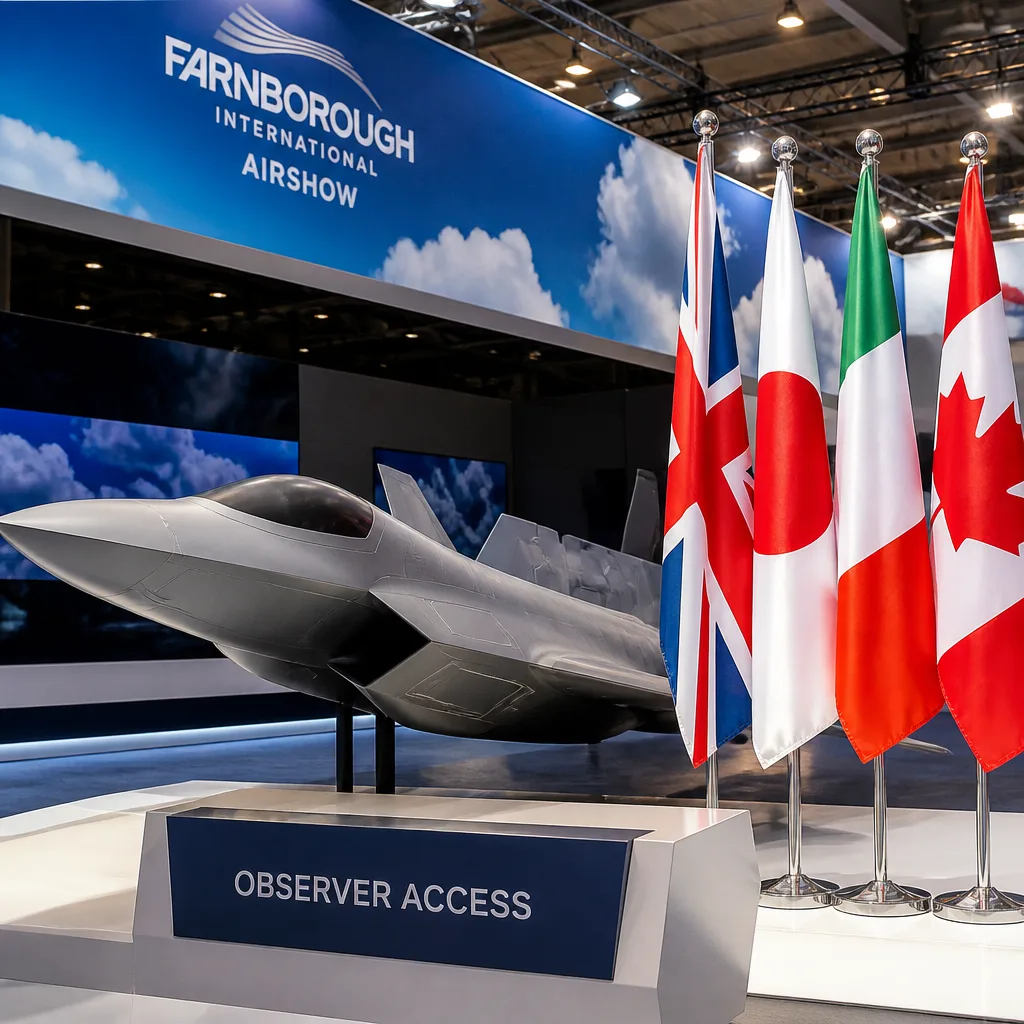
As aerospace executives and defence officials descend on England for the Farnborough Air Show, Ottawa is widely expected to step into the Global Combat Air Program (GCAP) — not as a full partner, but in an observer role that would open a window into a next-generation fighter effort led by the U.K., Japan and Italy.
International outlets have reported for months that Canada is poised to link up with the multinational initiative to develop a sixth‑generation combat aircraft. The move, anticipated as early as Tuesday, would give Canadian officials access to internal briefings and technical discussions before Ottawa decides on any deeper commitment.
What Ottawa is signalling
Several Canadian cabinet ministers are attending the biennial show in the U.K., where the defence and aerospace world regularly hashes out alliances and long-term bets on technology. The office of Defence Minister David McGuinty did not respond to requests for comment ahead of the show. But during a visit to Japan last month, McGuinty made clear that Ottawa is taking a close look at the program.
“[Canada is] anxious to learn more about” the fighter program, he told reporters in Tokyo, adding that he raised the issue with Japan’s defence minister.
Observer status — under discussion for Canada — would mean exposure to program details and partner thinking without the obligations of full membership. It also offers a vantage point on how the three founding nations are approaching design, development and industrial participation in a future combat aircraft.
The program at a glance
Backed by three G7 allies, GCAP has been building momentum on the international stage, including a high-profile presence at major air shows. A scaled demonstration model drew attention in Tokyo in 2024, underscoring the program’s push to showcase progress and attract partnership interest.
| Country | Role in GCAP |
|---|---|
| United Kingdom | Founding partner |
| Japan | Founding partner |
| Italy | Founding partner |
| Canada | Expected observer (access to inside information before any decision) |
Why it matters for Canada
For a country that leans on allied cooperation for air power and aerospace innovation, the chance to sit inside the tent — even in a limited capacity — is consequential. Access to briefings and technical data can help Ottawa assess how a future fighter might integrate with Canadian priorities and the North Atlantic security environment, while giving officials a clearer view of potential industrial work and research opportunities before making binding commitments.
- Insight without obligation: Observer status provides early, non-binding visibility into program direction.
- Allied alignment: Close coordination with the U.K., Japan and Italy on a next-generation platform.
- Timing: With ministers at Farnborough and talk of a Tuesday announcement, a decision point is near.
What comes next
Any formal move could surface at Farnborough, a venue that regularly hosts program unveilings and government-to-government announcements. While Canada’s precise pathway beyond observer status remains undecided, access to GCAP’s inside track would position Ottawa to evaluate the technical, financial and industrial dimensions from up close before choosing how — or whether — to proceed.
For now, the signal is one of cautious engagement. Ottawa is seeking to understand the scope and ambition of a sixth-generation project being shaped by close allies, with the option to stay at the edge — or step further in — as the details become clearer.
This article is based on reporting that Canada is expected to join GCAP in an observer role, with multiple cabinet ministers in the U.K. this week and an announcement possible on Tuesday. The Defence Minister’s office declined to comment ahead of the show; in Tokyo last month, he indicated Canada’s interest in learning more about the program.