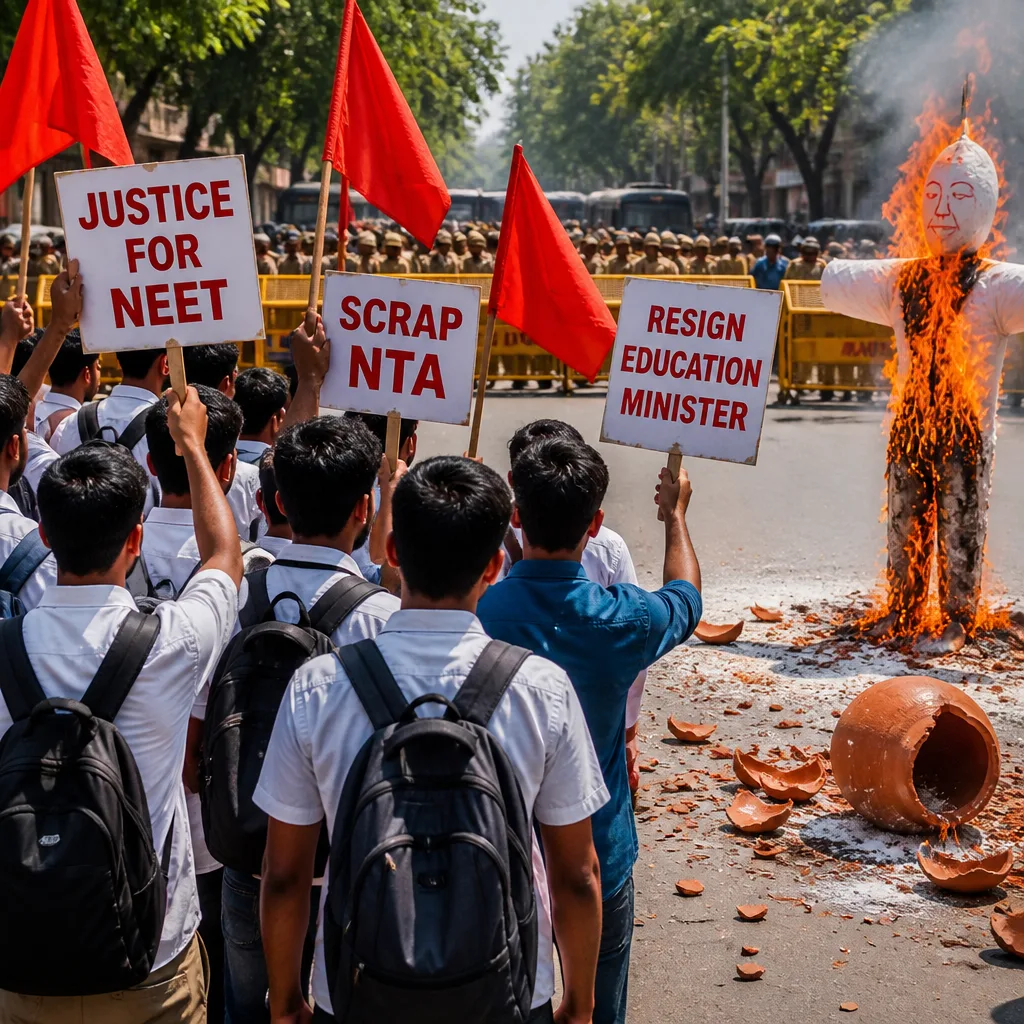
Protesters in southern India rallied on Sunday to condemn the detention of climate campaigner Sonam Wangchuk and to demand the resignation of Union Education Minister Dharmendra Pradhan, intensifying pressure over alleged irregularities tied to the NEET examination.
The demonstration, organised by members of the Communist Party of India (Marxist) in Kalaburagi, featured the burning of an effigy and the symbolic breaking of an earthen pot. Participants framed the action as a rebuke of what they called the Union Government’s "communal and fascist policies" and a failure to safeguard fair examinations.
Addressing the crowd, CPI(M) district secretary K. Neela alleged that police forcibly removed Wangchuk while he was on a hunger strike pressing for the minister’s resignation following reports of a question paper leak. Neela said the episode represented a broader clampdown on dissent and a refusal by authorities to engage with demonstrators’ concerns.
“[Police] had forcibly removed Mr. Wangchuk, who was on a hunger strike demanding the resignation of the Union Education Minister over the alleged NEET question paper leak,” Neela said, characterising the action as an attack on democratic rights and criticising the Centre for not opening dialogue with protesters.
Demands widen beyond exam probe
Speakers argued that the national government had not ensured transparent and leak-proof testing and linked the current controversy to deeper systemic issues. They criticised the centralisation and commercialisation of education under the National Education Policy (NEP) 2020 and targeted the National Testing Agency (NTA) that oversees major entrance exams.
- Resignation of Union Education Minister Dharmendra Pradhan
- Abolition of the National Testing Agency (NTA)
- Scrapping of the National Education Policy (NEP) 2020
Protesters said alleged leaks and irregularities have eroded confidence in the testing system, urging authorities to restore credibility through accountability and reform. Several party leaders from student and youth wings joined the agitation, underscoring the political stakes as well as student anxieties around high-stakes exams.
Symbolism and street action
The march at SVP Circle in Kalaburagi included the torching of an effigy depicting Prime Minister Narendra Modi alongside the education minister, a visceral show of discontent aimed at national leadership. Demonstrators also staged the breaking of an earthen pot to convey public anger and the perceived breaking point for students and families.
Participants named at the scene included Sudham Dhanni, Bhimashetty Yampalli, Pandurang, Shanta Ghanti, Chandamma Gola, Imam Saab, M.B. Sajjan, and Padmini Kirangi, along with other student and youth leaders affiliated with the party’s mass organisations.
What this means for students and families
For students preparing for competitive exams and their families, Sunday’s rally signals continued turbulence around test administration and oversight. While demonstrators pressed for leadership changes and structural shifts, the immediate concern for candidates is the stability and fairness of upcoming test cycles. Calls for dialogue and transparency highlight two priorities parents and students consistently raise: clear communication from authorities and predictable timelines for exams and results.
| Issue raised | Protesters' position |
|---|---|
| Alleged NEET irregularities | Demand accountability and safeguards against leaks |
| Role of NTA | Call for abolition and change in oversight |
| NEP 2020 | Oppose centralisation and commercialisation |
| Detention of Sonam Wangchuk | Denounce police action; seek dialogue |
As protests continue, the central question for learners is whether authorities will provide assurances that the next rounds of examinations will proceed without disruption and that safeguards are in place to protect the integrity of testing. Protest leaders maintain that only decisive, public-facing steps will restore trust.