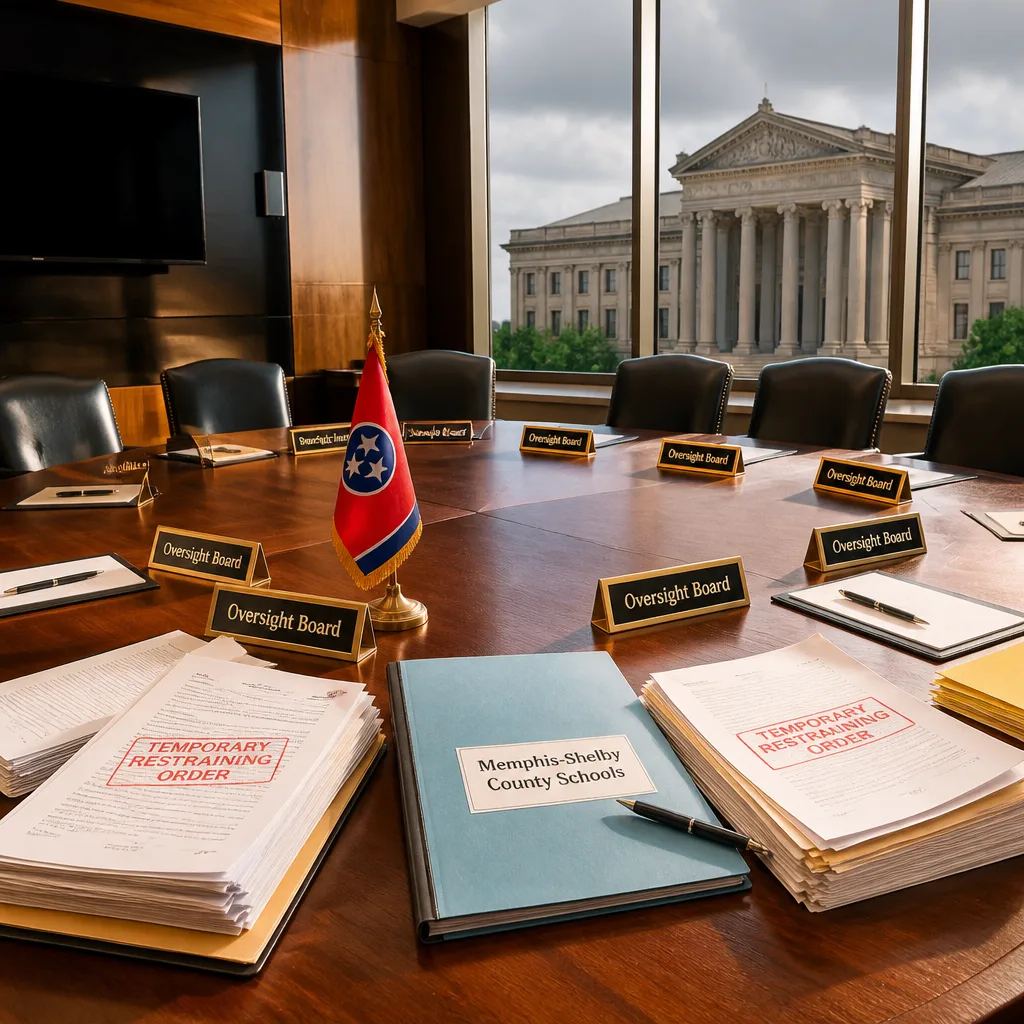
A federal judge has put a temporary stop to Tennessee’s move to assume control of Memphis-Shelby County Schools (MSCS), creating uncertainty for a nine-member Educational Oversight Board that had been slated to begin steering the district on July 1.
On July 1, the first day of the oversight board's legal start, a federal judge issued a temporary restraining order pausing the takeover.
What’s happened so far
The pause came in response to filings by MSCS and Shelby County Government. According to the case record described by the parties, attorneys for the district and county sought a temporary restraining order (TRO) and an emergency hearing on June 30. The judge’s order the next day halted the state’s plan on its legal start date. Multiple local entities — including MSCS, the elected school board, the Shelby County Board of Commissioners, and the nine individual members of the elected school board — joined a mid-June lawsuit challenging state leadership over the takeover. Members appointed to the new oversight board were subsequently added to that legal action as well.
A TRO is a short-term court order that temporarily preserves the status quo while a judge weighs arguments at a later hearing. In practice, that means the state’s takeover is on hold for now and the governance of MSCS remains in question until the court gives further direction.
Who picked the oversight board
The Educational Oversight Board for MSCS was created by state officials to guide the district. It consists of nine appointees named by Tennessee’s top leadership. By law, all but one of the members must live in Shelby County; one of the two appointees selected by the House Speaker may reside outside the county.
| Appointing authority | Number of appointees |
|---|---|
| Governor | 5 |
| Lieutenant Governor | 2 |
| House Speaker | 2 |
Here is one member identified in the public list of appointees and their background as detailed by officials:
- Tyrone Burroughs (appointed by the Governor) — Chair of First Choice Global. Co-founded The Burroughs Foundation in 2010 with a focus on financial literacy, workforce development and access to higher education. Holds a Master of Arts in teaching (elementary education) from the University of South Carolina.
Other board members were also appointed by the Governor, Lieutenant Governor and House Speaker; however, with the TRO in place, the future of the board and its nine members remains unclear while the litigation proceeds.
Why the court order matters
The judge’s intervention means the state cannot implement its proposed governance changes at this time. For families and educators, the immediate takeaway is that existing district operations continue under the pause until the court decides the next step. The order does not resolve the core dispute; instead, it defers action to allow a fuller review at a subsequent hearing.
The case also spotlights a larger debate playing out in parts of the United States: who should control major school systems — locally elected boards or state-appointed bodies — and under what conditions. The outcome in Memphis-Shelby County could influence how other jurisdictions structure oversight when student performance, accountability or management are at issue.
What parents and students should watch
- Court calendar: The TRO is temporary. Watch for notices of an emergency hearing and any subsequent rulings that could extend, modify or lift the pause.
- Board status: Because the oversight board’s legal start was halted on day one, any meetings or directives by that body are in limbo unless and until the court allows the takeover to proceed.
- District communications: MSCS and Shelby County officials are parties to the case. Families should rely on direct district updates for school-year planning, staffing and program information during the pause.
For now, the legal fight has stalled the state’s takeover and left a significant governance question unresolved in one of the country’s large school districts. The court’s next actions will determine whether the state’s appointees can assume authority or whether locally elected leadership retains control while the lawsuit advances.