The Texas A&M team behind a new device says it can reproduce the precise, millisecond-scale pulses of human blood flow inside lab-on-a-chip systems, clearing a major obstacle that has limited how faithfully microfluidic models mimic the body.
Why waveform fidelity matters
For more than two decades, researchers have used micro-physiological systems (MPS) — small chips seeded with real human cells — to emulate organs and blood vessels. But available pumps have struggled to match the complex, multi-pulse flow patterns produced by the human heart. The result: endothelial cells that line blood vessels may not behave as they would in a patient, limiting the models' usefulness for studying vascular disease, testing drugs or assessing physiological changes such as those induced by microgravity.
"The human blood flow arising from the heartbeat is made of multiple pulses, multiple wavelengths, and it happens over a very short period of time: you need a change in flow within 50 milliseconds," said Dr. Abishek Jain of Texas A&M.
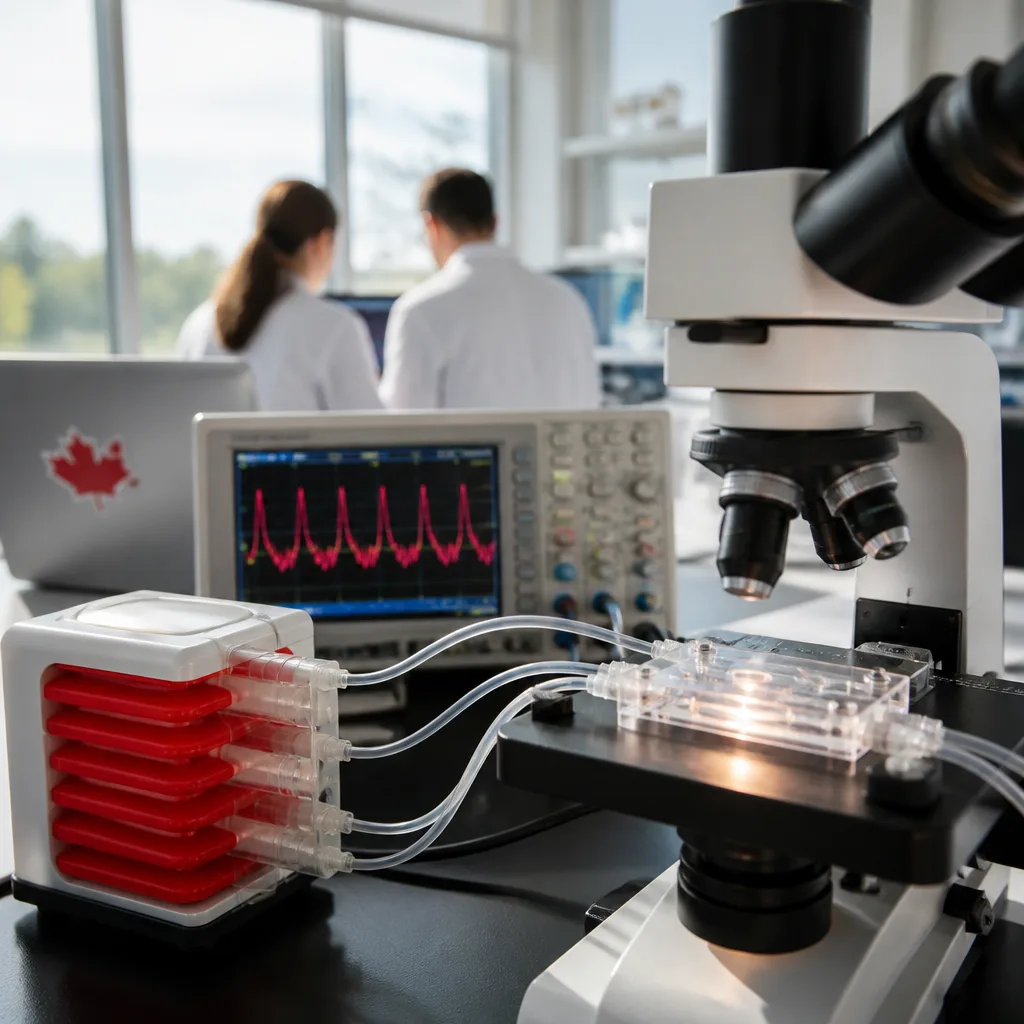
The newly reported device, called HemaDyne, is inspired by an accordion mechanism and can replicate any clinically recorded blood-flow waveform at the temporal resolution required to capture physiological dynamics. According to the researchers, that allows scientists to expose cultured endothelial cells to the same flow signatures observed in individual patients or specific vascular segments.
What HemaDyne enables
- Patient-specific modelling: recreate individual blood-flow traces from clinical recordings.
- Improved disease research: study how changes in flow patterns trigger cellular dysfunction linked to vascular illness.
- Drug discovery and safety: test therapies under more realistic mechanical conditions that affect drug response.
- Space biology: simulate altered flow in zero gravity to study risks to astronauts' vascular health.
HemaDyne's developers, led by Dr. Jain and Dr. Ankit Kumar, describe the device in a paper published in Nature Communications. The pump can deliver rapid changes in flow — on the order of tens of milliseconds — and is designed to be compatible with existing microfluidic setups used in labs worldwide.
Technical and practical implications
Reproducing authentic hemodynamic waveforms matters because the mechanical forces from pulsatile flow influence gene expression, cell shape and barrier function in the endothelium. With more accurate mechanical cues, MPS platforms may better predict how vessels respond to disease or treatment, potentially reducing reliance on animal models and improving translational relevance.
The HemaDyne approach also opens possibilities for integrating recorded clinical data directly into benchtop experiments. That would let researchers test hypotheses about how a specific patient's flow pattern contributes to disease progression or therapeutic efficacy.
| Capability | Why it matters |
|---|---|
| Sub-50 ms flow changes | Matches temporal dynamics of the heartbeat |
| Recreates clinical waveforms | Enables patient-specific experiments |
While the work originates in Texas, the implications are global: labs in Canada and elsewhere that use organ-on-chip systems could adopt the pump design to increase the physiological realism of their models. The paper's publication in a high-profile journal suggests the device will be scrutinized and tested by other groups seeking to benchmark its performance against existing perfusion systems.
HemaDyne addresses a concrete, technical shortcoming that has persisted for decades in microfluidics. If broadly adopted, it could change how researchers study vascular biology, evaluate candidate drugs and prepare humans for the physiological stresses of spaceflight.