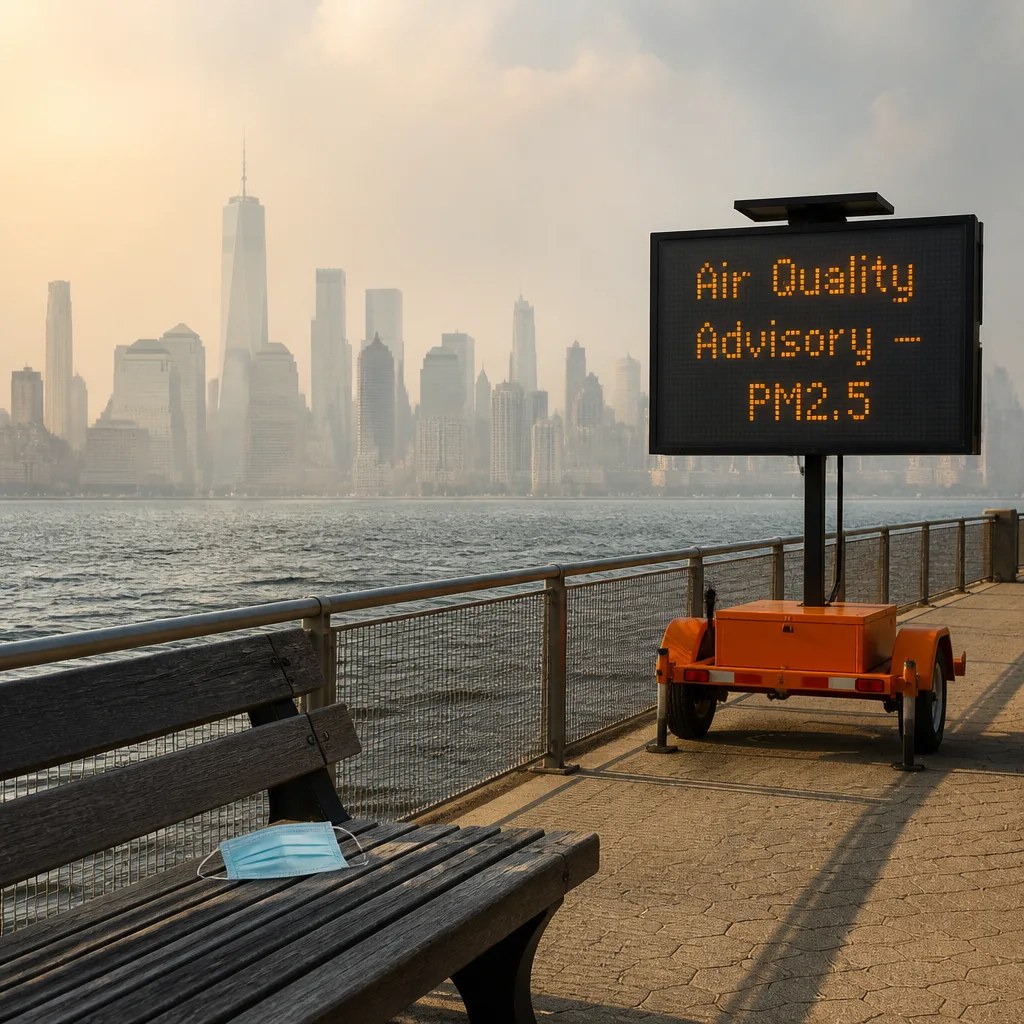
New York state authorities on Wednesday issued an updated Air Quality Health Advisory for fine particulate matter after smoke from wildfires in Canada reduced air quality and produced visible haze across the state.
Scope and timing of the advisory
The advisory, announced by the New York State Department of Environmental Conservation (DEC) and the State Department of Health (DOH), covers much of the state and is effective from 10 a.m. until 11:59 p.m. Officials said smoke-related pollution will cause spikes in particulate concentrations, with some regions forecast to reach levels considered unhealthy.
Who and where are affected
The agencies identified fine particulate matter (PM2.5) as the pollutant of concern. Forecasts classify several regions as unhealthy or unhealthy for sensitive groups:
- Unhealthy for sensitive groups: Long Island, New York City Metro, Lower Hudson Valley, Upper Hudson Valley and the Adirondacks.
- Unhealthy: Eastern Lake Ontario, Central New York and Western New York.
DEC and DOH listed the specific counties included in each Air Quality Health Advisory region, naming Nassau and Suffolk on Long Island; New York City, Rockland and Westchester in the New York City Metro; counties in the Lower and Upper Hudson Valleys; Adirondack counties; and multiple counties across the Central, Eastern Lake Ontario and Western New York regions.
How the advisory is determined
DEC meteorologists issue Air Quality Health Advisories when they expect concentrations of ozone or PM2.5 to push the Air Quality Index (AQI) above 100. The AQI translates levels of different pollutants to a single scale in which higher values correspond to worse air quality and increased health risks.
| Metric | Trigger |
|---|---|
| Pollutant of concern | Fine particulate matter (PM2.5) |
| AQI threshold for advisory | Greater than 100 |
| Advisory effective | 10 a.m. to 11:59 p.m. (Wednesday) |
Public-health implications and practical guidance
Air quality described as "unhealthy" or "unhealthy for sensitive groups" signals increased risk of respiratory and cardiovascular effects, particularly for children, older adults, pregnant people and individuals with pre-existing lung or heart conditions. While the advisory text does not list behavioural recommendations, such notices typically prompt authorities to advise minimizing outdoor exertion, using air filtration indoors where possible, and following guidance from health-care providers for anyone with chronic conditions.
Officials attributed the degraded air to smoke transported from wildfires in Canada, underscoring how distant large fires can quickly affect air quality across international borders.
Residents in the named advisory regions should monitor local air-quality updates from DEC and DOH, follow any additional public-health guidance issued by local health authorities, and consider limiting time spent outdoors while particulate concentrations remain elevated.