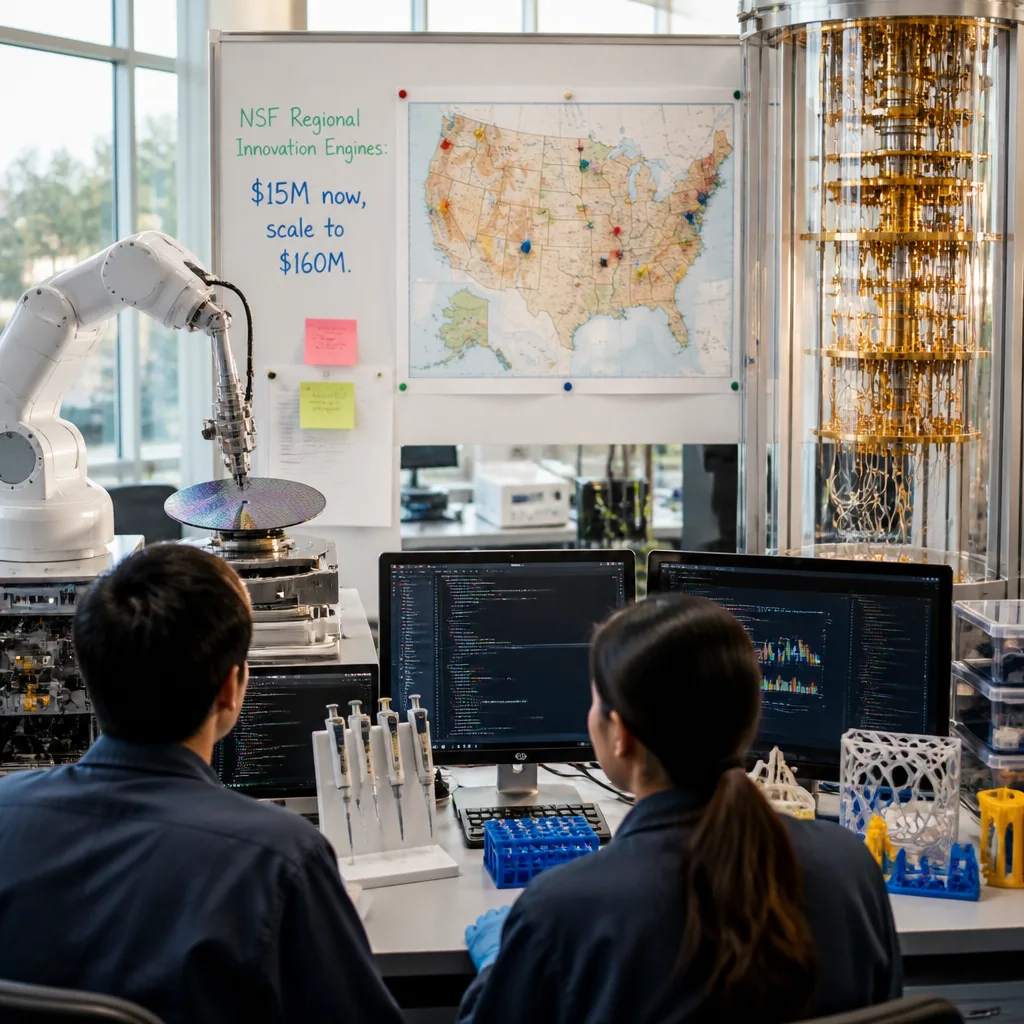
Twelve new U.S. technology coalitions will receive $15 million each over two years to jump-start regional clusters in areas such as artificial intelligence, quantum computing, semiconductors, biotechnology, critical materials, energy infrastructure and advanced manufacturing. The awards, announced by the U.S. National Science Foundation (NSF), form the second cohort of its Regional Innovation Engines program, pairing research institutions with industry, non-profits and workforce partners across 20 states.
University-led coalitions with a workforce mandate
The engines are structured as university-led consortia designed to move lab breakthroughs closer to market while building the training pipelines needed for emerging jobs. The model brings together higher education, private companies, workforce organizations and regional stakeholders to align R&D, commercialization and skills development.
Leading institutions in the new cohort include Indiana University, Iowa State University, Oregon State University, the University of Connecticut, the University of Missouri–Kansas City and the University of Rochester. Other engines are headed by research and regional organizations in collaboration with academic partners.
“These new NSF Engines will be transformational for America's innovation infrastructure — helping secure our national competitiveness in technologies and future industries that will be critical to our economic and national security for decades to come.”
Focus areas: from AI-driven chips to quantum tech
NSF highlighted distinct technical thrusts among the engines. In Oregon, the NSF FAST Engine—led by Oregon State University—plans to apply AI to accelerate semiconductor design, optimize manufacturing processes and shorten development cycles. The coalition’s goals include progress toward fully automated chip design and AI-driven control systems for fabrication.
In Connecticut, the University of Connecticut will lead the NSF Quantum Technologies Engine, supporting applied research, technology transfer and workforce development in quantum-related fields. Across the program, projects cover critical technologies spanning AI, quantum, semiconductors, biotechnology, energy infrastructure, advanced manufacturing and critical materials.
Funding now, scale later
Each engine’s initial award supports two years of activity, with the prospect of significantly more capital on the table. Teams that hit defined milestones could receive up to $160 million each from NSF over the next decade, positioning the engines as long-horizon platforms for regional tech capacity.
| Program element | Detail |
|---|---|
| Number of engines | 12 |
| Initial award per engine | $15 million |
| Initial funding period | Two years |
| Geographic scope | 20 states |
| Potential long-term funding | Up to $160 million per engine over a decade |
Why it matters
The NSF Engines approach is designed to stand up durable, place-based tech ecosystems that blend research, commercialization and talent development. By tying funding to measurable milestones, the program aims to keep teams focused on technology deployment and workforce outcomes, not just publications or prototypes.
- Targets dual goals: accelerate strategic technologies and expand skilled talent pipelines.
- Links universities with employers and workforce groups to match training with regional needs.
- Prioritizes areas central to supply chains such as semiconductors and critical materials.
Specific initiatives illustrate how the engines intend to operate. In semiconductors, AI-driven design and fab control promise faster iteration and potential yield gains, lowering time-to-market for new chips. In quantum, emphasis on applied research, commercialization and workforce upskilling aims to translate lab advances into deployable technologies and jobs.
While each engine is regional, the combined effect is national scale: a distributed network of specialized hubs with aligned incentives to move innovations from bench to industry. The program also underscores workforce as a first-order priority, placing job preparation on equal footing with science and engineering breakthroughs.
NSF said the second cohort assembles universities, non-profits, private firms and regional partners with a mandate to expand research, push technologies toward deployment and prepare workers for roles in their regions. The engines’ next steps will involve mobilizing partners, setting milestones and allocating early dollars to projects that can demonstrate momentum within the two-year window.