University of Ottawa spinout advances assistive tech
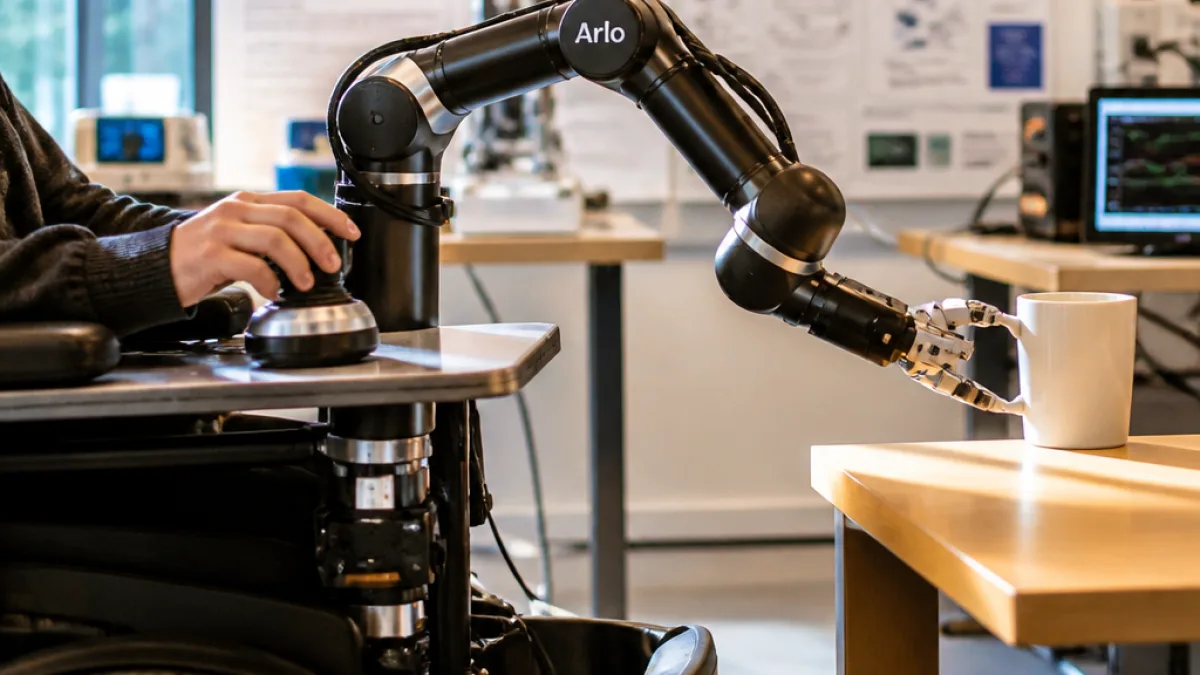
An Ottawa-founded startup is pushing forward on a device designed to make daily tasks easier for people with physical disabilities. Sielo Robotics, still operating out of a lab at the University of Ottawa, is developing an assistive robotic arm known as Arlo. The team says a recent $1 million seed raise in May will speed up work through the summer as they expand real-world testing with local users.
For Hollis Pierce, who uses a powered wheelchair and leads accessibility and partnerships at the company, the technology has already translated into practical gains. Using a specialized controller — a space mouse that moves in six directions — he can steer Arlo to handle routine actions. As part of product testing, he set himself a simple goal that had long been out of reach.
“I’m 38 years old and I’ve never taken my own selfie,” Pierce said, describing how the arm helped him complete the task after a learning period.
Pierce said the latest fourth-generation model is more intuitive, likening the experience to playing a video game. He credits the engineering team for iterating quickly based on feedback from people who will use the device daily, while being candid about what works and what does not during trials.
Built with lived experience and local partnerships
Sielo emphasizes that Arlo’s design has been shaped by users from the outset. The company has aligned with The 8-80 Collaborative, a partnership between the CHEO Research Institute and Bruyère Health, to connect with testers in health and rehabilitation settings. Company leaders say the seed round came together on the strength of the mission rather than traditional venture channels.
“We didn’t have any [venture capital] or organizations funding what we were doing. It was all people… hearing what we’re doing,” said Laila Burns, chief revenue officer.
As development continues, the team is looking for more participants like Pierce to validate day-to-day usefulness. Tasks such as taking a drink of water or wiping one’s nose can involve waiting for assistance; Pierce said an arm that can be commanded directly has the potential to make those moments faster and simpler.
From lab bench to daily routines
Rafaël Hébert, the company’s chief technology officer and a recent engineering graduate, said seeing users progress is a motivator for the engineering team.
He noted that a tester can now “take a selfie and grab items to put on his tray and even interact with his own body.”
While Arlo remains under evaluation at the University of Ottawa lab, the goal is to expand trials beyond controlled settings. Before the system can move into homes or community environments at scale, the company says it needs broader feedback to refine features and reliability.
For Ottawa residents, the work highlights a growing cluster of health technology efforts tied to academic research and local health institutions. If testing confirms benefits, an assistive arm capable of precise, repeatable motion could offer a measure of independence for users and reduce demand on caregivers for routine tasks.
What Arlo’s development means for Ottawa
- Local innovation: Built at the University of Ottawa with clinical partnerships through CHEO and Bruyère.
- User-led design: Iterations informed directly by people with lived experience, including on-device controls via a space mouse.
- Next steps: Scale up testing to validate everyday tasks before broader community use.
Milestones at a glance
| Milestone | Detail |
|---|---|
| Funding | $1 million seed raised in May |
| Product stage | Fourth-generation assistive robotic arm under test |
| Location | Lab at the University of Ottawa |
| Clinical ties | Working with The 8-80 Collaborative (CHEO Research Institute and Bruyère Health) |
Sielo’s team says the coming months will focus on building a larger base of testers and continuing to iterate on controls, reliability and task execution. For users like Pierce, each small improvement translates into tangible autonomy.