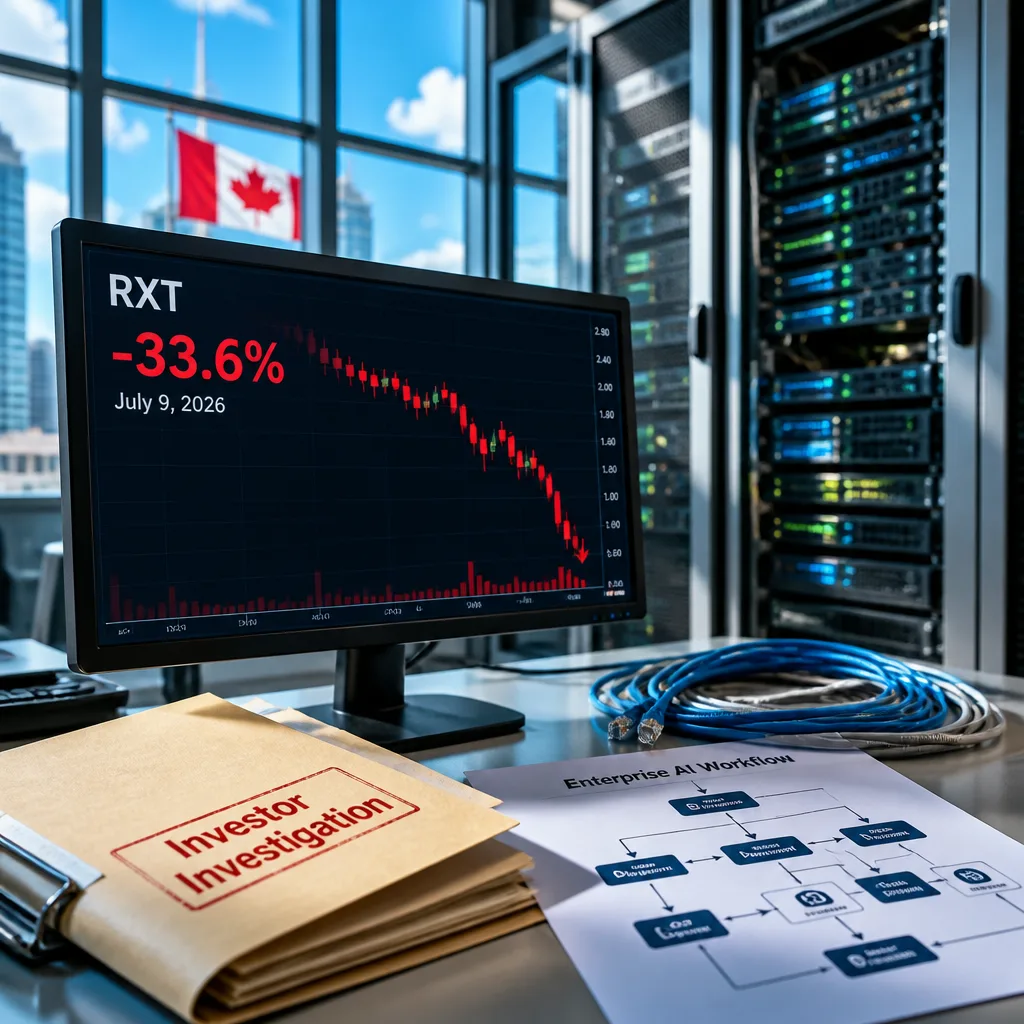
Rackspace Technology is under scrutiny from a U.S. shareholder-rights firm after the cloud services provider slashed its 2026 outlook and blamed the move on abandoning lower-margin contracts to focus on enterprise AI—a shift that sent its shares down 33.6% in a single session.
Shareholder investigation follows outlook reset
The Schall Law Firm said it is investigating whether Rackspace Technology, Inc. (NASDAQ: RXT) violated U.S. securities laws by making false or misleading statements or omitting key facts relevant to investors. The probe was announced after Rackspace released preliminary Q2 2026 results on July 9, 2026 and lowered its full-year guidance.
In its update, the company said the revised outlook was:
“to account for (its) transition away from certain low-margin engagements that will be redeployed to (its) enterprise AI business.”
That disclosure triggered a sharp market reaction, with RXT dropping 33.6% the same day, according to the firm. The legal team is inviting shareholders who incurred losses to contact them and consider their rights options.
Why this matters: AI pivots meet investor protection rules
Rackspace’s move underscores a broader tension in tech: companies racing to retool for AI-driven services while navigating disclosure obligations. Shifting away from low-margin, legacy workloads can strengthen profitability over time, but it often creates short-term revenue pressure—and raises questions about how clearly management signalled those trade-offs before resetting expectations.
Shareholder investigations like this often examine whether prior statements aligned with internal realities as conditions evolved. While an investigation does not itself allege wrongdoing or guarantee litigation, it can precede class-action filings if law firms conclude investors were misled.
What Rackspace told the market
- Date of update: July 9, 2026 (preliminary Q2 2026 results)
- Guidance: Full-year outlook reduced to reflect redeployment away from lower-margin engagements
- Strategic focus: Expansion of enterprise AI services
- Market reaction: RXT shares fell 33.6% on the day
| Event | Date | Immediate Impact |
|---|---|---|
| Preliminary Q2 2026 results, guidance cut | July 9, 2026 | Shares down 33.6% |
| Shareholder-rights investigation announced | Subsequent to July 9, 2026 | Probe into potential securities law issues |
The disclosure test for AI transitions
Companies repositioning around AI must explain how that strategy affects near-term revenue, margins and cash flow. Investors typically look for:
- Clarity on contract mix: Which engagements are being wound down and when the transition will hit top-line results.
- Path to profitability: Timelines and milestones for AI offerings to offset lost revenue from lower-margin work.
- Consistency over time: Whether prior guidance and commentary adequately anticipated the change.
Rackspace’s update links the outlook reduction directly to redeploying resources into enterprise AI. The investigation will focus on whether the company’s earlier statements and disclosures properly prepared investors for that shift and its financial consequences.
What shareholders can consider now
For investors—including Canadians exposed through U.S.-listed holdings—the key questions are about execution and transparency. If Rackspace can quickly replace legacy workloads with higher-value AI services, the near-term hit may be transitory. If the transition takes longer, volatility could persist. In parallel, the legal review will assess the adequacy of past communications to the market.
The Schall Law Firm, which specializes in securities class actions and shareholder-rights litigation, is collecting information from affected investors. The firm notes that this announcement may be considered attorney advertising in certain jurisdictions.
The company has not, in the materials referenced here, provided additional detail on the scale of the contracts being exited, the expected cadence of AI-related revenue, or revised quantitative guidance ranges beyond acknowledging the full-year outlook cut. Investors will be looking for those specifics in the final Q2 results and subsequent filings.