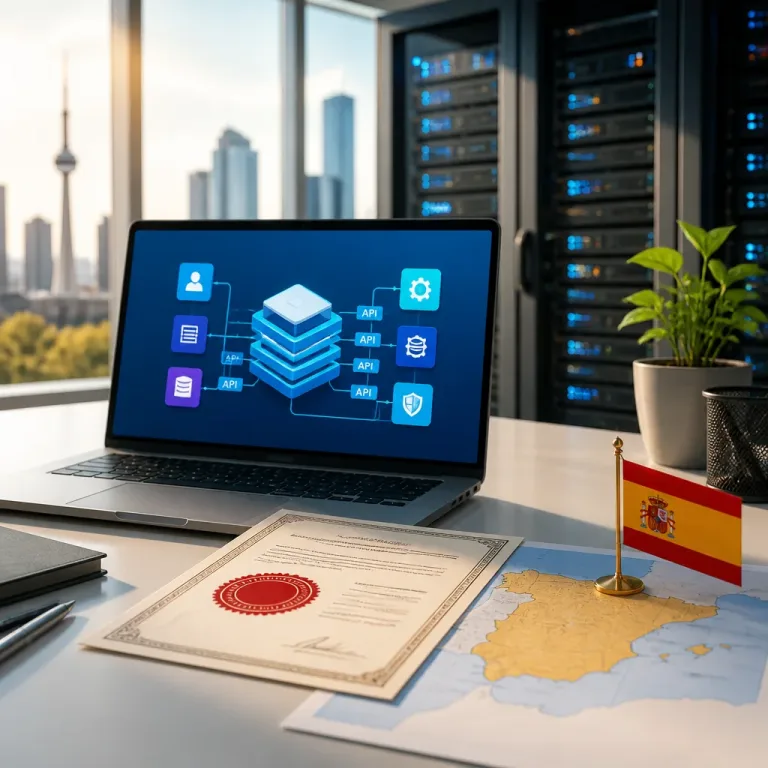

Enterprises reshaping their tech stacks for artificial intelligence and cloud computing are being pulled in two directions: toward software platforms that centralize customer data and workflow, and toward the physical infrastructure that runs those workloads. Two bellwethers — Salesforce and Dell Technologies — embody that split, and their latest moves show how each plans to capture a larger share of corporate IT budgets in 2026.
Different roads to the same budget
Salesforce’s pitch is familiar but evolving. The company built its franchise on cloud-based customer relationship management and has been layering in automation and AI to knit sales, marketing and support into a single operating plane. In June 2026, it agreed to acquire Fin for nearly US$3.6 billion, a push to strengthen autonomous agent capabilities inside its platform. The through line: keep customer data and workflows inside Salesforce, then apply AI to speed decisions and reduce manual work.
Dell, by contrast, leans into the hardware and infrastructure that power modern computing — from end-user devices to storage and AI-oriented systems. It serves a broad commercial and consumer base and recently adjusted its North American distribution approach by ending an enterprise computing partnership with Arrow Electronics, a move aimed at tightening how it reaches customers. The underlying strategy is to be the dependable backbone for organizations deploying AI and data-heavy applications.
Why the money metrics matter
On paper, Salesforce’s 2026 fiscal profile reflects a software business converting scale into profit and cash. Reported revenue reached US$41.5 billion, up nearly 10% year over year, with US$7.5 billion in net income — an implied 18% net margin. Free cash flow came in at US$14.4 billion. Leverage was modest, with a debt-to-equity ratio of 0.3x, and liquidity, measured by a current ratio of 0.8x, signals a tight but manageable near-term profile for a subscription software vendor.
There’s an important footnote: stock-based compensation accounted for 23.4% of operating cash flow. SBC is a non-cash expense that’s added back in cash flow reporting, which can make free cash flow look stronger than the underlying cash earned from customers. For investors and technology buyers alike, this matters because it colours how much fuel a company actually has for research, acquisitions and customer-support investments.
AI integration: platform or plumbing?
Both companies are chasing the same AI wave from opposite ends of the stack. Salesforce wants to be the place where sales teams, service agents and marketers interact with models and autonomous agents directly in their daily tools. Dell aims to supply the compute, storage and connectivity those models need to run — on premises, at the edge, or in hybrid configurations.
- Salesforce’s tack: consolidate customer data and workflows, then embed AI to automate routine tasks and recommendations.
- Dell’s tack: deliver reliable, scalable infrastructure so enterprises can train, deploy and serve AI without bottlenecks.
In practice, these approaches are interdependent. A company modernizing its contact centre might centralize records and automation inside Salesforce while deploying Dell’s servers and storage to handle analytics and inference close to where data is generated. The competitive tension isn’t only head-to-head — it’s also about which layer of the stack commands more of the long-term budget and strategic control.
How the Salesforce ledger stacks up
Salesforce’s latest figures provide a snapshot of financial capacity to keep investing through the AI cycle. Here are the numbers disclosed:
| Metric (FY2026) | Salesforce |
|---|---|
| Revenue | US$41.5B |
| Net income | US$7.5B |
| Net margin | 18% |
| Free cash flow | US$14.4B |
| Debt-to-equity | 0.3x |
| Current ratio | 0.8x |
| SBC as % of operating cash flow | 23.4% |
Those indicators tell a story of a software provider with scale, profitability and ongoing acquisition capacity — tempered by the need to manage stock-based pay and short-term liquidity prudently.
Dell moves to tighten its channel
Dell’s business spans devices, storage and infrastructure tailored for AI-era workloads. The recent decision to wind down an enterprise computing relationship with Arrow Electronics in North America suggests a shift in how Dell intends to reach and support customers. For CIOs, channel design affects pricing power, delivery timelines and support models — all critical when rolling out hardware-heavy programmes such as AI pilots, data platform refreshes or edge deployments.
The takeaway for Canadian enterprises
For Canadian organizations balancing cloud-first mandates with data residency, security and cost control, the strategic split is clear. Platform vendors like Salesforce compete to own the customer-facing workflow and the AI-infused automation layer. Infrastructure providers like Dell compete to supply the reliable, scalable plumbing beneath it. In most real-world transformations, buyers will need both — but the sequencing and vendor leverage will depend on budgets, talent and the degree of on-premises versus cloud deployment.
The current signal from both companies is unambiguous: corporate technology spending in 2026 will be shaped by how quickly enterprises can operationalize AI. Whether that value accrues to the platform or the plumbing will depend on where organizations believe the most strategic control — and return — lies.