YELLOWKNIFE — With summer travel hitting its stride across the North, Parks Canada and Indigenous partners are reminding visitors that Thaidene Nëné National Park Reserve is open for backcountry adventures — and that careful trip planning, cultural respect and a firm no‑drone rule apply throughout the protected area.
Thaidene Nëné — translated as “The Land of the Ancestors” in Dënesųłiné Yati — anchors an Indigenous Protected Area spanning more than 26,000 km² in the Northwest Territories. The reserve sits where the tundra meets the subarctic boreal forest on the shores of one of the world’s largest freshwater lakes, offering sweeping barrens, jack pine and spruce, and long horizons that seem to fold into Great Slave Lake.
Shared governance rooted in place
Management of the national park reserve is shared by Parks Canada and Indigenous governments with deep cultural ties to the region: the Łutsël K’é Dene First Nation, Northwest Territory Métis Nation, Deninu Kųę First Nation and Yellowknives Dene First Nation. Their continued relationship with the land underpins how the area is protected and how visitors are welcomed — a reminder to tread lightly, follow guidance and remember you’re travelling in a place that holds spiritual and cultural significance.
Know before you go
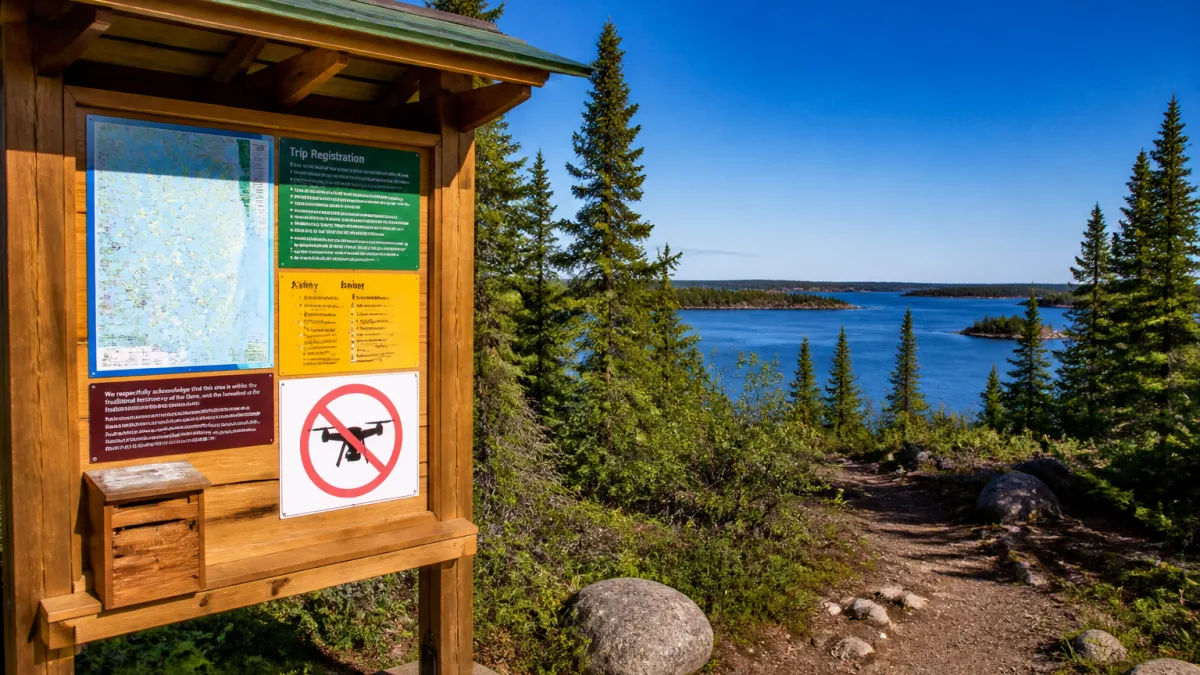
Officials emphasize that recreational drones are not permitted anywhere inside the park reserve. Flying a drone within the boundaries can lead to enforcement action and fines of up to $25,000. The ban helps protect wildlife, maintain cultural privacy and preserve the quiet most people come north to find.
Beyond the aircraft rules, visitors are urged to register, review current bulletins and plan for self-reliance in a remote setting. Weather shifts quickly. Communications are limited outside communities. And wildlife — from bears to muskoxen — demand vigilance and know‑how.
Where to get information
Visitor information is available on weekdays, 8:30 a.m. to 4:30 p.m., through offices in Yellowknife and Łutsël K’é:
| Location | Address | Hours |
|---|---|---|
| Yellowknife | Suite 220, 5101 50th Avenue, Yellowknife, NT X1A 3Z4 | 8:30 a.m.–4:30 p.m. (visitor information) |
| Łutsël K’é | House #24, across from the Co‑op | 8:30 a.m.–4:30 p.m. (visitor information) |
What to do on the Land of the Ancestors
For those prepared to travel safely and respectfully, the park reserve offers classic northern experiences, from quiet shoreline camps to long paddles and cultural learning.
- Cultural experiences guided by local knowledge keep the park’s stories front and centre.
- Fishing and shore lunches along cold, clear waters.
- Flightseeing and air charters that reveal the scale of the shield and lake country.
- Boating, paddling and multi‑day camping in backcountry settings.
- Seasonal berry picking, hiking and quiet wildlife watching.
Park guidance highlights core safety topics that matter on this landscape:
- Bear safety and food storage practices.
- Muskox safety and keeping a respectful distance.
- Backcountry, boating and paddling safety — including cold‑water risks and weather planning.
- Winter and snowmobiling safety for shoulder and cold seasons.
- Communications planning and checking Important Bulletins before departure.
Practical steps for a smoother trip
Before you pack the tent or book a charter, carve out time to look through the park’s visitor guidelines and maps, and confirm your route with current conditions. If you’re flying in or arranging a water taxi, reach out to licensed tour operators and charters listed by the park. In a place this vast, redundancy matters: carry a satellite communicator, share your itinerary, and build extra days into the plan in case weather keeps you grounded.
Visitors can contact Parks Canada’s offices in Yellowknife or Łutsël K’é for help with registration, route suggestions and safety resources. Taking these steps adds a layer of safety and shows respect for the land and the people who have stewarded it for generations.
Thaidene Nëné’s draw is no secret to Northerners: big skies, quiet coves on Great Slave Lake and the humbling feeling of standing on rock shaped by ice and time. The promise this season is the same as ever — a chance to be small in a big place — with one non‑negotiable: leave the drone at home, and let the silence do the work.