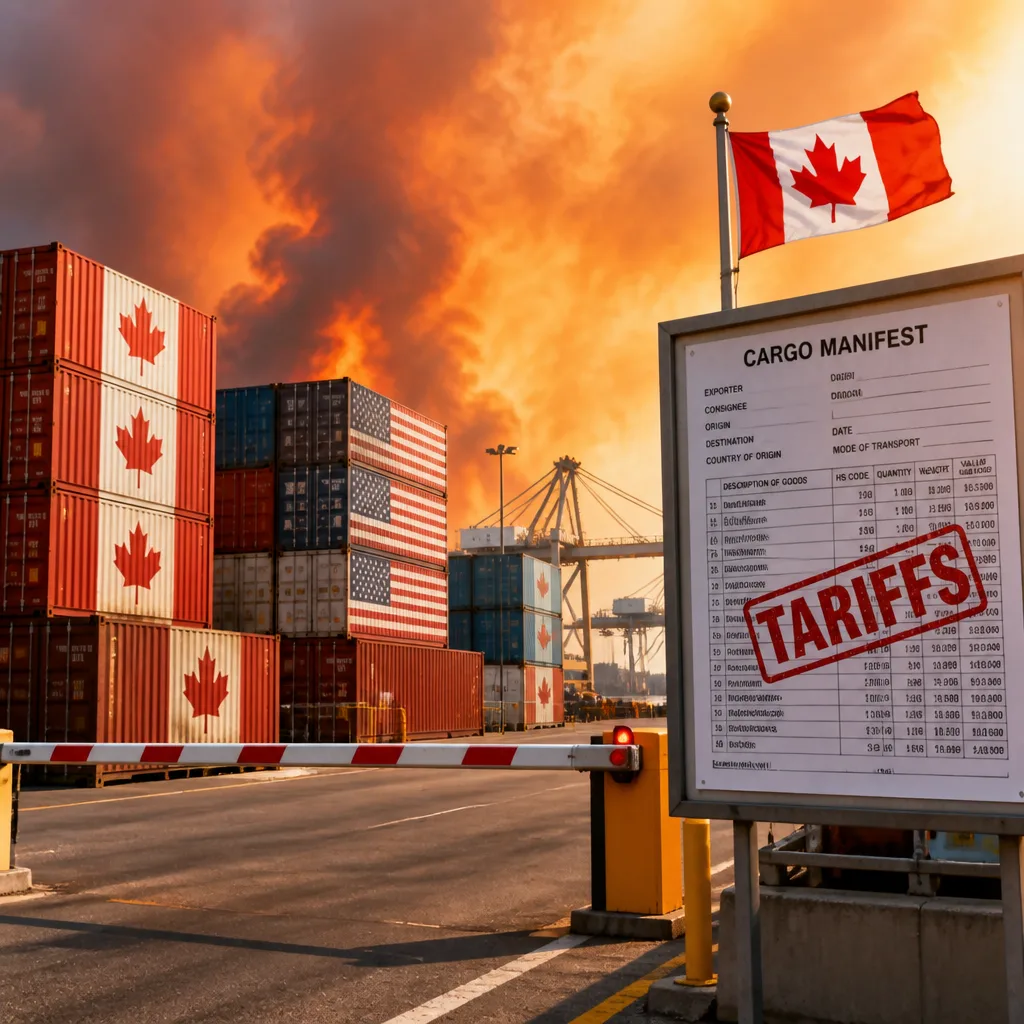
President Donald Trump on Friday threatened to levy tariffs on Canadian imports, blaming Canada for unchecked wildfires whose smoke has degraded air quality across parts of the United States.
In a post on Truth Social, the president accused Canada of "willful negligence" in its approach to forest management and said the cross-border pollution was causing harm and costing the United States billions. The warning comes as hundreds of blazes continue to burn in Canada, sending smoke into the Midwest and Northeast and prompting air-quality alerts in more than a dozen U.S. states.
Numbers on the ground
The Canadian Interagency Forest Fire Centre reported there were 896 active wildfires as of Friday, with 70 new fires igniting in the previous 24 hours. Officials have linked the burn-off to widespread advisories across U.S. states and concern about public health impacts.
| Metric | Figure |
|---|---|
| Active wildfires in Canada | 896 |
| New fires in past 24 hours | 70 |
Political and legal complications
Tariffs are a familiar instrument for the U.S. president when dealing with external disputes, but their use here raises legal and diplomatic questions. Earlier this year, the U.S. Supreme Court limited the president's unilateral authority to impose tariffs, complicating any straightforward path to new duties.
Asked about the tariff threat, Canadian leadership did not immediately file a direct rebuttal. Speaking to reporters, the person identified as Canada's prime minister stressed the shared responsibility for climate action.
"Fighting climate change is the responsibility of all countries, including the United States."
Local impacts, broader consequences
Across the border, communities have faced degraded air quality, which can aggravate respiratory conditions and strain public health services. The possibility of tariffs frames the smoke episode not only as an environmental emergency but also as a matter with potential economic consequences for exporters and cross-border trade.
- Air-quality alerts reported in more than a dozen U.S. states across the Midwest and Northeast.
- Environmental management at the heart of political rhetoric and bilateral scrutiny.
- Trade and legal issues complicated by recent judicial limits on presidential tariff powers.
The situation remains fluid: wildfires continue to burn, smoke forecasts can change rapidly, and political responses may evolve. For Canadians and U.S. communities affected by the smoke, the immediate priorities remain health advisories and firefighting efforts even as leaders weigh the diplomatic and trade implications.
— National Desk, InfoRadar