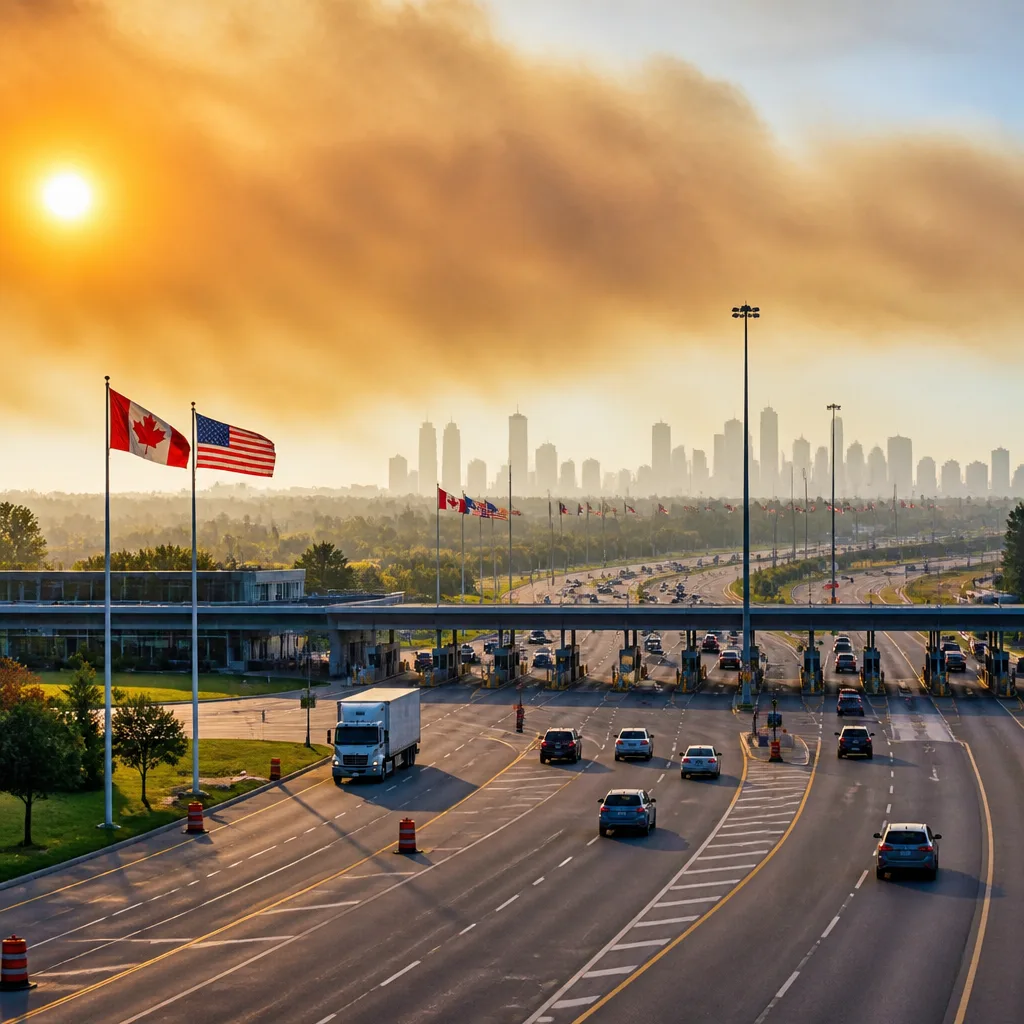
Washington moves to threaten sanctions over drifting smoke from Western Canada, an escalation that spotlights the international consequences of this summer’s wildfire season and raises fresh questions about co‑operation on cross‑border fire control.
U.S. Sen. Bernie Moreno, an Ohio Republican, told colleagues he will introduce legislation targeting Canada and specific Canadian officials for what he calls insufficient investment in wildfire prevention measures such as forest thinning, prescribed burns and other fuel‑reduction efforts. The move follows visible episodes of smoke that have contributed to poor air quality in major American cities.
Heightened political pressure from U.S. lawmakers
Beyond the senator’s planned bill, four Republican members of the U.S. House wrote to what the source identifies as “Prime Minister Mark Carney,” accusing Canada of repeatedly failing to prevent smoke incidents and suggesting U.S. agencies might take a direct role in cross‑border fuel reduction or firefighting. Their letter characterises the situation as a recurring crisis that they believe Canada could address with different land‑management choices.
"This is the third consecutive year we have had to write to Canadian officials about a crisis that Canada has the tools to prevent and has chosen not to,"
At the diplomatic level, the U.S. ambassador to Canada offered a markedly different tone, calling the situation a shared problem requiring joint action and praising real‑time coordination between the two governments.
"This challenge knows no borders ... This is a shared challenge, and it demands a shared response,"
Local impacts, national implications
The smoke has been linked to degraded air quality in several U.S. population centres, among them Chicago, Cleveland, Detroit and Minneapolis. Those on the ground see immediate public‑health effects, while policy makers are now debating accountability and the scope of bilateral response.
- Proposed U.S. legislation would aim at Canadian officials and possibly economic measures.
- U.S. House Republicans suggested U.S. agencies could be authorised to operate across the border on fuel reduction and firefighting.
- The U.S. ambassador framed the situation as one for co‑operation and shared action.
| Actor | Position |
|---|---|
| Sen. Bernie Moreno (R‑Ohio) | Plans sanctions legislation |
| Four Michigan Republican House members | Wrote to Canadian leadership calling for action |
| U.S. Ambassador to Canada, Pete Hoekstra | Called for joint response and praised co‑operation |
For Ottawa, the episode poses several dilemmas. Federal and provincial authorities must balance forestry‑management decisions, Indigenous and community rights, and public‑safety priorities while responding to external political pressure that could affect trade and diplomatic relations. The public debate will likely intensify around whether existing prevention measures are adequate and how Canada and the United States should share resources and authority during cross‑border smoke and fire events.
Officials in both countries have a track record of operational co‑operation during major fires, including information sharing and mutual assistance. The latest political interventions — one threatening punitive measures and the other emphasising partnership — reveal divergent approaches in Washington to managing a problem that does not respect international boundaries.
As summer progresses and fires continue to shape air quality and public health in multiple jurisdictions, Canadian policy makers will face questions about investments in prevention, the scope of binational agreements, and how best to protect communities while maintaining diplomatic relations with their largest trading partner.