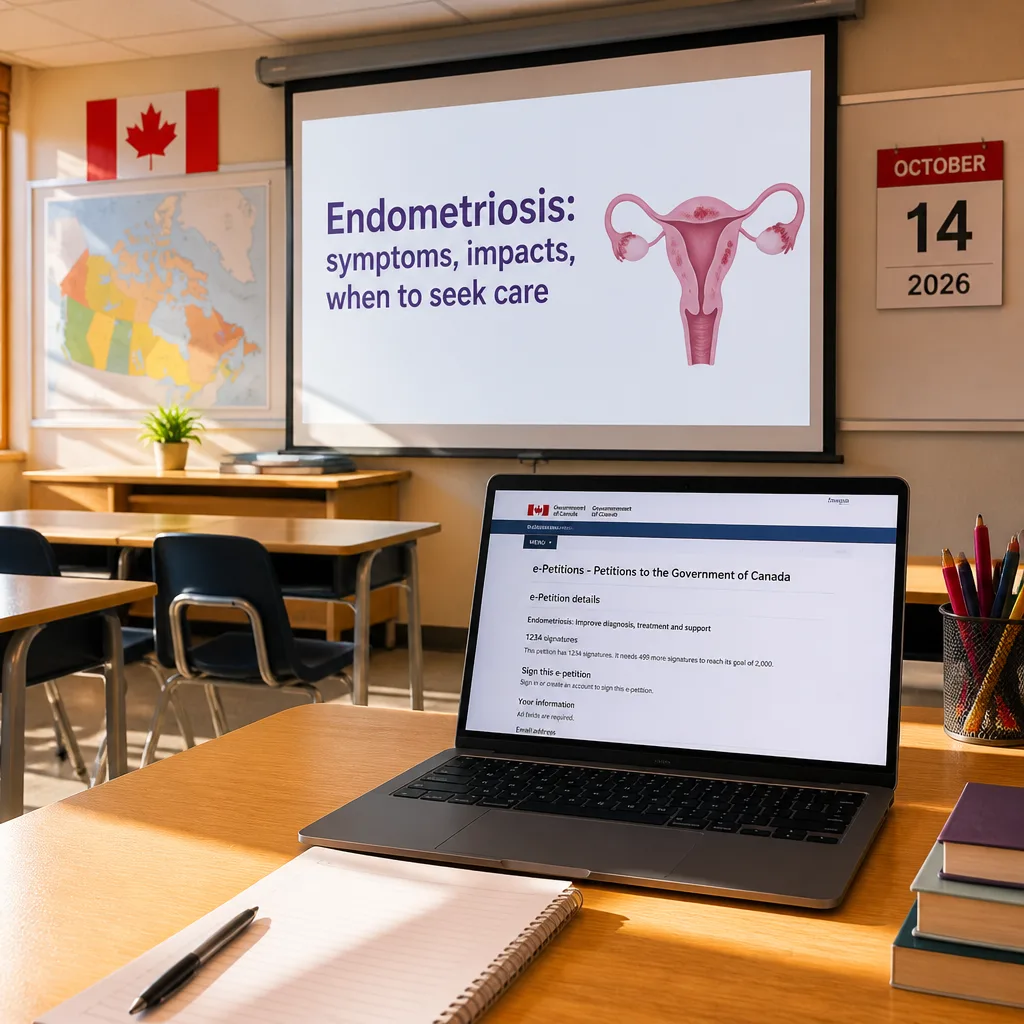
A Vancouver 16-year-old, Elize Nocente, is calling on the federal government to support classroom teaching on endometriosis, a condition that affects about one in 10 people assigned female at birth — roughly two million Canadians. Through a federal e‑petition that has already drawn more than 600 signatures, she is pressing for a national approach to instruction on symptoms, impacts and when to seek care.
What the petition asks
Nocente is asking Ottawa to fund a national advisory board to craft an evidence‑based endometriosis lesson plan and collaborate with provinces and territories to introduce it in age‑appropriate classrooms across the country. If all signatures are validated, Jenny Kwan, NDP MP for Vancouver East, will present the petition in Parliament after it closes on Oct. 14, 2026.
- Create a federally supported advisory body to develop curriculum materials on endometriosis.
- Work with provinces and territories to bring the lesson plan into classrooms at suitable grade levels.
- Use education to help students recognize symptoms and seek timely medical attention.
Why this matters for students and families
Endometriosis occurs when tissue similar to the uterine lining grows outside the uterus on nearby organs such as the bladder, bowel or ovaries. The condition can cause debilitating pain. According to Nocente, pain linked to menstrual cycles is often dismissed, leaving many students to manage severe symptoms without support.
“You’re told that period pain is normal and not to be scared,” Nocente said. “Some discomfort and pain is normal, but when it gets to the point where some girls can’t even get out of bed because they’re in so much pain, then that’s not normal at all.”
Nocente argues that better classroom education can counter the minimization many experience and help teens recognize when pain is not typical. She describes a “cycle of shame,” where students doubt themselves because they cannot cope as easily as their peers.
What the condition can look like
Experiences vary, but the source describes impacts that can be severe. In some cases, endometriosis can lead to kidney failure, bowel obstruction, painful bowel movements, and blood in stool and urine. Many report intense cramps, and some face fertility challenges.
| Measure from source | Detail |
|---|---|
| Prevalence | About 1 in 10 people assigned female at birth in Canada (~2 million) |
| Common symptom | About 90% with symptoms experience severe cramps |
| Fertility impact | About 30% of people with endometriosis have trouble conceiving |
Because the pain is frequently tied to the menstrual cycle, some people report that their symptoms are minimized by medical professionals. Nocente believes that learning the signs in health class could encourage students to speak up earlier and seek care.
How school instruction could help
The petitioner’s goal is a clear, factual lesson plan that demystifies symptoms and points students toward help. She says people often assume girls already receive adequate education about their bodies, when that is not the case.
“People don’t really care about girls receiving proper education about their own bodies,” she said. “They kind of assume that they already know, but really it’s not a given.”
Nocente frames education as the catalyst for change, contending that a nationwide curriculum component could help students distinguish between typical discomfort and signs that warrant medical attention, and reduce stigma around discussing menstrual health in class.
What happens next
The federal e‑petition remains open until Oct. 14, 2026. If all signatures are confirmed, Jenny Kwan will table it in the House of Commons. Nocente maintains that embedding endometriosis content in school health education is the most direct way to reach young people early.
Education is the best way to make societal change. Teaching people about endometriosis will help some teenagers know they are suffering from a medical condition, she said.
For parents and students tracking the effort, the practical steps are straightforward: add your name to the petition if you support federally backed curriculum development, watch for the certification of signatures after the closing date, and follow the parliamentary presentation that will put the request on the official record.