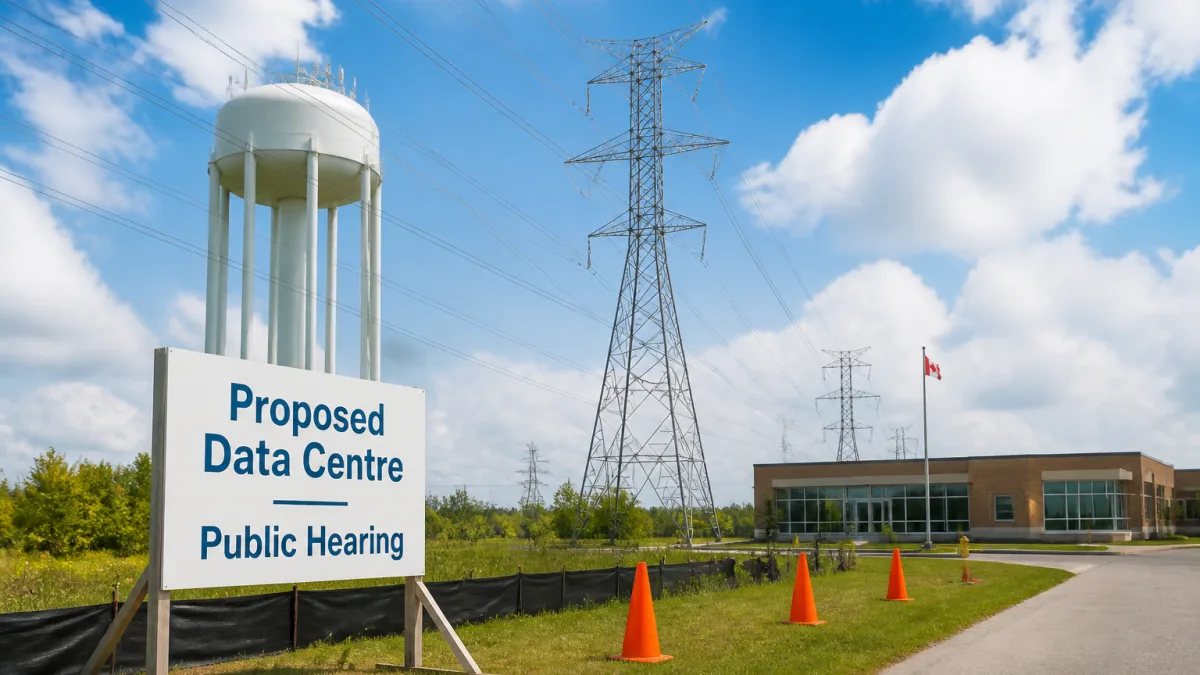
U.S. local meetings underline planning choices many cities face
Two communities in Kentucky — including a city named Georgetown — are moving early to shape how potential data centre projects would be handled, even before formal applications are filed. Their approaches, laid out this week at public meetings in Georgetown (Scott County) and neighbouring Nicholasville (Jessamine County), surface practical questions that any municipality may need to settle in advance: when to pause, what to study and how to signal expectations to industry and residents.
According to officials and residents who spoke at the meetings, Scott County has enacted a temporary moratorium on data-centre development. The pause — described locally as a time-out rather than a prohibition — was originally set to expire in September but has been extended to the end of December. The City of Georgetown, Kentucky, supported that county-level pause through a council resolution, despite having no formal applications before it.
In Nicholasville, by contrast, there is no moratorium. City staff said elected officials intend to take time to learn about the industry and hear public input before deciding on next steps. As in many places examining large-scale computing projects, residents there have asked about potential impacts tied to electricity demand, water use and noise.
“Every time I see it, it ends up that either somebody has electric bills that go up or water contamination, and we already have water issues here in Georgetown,” said resident Ken Beitler at the Kentucky meeting. “We cannot support putting in a data center.”
Doug Blackford, director of general government for Nicholasville, said, “What our board is choosing to do is to step back, get some time, and educate and learn more about them before they make any decisions.” He added that, to his knowledge, no applications have been filed there.
Why this matters for Georgetown readers
While these meetings took place in the United States, the questions they raise mirror the due diligence many Canadian municipalities undertake when considering projects that can place heavy loads on local grids and water systems. Data centres vary widely in size and technology, but they often concentrate power consumption and require consistent cooling. Communities evaluating such projects typically look at:
- Infrastructure capacity: Whether existing electricity and water systems can reliably support a new large user without degrading service or driving costly upgrades.
- Zoning and siting: What industrial lands are appropriate, how setbacks and sound mitigation would be handled, and how facilities fit with surrounding uses.
- Ratepayer and taxpayer exposure: How utility expansions would be funded and whether new demand could affect household bills.
- Emergency planning and resilience: Risks from extreme heat, drought, storms and how backup systems operate.
Temporary pauses, like the one in Scott County, are sometimes used to create space for technical studies and to draft standards on noise, landscaping, energy efficiency and community benefits. Other places, as in Nicholasville, keep options open while they gather information without enacting a formal pause.
At-a-glance: how two Kentucky communities are preparing
| Jurisdiction | Current stance | Timeline | Applications filed |
|---|---|---|---|
| Scott County (incl. Georgetown, KY) | Moratorium on data-centre development; city council signalled support | Extended through December | None reported at meeting |
| Nicholasville (Jessamine County) | No moratorium; study-first approach | Ongoing review | None reported at meeting |
Public input and policy sequencing
The Kentucky discussions show how municipalities can organize decisions before proposals land: set a temporary pause if needed; define study questions; consult with utilities; and record residents’ concerns on the public record. Even in the absence of applications, officials can benchmark noise standards, map electrical capacity and identify water constraints. Clear policies can also reduce uncertainty for prospective developers by outlining expectations on location, design and community impacts.
For residents, early engagement provides avenues to raise questions about costs, reliability and environmental safeguards. For councils and staff, it can help shape a checklist of conditions any large computing project would need to meet, from efficiency targets to connections with district energy or heat-recovery opportunities, where technically feasible. The Kentucky example underscores that timing matters: whether a community chooses a moratorium or a study-first path, the work typically begins before any application is submitted.
These public steps in Georgetown and Nicholasville are a reminder that decisions about fast-growing digital infrastructure are, at their core, local infrastructure choices. Establishing a clear process — and doing so early — can determine whether, how and where projects proceed.