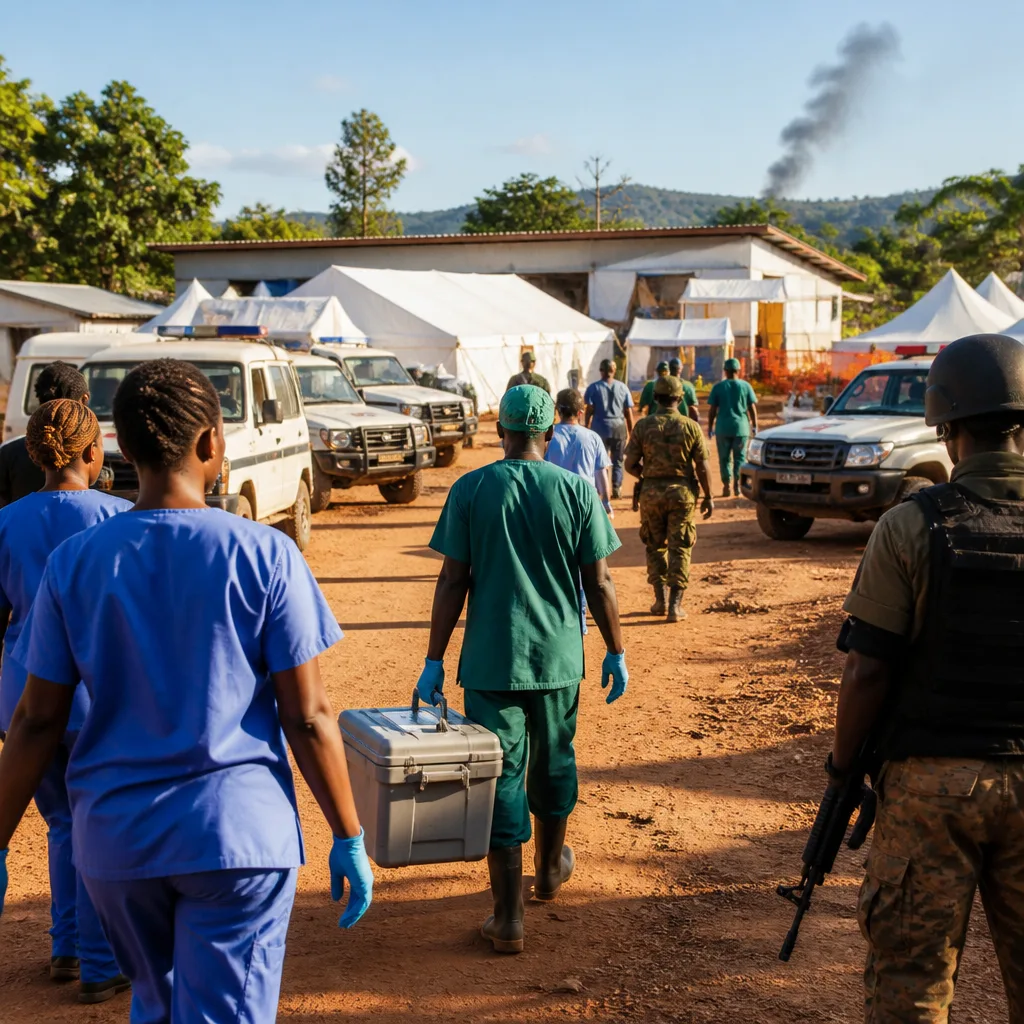
Neighbours opened fire on July 15 near an Ebola Treatment Centre (ETC) in Nyankunde, about 45 kilometres southwest of Bunia in the eastern Democratic Republic of the Congo (DRC), prompting the World Health Organization (WHO) and partner organisations to withdraw personnel and further slow the response to the country’s ongoing outbreak.
Security forces and health response collide
Following the clash, medical staff from the WHO, Africa CDC and the non-governmental organisation Samaritan’s Purse evacuated from Nyankunde, according to reporting on the incident. The movement of international teams away from the ETC reduces on-site capacity and complicates delivery of specialised care, infection control and patient transport.
“There was an attack yesterday and there are frequent attacks, actually since the end of 2025. The armed conflict has intensified,”
WHO Director-General Tedros Adhanom Ghebreyesus said during a press briefing after the incident, underscoring that the security situation in parts of eastern DRC has deteriorated and is hampering the outbreak response.
Outbreak context and operational challenges
The country is facing its 17th Ebola outbreak, driven by the Bundibugyo strain. While that strain has not been characterised as the most lethal Ebola variant, the current outbreak has spread rapidly: U.S. Centers for Disease Control and Prevention figures cited in reporting show 2,124 cases and 828 deaths recorded within two months, making it the fastest-spreading Ebola event on record.
Officials say the outbreak is centred in a mining town with a highly mobile population of migrant workers, a dynamic that increases transmission risk across the region. That mobility, combined with persistent armed conflict and deep community mistrust, complicates surveillance, vaccination, contact tracing and treatment.
Local health leadership reported that some national staff remained to care for patients at the Nyankunde ETC despite the evacuation of international personnel. Dr. Desire Duabo, head of the Nyankunde health zone, described heightened tension in the days following the shooting and said patients were being looked after by local teams.
Implications for the response
Security-driven withdrawal of international teams can have several consequences:
- Reduced clinical capacity at specialised treatment centres, particularly for critical-care management and infection prevention.
- Disruption of vaccination and surveillance programmes, which depend on mobile teams and logistic support.
- Increased risk of unmonitored transmission if contact tracing and community engagement are scaled back.
| Metric | Value |
|---|---|
| Reported cases (two months) | 2,124 |
| Reported deaths (two months) | 828 |
Humanitarian and health agencies have repeatedly emphasised that safe, sustained access to affected communities is essential to controlling Ebola. The persistence of armed groups in North Kivu and neighbouring provinces has repeatedly forced adaptations to operational plans, including temporary suspensions, remote support and reliance on local staff when international teams cannot safely operate.
International observers say that restoring secure access and rebuilding community trust will be key to resuming full-scale response activities and reducing transmission. For now, the evacuation from Nyankunde represents another setback in an outbreak already notable for its rapid spread and the layered challenges of conflict, population movement and mistrust.
This report is based on accounts from WHO briefings and local health officials as reported by Mongabay, and on data summarised by the U.S. Centers for Disease Control and Prevention.