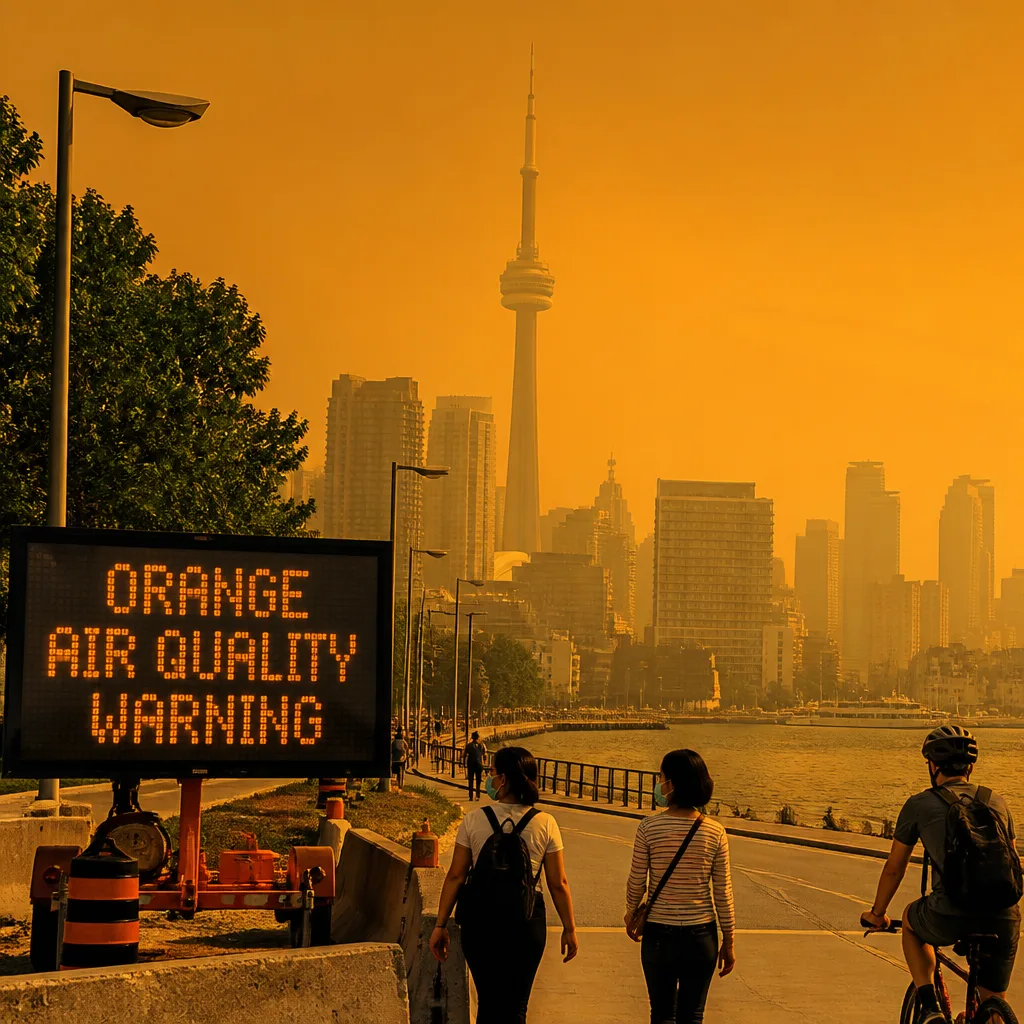
Toronto registered the worst air-quality reading in the world on Wednesday morning as smoke from numerous wildfires in northwestern Ontario rolled across the province, according to real-time data from the Swiss air monitoring firm IQAir.
Air readings and public-health alerts
IQAir reported a U.S. Air Quality Index (AQI) of 184 for Toronto, a level that placed the city ahead of Kinshasa, Democratic Republic of the Congo, and Delhi, India, in the company’s hourly rankings. The company said concentrations of fine particulate matter in the region were about 22.9 times the World Health Organization guideline value.
| Measure | Value |
|---|---|
| U.S. AQI (Toronto) | 184 |
| PM2.5 relative to WHO guideline | 22.9× |
Environment and Climate Change Canada issued an orange-level warning covering much of southern Ontario, citing "very poor air quality and reduced visibility." Communities named in the federal advisory include Toronto, Mississauga, Brampton, Hamilton, Burlington, Oakville and a long list of surrounding municipalities extending across the Golden Horseshoe and southwest Ontario.
Who is most at risk and what to do
Health authorities warn that smoke exposure can cause eye, nose and throat irritation, headaches or mild coughing. More severe but less common effects include wheezing, chest pain and difficulty breathing. The groups most vulnerable include older adults, pregnant people, infants and young children, those with existing chronic conditions, and people who work outdoors.
- Limit time outdoors and avoid strenuous activities.
- Reschedule or cancel outdoor sports and events.
- Keep windows and doors closed whenever possible.
- If you experience severe symptoms or a medical emergency, seek immediate care.
Federal forecasters said conditions could begin to improve by Friday morning, depending on how the fires evolve and how winds shift. Dozens of active wildfires in the province’s northwest have forced evacuations in some communities, and their smoke plumes have been carried southward into densely populated regions.
Why this matters to Canadians
The episode highlights how wildfires in remote regions can produce acute public-health hazards hundreds of kilometres away when weather patterns carry smoke into urban centres. For Canadians, the consequences extend beyond immediate health effects: poor air quality can disrupt transit and outdoor work, strain emergency services and affect vulnerable populations disproportionately.
As climate-driven changes lengthen and intensify fire seasons in parts of Canada, episodic events that compromise air quality in major cities are likely to recur. Authorities and residents face a continuing need to monitor forecasts, protect vulnerable groups and adapt public-health responses to fast-moving smoke events.
For now, federal and provincial agencies urge residents in affected areas to follow the precautions laid out by Environment and Climate Change Canada and to stay updated as conditions evolve.