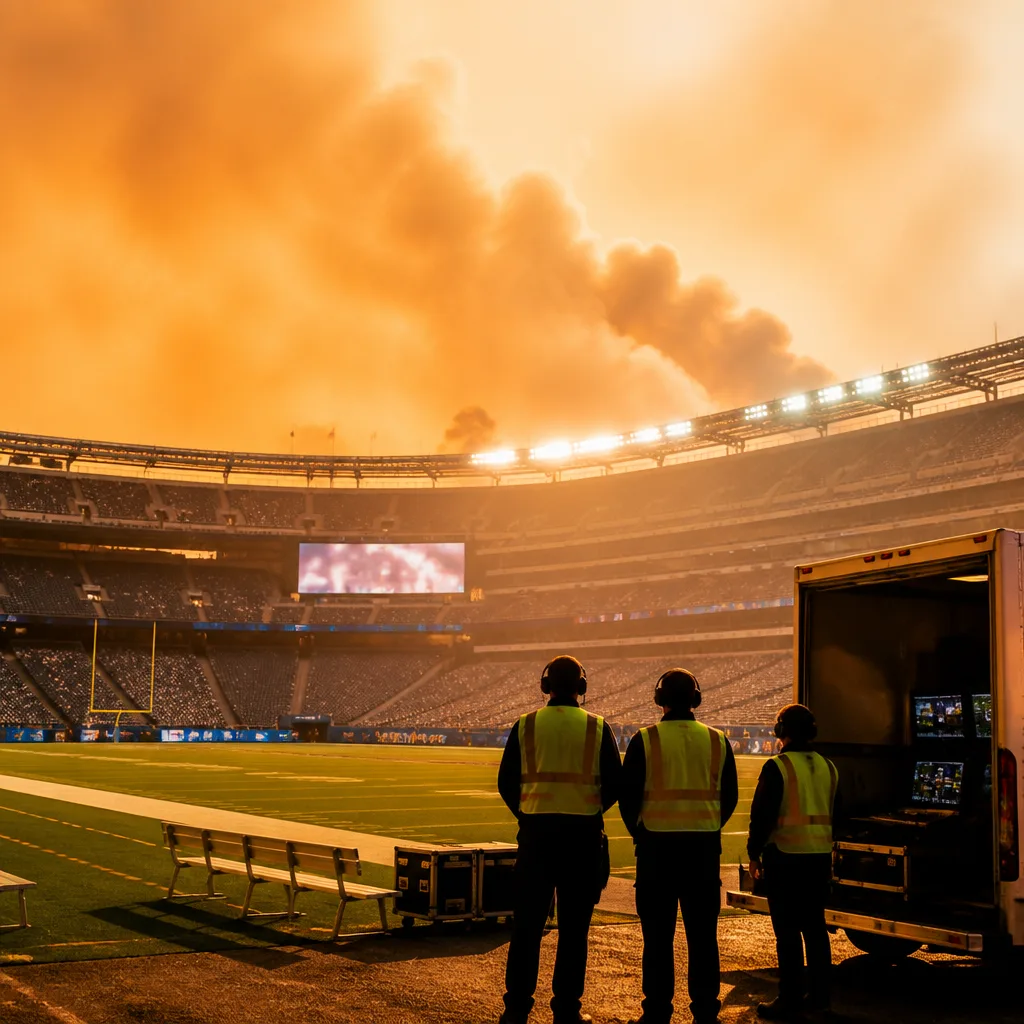
Smoke from Canadian wildfires has drifted into the New Jersey Meadowlands and is being closely monitored ahead of Sunday’s World Cup final at MetLife Stadium in East Rutherford. Medical advisers say a postponement remains unlikely at present but could become necessary if air quality deteriorates or heat intensifies.
Health experts urge caution as officials watch conditions
Dr. Myles Druckman, senior vice-president and global medical director at International SOS, said organisers will likely track air-quality readings and weather trends through the day and could opt to delay kickoff if conditions become hazardous.
“I think that if we get into that kind of situation, then we’ll probably see a delay, but we’re all hoping that that’s not going to be the case.”
Druckman, a Toronto native and McGill University alumnus now based in Santa Monica, California, noted that the combination of smoke and high temperatures poses a particular risk to spectators and players. He described recent episodes of reduced visibility in the region — sometimes called “yellow-outs” — as examples of when event timing might be reconsidered.
Local forecasts, cancellations already linked to Canadian fires
Air-quality forecasts from the World Health Organization indicated an expected improvement to moderate levels in East Rutherford ahead of the match, but uncertainty remains, particularly given a forecast of up to 3.17 centimetres of rain for Saturday that could alter smoke dispersion.
Across North America, wildfire smoke has already disrupted sporting events this week. Examples include:
- Major League Soccer: Vancouver Whitecaps game in Chicago postponed.
- Canadian Premier League: Forge FC vs. Pacific FC in Hamilton rescheduled.
- Major League Baseball: New York Mets and Philadelphia Phillies advanced start time because of air-quality concerns.
| Item | Detail |
|---|---|
| Predicted rainfall (Saturday) | 3.17 cm |
| Forecast air quality (East Rutherford) | Moderate (WHO) |
The prospect that Canadian wildfire smoke could affect one of the most-watched sporting events on the planet highlights how domestic climate-driven hazards carry cross-border consequences. For Canadians, it serves as a reminder that fires burning at home can produce far-reaching public-health impacts and disrupt international schedules, travel and tourism.
Organisers and health officials will be balancing the risks to attendees and athletes against the logistical and commercial complications of postponement. With the situation fluid, authorities have signalled they will be guided by up-to-date air-quality indices and weather developments as the event approaches.
For Canadians tracking the wildfire season, the episode underscores the interconnected nature of climate risks: smoke plumes do not respect international borders, and their unpredictability can ripple into major global events.