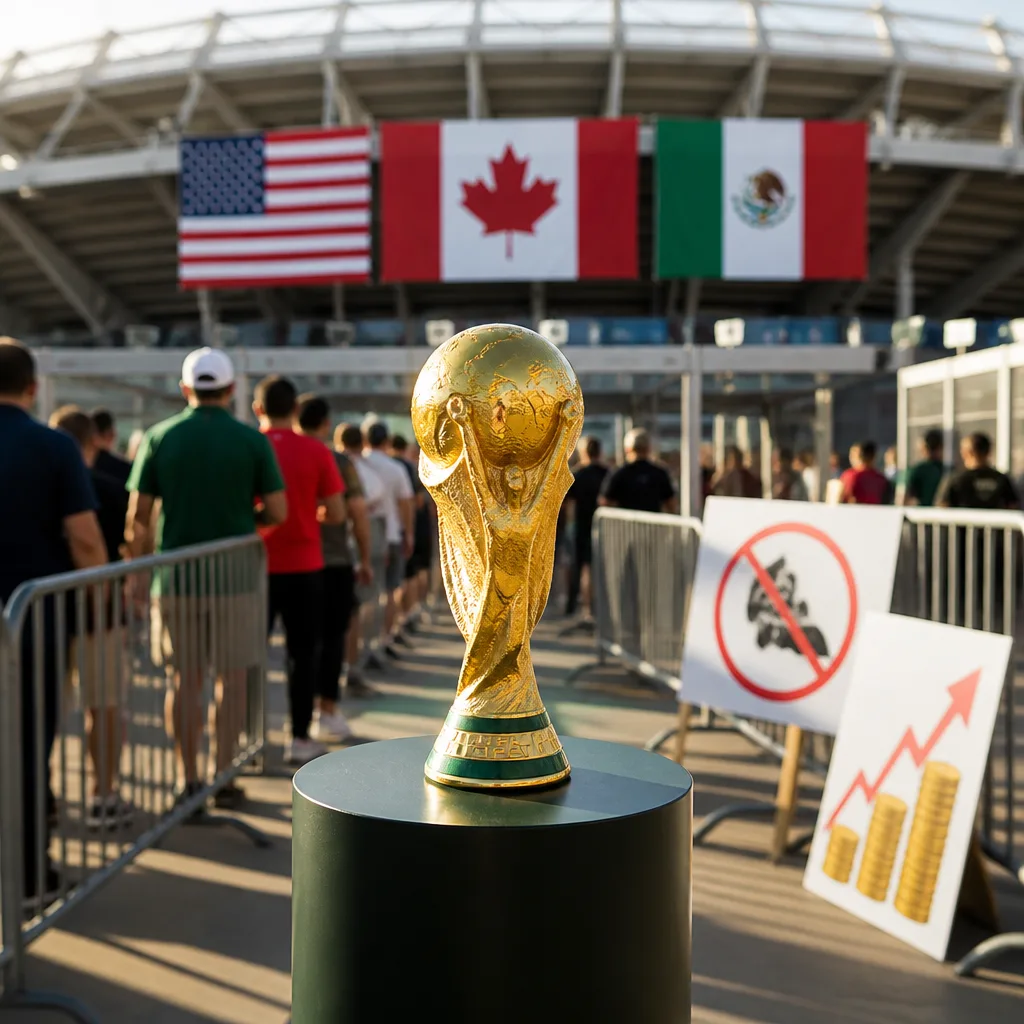
Donald Trump is set to present the World Cup trophy to the winner of Sunday’s final between Argentina and Spain, framing the month-long tournament as a victory for the United States even as the co-hosted event tested cross-border coordination with Canada and Mexico.
“It turned out we were a soccer country, and I think it’s going to remain,” Trump said Friday at a FIFA reception in New York City. “This has really brought the world together.”
The White House has treated the championship match as the culmination of more than a year of planning for what officials billed as the biggest World Cup in history, managed alongside co-hosts Canada and Mexico. That effort, however, unfolded amid a series of policy and operational tensions: hard-line migration rules that kept some supporters and officials from entering the U.S., political sparring over federal cooperation with cities, a public backlash over high ticket prices, and disputes over transit costs near match venues.
Cross-border stakes for Canada
For Canada, which shared hosting duties and logistics, the tournament became a test of trilateral coordination. Canadian organizers worked within a framework where U.S. visa decisions influenced who could cross the border to attend games or work them, while local authorities on both sides navigated cost-sharing and security arrangements. The White House’s approach drew warnings from human rights groups and generated uncertainty for travelling fans and officials.
As the tournament began, global scrutiny intensified over cases that illustrated the stakes. The administration denied entry to a Somali referee recognized for his officiating, and tensions rose sharply after Trump launched a war with Iran, leaving the U.S. side to handle an Iranian national team whose fans and some support staff were barred from entering and were based across the border in Tijuana. Those decisions reverberated through scheduling, team logistics and fan travel, with knock-on effects for co-hosts.
Politics meets the pitch
Trump at times threatened to move matches out of cities that resisted cooperation with federal immigration authorities. In the lead-up to kickoff, local governments also sparred with FIFA over transit funding, adding friction to late-stage preparations. Cost concerns and accessibility issues fed public frustration, particularly over ticket pricing, even as social media flooded with stories of visitors sampling quintessential American fare.
Despite those pressures, the narrative shifted as the games progressed. The administration’s focus turned to showcasing the U.S. as a hospitable sports host, a message Trump underscored on the eve of the final. The planned on-field trophy handoff is set to cap a tournament that blended geopolitics, border management and football spectacle across the Canada–U.S.–Mexico partnership.
Why it matters for Canadians
- Co-host accountability: Canada’s reputation and event legacy are tied to how the tri-national operation handled visas, mobility and stadium access.
- Policy ripple effects: U.S. migration and security decisions shaped travel and workforce flows that affected Canadian organizers and fans.
- Cost debates: Disputes over transit and ticket pricing underscore the public cost of mega-events—a live issue for Canadian cities weighing future bids.
Flashpoints that shaped the tournament
| Issue | Illustration from the tournament |
|---|---|
| Migration and visas | Entry denied to a Somali referee; restrictions on Iranian fans and personnel |
| Geopolitical tensions | Pressure intensified after a war with Iran was launched |
| Local cooperation | Trump floated moving games from cities that resisted federal immigration cooperation |
| Costs and access | Backlash over high ticket prices; clashes over transit costs |
As final preparations were made in New York, Trump cast the broader experience as proof of the United States’ emergence as a football nation. The statement landed after months in which U.S. policy choices rippled through a tournament shared with Canada and Mexico, leaving co-hosts to balance pageantry with the practicalities of moving teams, officials and fans across borders.