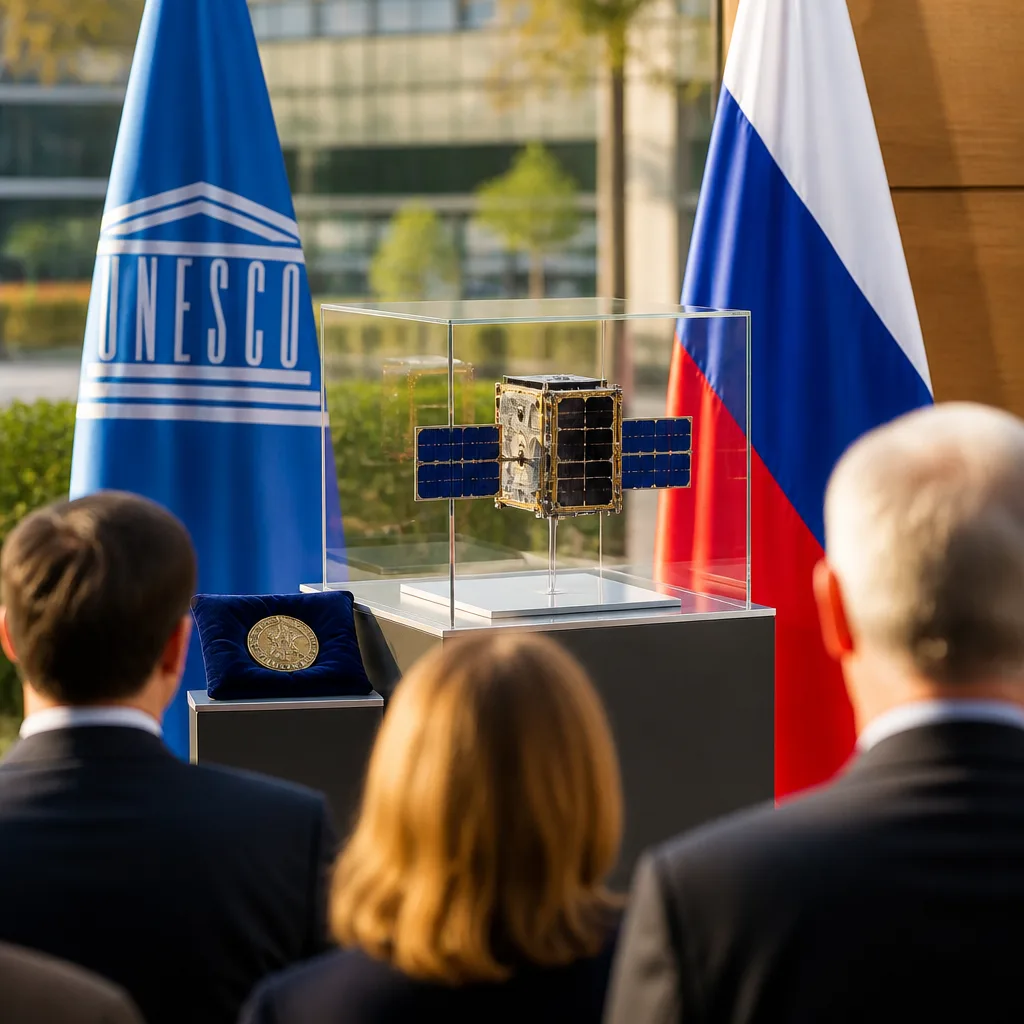
Pan Jianwei, a leading figure in quantum optics and communications, has been named a recipient of the UNESCO-Russia Mendeleev International Prize in the Basic Sciences, becoming the first scientist from China to receive the award. The ceremony took place at UNESCO headquarters in Paris on July 17, 2026.
Recognition for satellite-enabled quantum breakthroughs
UNESCO cited Pan for his "pioneering contributions to large-scale secure quantum communications and scalable quantum computation". He is based at the University of Science and Technology of China and leads research that has moved several concepts from theoretical proposals toward operational demonstrations.
Pan's team developed the Quantum Experiments at Space Scale (QUESS) satellite — widely known as Micius — launched in August 2016. Using that platform, Chinese researchers reported achievements such as satellite-to-ground quantum key distribution and ground-to-satellite quantum teleportation, demonstrating quantum links across thousands of kilometres.
From demonstrations to a global quantum network?
UNESCO also noted that Pan's group has demonstrated quantum computational advantage, a milestone indicating quantum processors outperform certain classical computations. Those results, together with space-based quantum links, have been framed as advancing the practical prospect of a global quantum network.
- The prize is awarded annually and was established in 2019.
- It is named after Dmitri Mendeleev, the chemist noted for the periodic table.
- Two laureates are chosen each year; this year’s co-recipient was Sergei S. Sheiko of the University of North Carolina at Chapel Hill, recognised for work in polymer physics and materials science.
| Item | Detail |
|---|---|
| Prize | UNESCO-Russia Mendeleev International Prize in the Basic Sciences |
| Established | 2019 |
| Laureates (2026) | Pan Jianwei; Sergei S. Sheiko |
| Noted contributions | Satellite quantum key distribution; quantum teleportation; quantum computational advantage |
While the award underscores substantial technical progress, experts caution that integrating quantum processors and widespread secure quantum links into routine infrastructure remains complex. Demonstrations such as those achieved with Micius show feasibility at scale, but they do not eliminate remaining engineering, standards and interoperability challenges.
For Canada and other nations watching the quantum race, the prize highlights both the accelerating pace of fundamental advances and the geopolitical and technological implications of quantum-secure communications and computing. Scientific honours such as the Mendeleev prize serve as markers of where laboratory capabilities are converging with ambitions for secure global networks and next-generation computation.