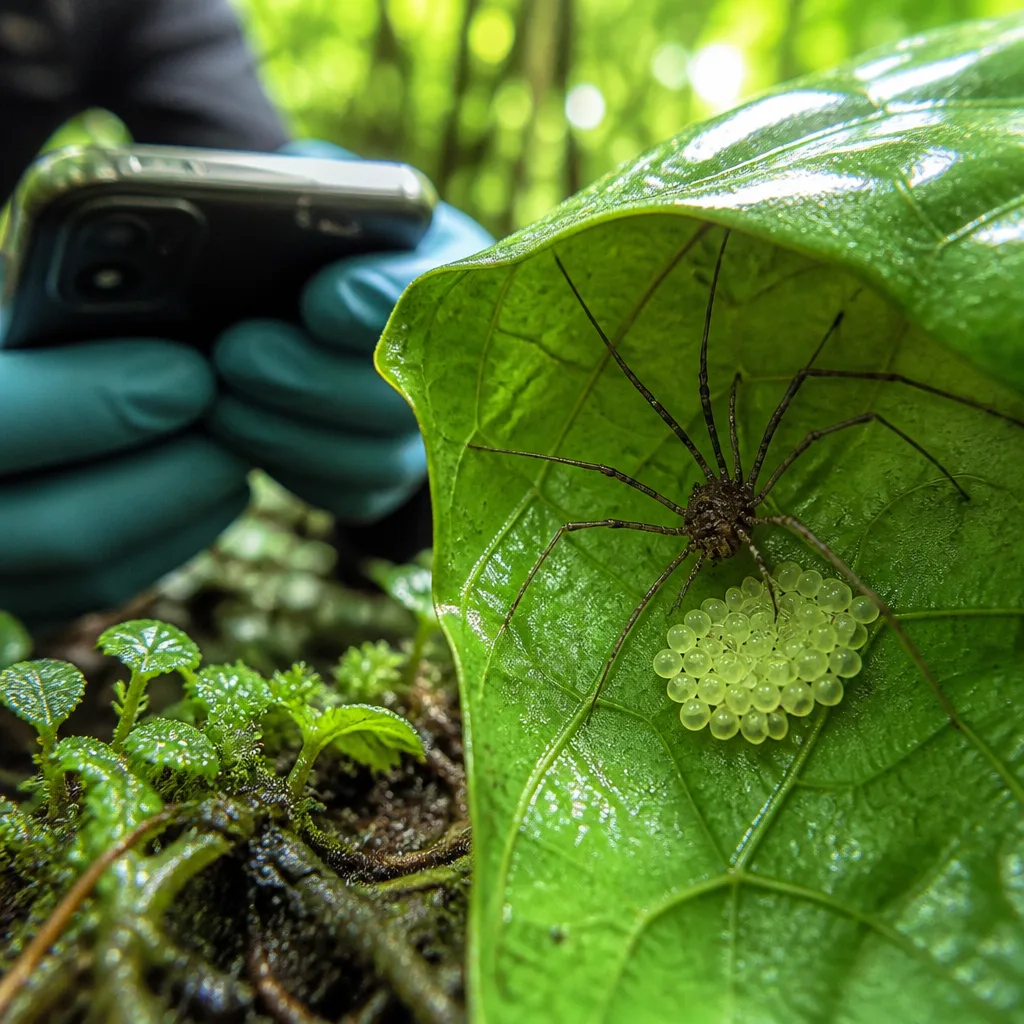
Citizen scientists have helped biologists crack a long‑standing evolutionary puzzle: why paternal care, vanishingly rare across animals, shows up again and again in harvestmen—arachnids often called “daddy longlegs”. A new study in the Zoological Journal of the Linnean Society, led by researchers at the University of São Paulo, draws on crowd‑sourced observations to more than double the number of species known to guard eggs and tend offspring, offering the statistical power to trace how such care evolved across the group.
Parental care by males is exceptional in nature. Yet within the order Opiliones, which includes more than 6,900 described species, multiple lineages show fathers that stay with clutches and perform egg‑tending behaviours. By mining vetted records submitted to the citizen science platform iNaturalist, the team expanded a dataset that had taken three decades of traditional fieldwork to assemble. The result: a jump from 80 species with documented care to 142, a threshold sufficient to reconstruct the evolutionary pathways that produced devoted dads across the tree of harvestmen.
“It’s a tremendous source of information that can improve the speed with which we accumulate biological information,” explains study author Glauco Machado in a press release. “I would never be able to do this by visiting museums around the world. It would be very expensive, very time-consuming, but here we conducted the search in only one week.”
From trickle to torrent: what citizen data changed
Historically, progress on this question was slow. Field teams and museum work accrued records of egg‑guarding over decades, but the pace limited broad comparative analysis. Incorporating public uploads—photographs and notes from naturalists worldwide—compressed that timeline dramatically. After expert screening, those contributions filled geographical and taxonomic gaps, capturing behaviours often missed outside brief seasonal windows when harvestmen are most active in late summer and autumn.
- Scale: Vetted iNaturalist reports moved the dataset from 80 to 142 species with parental care.
- Speed: A targeted search aggregated key observations in about one week.
- Scope: The richer sample allowed researchers to decipher patterns in the evolution of paternal care across Opiliones.
Why harvestmen matter for the evolution of care
Harvestmen are arachnids, not spiders, though they share the same broader group. The study points to a continuum of behaviours—guarding, tending and other forms of egg care—expressed by different species. This diversity within a single order makes harvestmen a natural experiment for understanding how and why male care can persist. With more species documented, researchers can test evolutionary hypotheses with greater confidence, comparing lineages where fathers watch over clutches against close relatives that do not.
| Measure | Before citizen data | After citizen data |
|---|---|---|
| Species with documented care | 80 | 142 |
| Time to aggregate new records | ~30 years of fieldwork | ~1 week (targeted search) |
| Total described Opiliones | 6,900+ species (recent estimates) | |
Quality control and what comes next
While the study underscores the scale advantages of citizen science, it also relies on careful vetting to ensure behavioural identifications are accurate. The authors report that the influx of public records did not replace expert work; it focused and accelerated it. That approach—curating large volumes of reliable, time‑stamped observations—could be applied to other questions where rare behaviours are unevenly distributed across species and seasons.
One photographed example, a male Opilio canestrinii perched on a geranium, illustrates the kinds of close‑range encounters naturalists routinely capture. Such images, once scattered in personal archives, now feed into shared databases that let scientists spot patterns at continental scales.
A model for future biodiversity research
Beyond harvestmen, the study is a proof‑of‑concept for leveraging public participation to address long‑tail biological phenomena—behaviours that are common enough to matter ecologically but rare enough to evade small research teams. As platforms mature and verification improves, the combination of pro‑am collaboration, museum collections and targeted field studies could shift how evolutionary biology is done, especially for diverse groups with patchy historical coverage.
The work also reframes the public’s role in research. The path from a backyard photograph to a peer‑reviewed dataset is now short and practical. For scientists, the message is clear: strategic use of well‑curated citizen observations can turn a slow trickle of data into a torrent—fast enough to answer questions once postponed for lack of evidence.