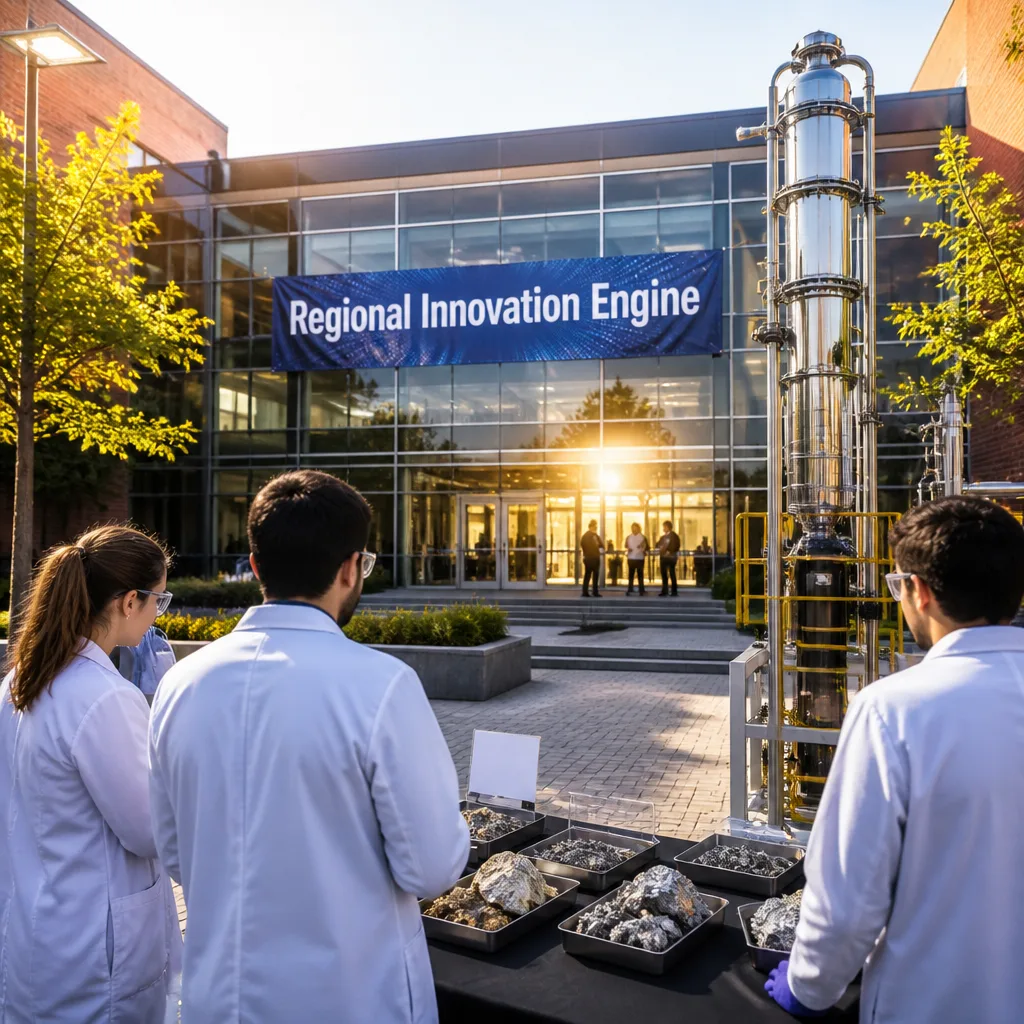
The U.S. National Science Foundation has selected the Critical Materials Crossroads consortium as one of its Regional Innovation Engines, making the partnership eligible for up to US$160 million in support over a ten-year period.
The consortium is led by the University of Missouri–Kansas City and counts industry collaborators including ReElement Technologies, a U.S. firm in which American Resources Corporation holds a minority stake. ReElement is being presented as a provider of proprietary refining and separation know-how, commercial-scale production capability and industrial relationships to back research, workforce development and efforts to commercialize technologies aimed at strengthening domestic and allied critical-mineral supply chains.
"The Critical Materials Crossroads initiative brings together the research, industrial, commercial and government partners needed to strengthen America's domestic critical mineral supply chain," said Kirk Taylor, Chief Financial Officer of ReElement Technologies.
What the consortium intends and who will contribute
According to the consortium, its stated ambitions within a decade include delivering a total economic impact of US$40 billion and increasing the state gross domestic product by US$17 billion annually. The partnership frames its work around moving refining and separation technologies closer to commercial deployment and expanding the skilled workforce needed to operate those facilities.
ReElement's role, as outlined in the announcement, centres on providing technology and capacity to accelerate commercialization efforts and domestic rare-earth and critical-mineral production. The company emphasised existing collaborations with federal agencies and commercial partners as part of its case for contributing to the initiative.
Why this matters nationally
- Strategic supply chains: Critical minerals and rare-earth elements underpin electric vehicles, renewable-energy systems, defence applications and electronics; enhancing domestic refining capacity is a policy priority.
- Public–private coordination: The NSF Engine model funnels long-range federal support toward university-led consortia that pair academic research with industry-scale capabilities.
- Commercialisation and workforce: The stated focus on moving lab discoveries into production spotlights near-term manufacturing, regulatory and training challenges.
Funding and timelines
| Item | Detail |
|---|---|
| NSF designation | Regional Innovation Engine |
| Maximum eligible funding | US$160 million over 10 years |
| Stated 10-year impact goal | US$40 billion total economic impact; US$17 billion annual state GDP increase |
Further operational details — including specific project timelines, funding tranches, participating firms beyond ReElement and the precise mechanisms for technology transfer and workforce training — were not specified in the announcement. The NSF Engine award process typically ties continued funding to milestone achievement, collaboration outcomes and measurable regional benefits.
This selection places critical-mineral refining and separation squarely within federal efforts to shore up supply chains deemed essential to advanced manufacturing and national security. The announcement also reinforces an ongoing shift in research policy: pairing university-led research ecosystems with industry partners that can scale processes to commercial volumes.