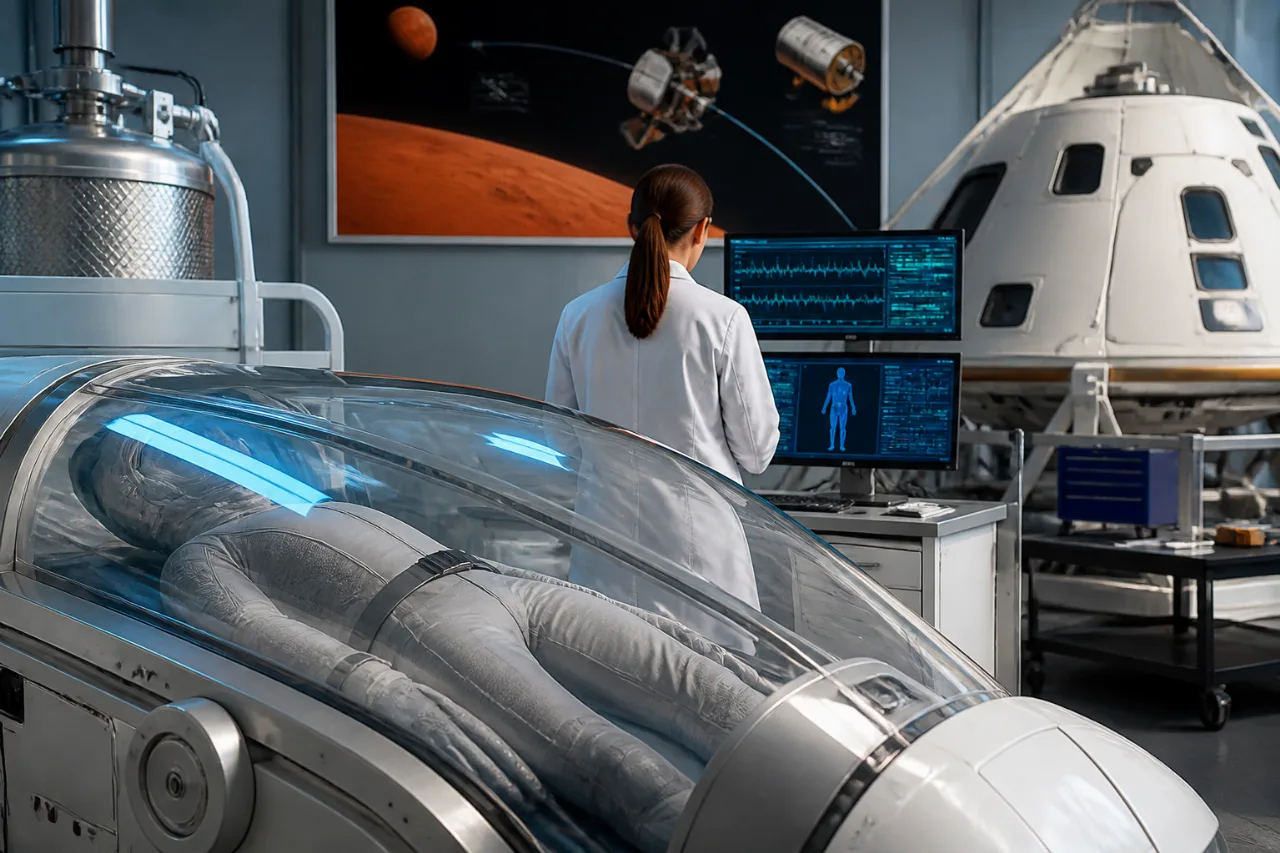
Space agencies are investigating whether putting crews into a controlled, reversible state akin to animal hibernation could blunt the health hazards of months-long missions and make crewed journeys to Mars more feasible. Backed by teams funded in part by the European Space Agency (ESA) and NASA, researchers are mapping out how some animals radically slow their physiology — and whether a safe version can be induced in humans who do not naturally enter torpor.
Ancient survival strategy, modern mission problem
Long-duration spaceflight layers risk upon risk. Persistent exposure to ionizing radiation elevates cancer and tissue damage concerns. Microgravity steadily erodes muscle mass and bone density, and can change vision. Confined living for months can tax mental health. On Earth, many mammals, birds and even some fish sidestep energy scarcity by dramatically reducing metabolism for extended periods. That 250‑million‑year‑old adaptation allows hibernators to conserve energy without eating or drinking and to withstand cold while largely immobile — and, crucially, without experiencing hunger or thirst.
Translating that strategy to human spaceflight has intuitive appeal. Experimental and observational work suggests torpor may confer resilience against several threats relevant to space, including radiation damage and degeneration of bone and muscle. In principle, lowering metabolic demand could also shrink the mass of food and water needed for a voyage, easing payload constraints. For crews sharing tight quarters, extended unconsciousness could reduce the cumulative psychological strain of isolation and monotony.
“This is a very promising area,” says Christiane Hahn, who oversees space biology research at Esa.
The catch: humans are not natural hibernators
Unlike ground squirrels, bats or bears, humans have not evolved a seasonal torpor switch. That leaves scientists with two intertwined challenges: inducing a deep, stable metabolic slowdown safely, and returning patients to baseline physiology without organ injury after weeks or months of inactivity and fasting. Research groups supported by ESA and NASA are dissecting how hibernating species down‑shift and then reawaken with minimal ill effects, seeking molecular and neurological levers that could be translated to clinical protocols.
Investigators are probing how hibernators protect tissues from low blood flow, maintain bone integrity without weight‑bearing, and preserve muscles despite disuse. They are also examining how these animals keep oxidative stress and inflammation in check during arousal. Any eventual human approach would have to address parallel risks, from blood clotting to immune dysregulation, and safeguard the brain during prolonged unconsciousness.
Potential mission payoffs — and hard questions
If medically feasible, induced torpor could relieve multiple bottlenecks in planning for interplanetary flight. The concept touches several mission constraints at once:
- Health protection: Slower metabolism and immobilization may mitigate muscle and bone loss and reduce some radiation effects.
- Logistics: Lower metabolic needs could cut food and water requirements, easing payload mass.
- Behavioural health: Time spent in torpor could lessen the psychological toll of confinement.
Even with those potential advantages, daunting engineering and medical hurdles remain. Spacecraft would need systems to maintain safe temperatures, ventilation and waste handling for torpid passengers. Medical teams would require reliable monitoring and autonomous controls capable of adjusting sedation, nutrition substitutes, and fluid and electrolyte balance over long periods without continuous, on‑site clinical oversight. Contingency procedures would be needed for emergencies mid‑torpor, including partial arousal or unexpected illness.
From animals to astronauts: what scientists are learning
Hibernation is not a simple on/off state. Species exhibit a spectrum of torpor patterns, from daily cycles to multi‑month dormancy. Researchers studying these rhythms are tracing how organ systems tolerate near‑standstill physiology. Particularly relevant for space is how bones in hibernators avoid drastic calcium loss despite near‑zero loading, and how muscles preserve structure when protein turnover slows. Investigations into hibernators’ DNA repair and antioxidant systems could intersect directly with countermeasures for space radiation.
There is also growing interest in how the brain withstands prolonged inactivity without cognitive decline. Lessons there could inform not only astronaut care but also terrestrial medicine, such as protecting the brain and other organs during complex surgeries or after traumatic injury, where controlled metabolic suppression might buy time.
Earthside implications
The quest for torpor has applications beyond spaceflight. Technologies that safely induce deep metabolic reductions could aid emergency medicine by stabilizing patients after severe blood loss, stroke or cardiac arrest, extending the treatment window. Intensive care units might benefit from protocols that reduce metabolic demand while minimizing muscle wasting. Understanding how hibernators reawaken without clotting or immune complications could inspire better recovery pathways for patients immobilized for long periods.
For now, the promise coexists with uncertainty. The human body does not naturally enter hibernation, and translating nature’s design into medicine and mission architecture will require carefully phased research. But the road map is taking shape: decode the biological switches perfected over geological time, test them cautiously in clinical settings, then adapt them to the unforgiving conditions of space.
As planners consider crewed missions beyond low Earth orbit, the idea of bringing a piece of Earth’s evolutionary toolkit along — not a new propulsion system or a heavier shield, but a biologically informed pause button — is moving from the realm of speculation toward a research agenda shared by major space agencies.