Scientists have identified a rare class of meteorite as the most likely culprit behind the mass extinction that ended the age of dinosaurs 66 million years ago. An international team including researchers at the University of British Columbia found that the impactor’s chemical signature matches a CO chondrite, a type of carbonaceous meteorite uncommon in collections on Earth. The finding, published in Science Advances, suggests that the devastation that wiped out about 75 per cent of species was driven chiefly by planet-cooling dust and debris lofted into the atmosphere, rather than sulfur released from the object itself.
Nickel isotopes trace an uncommon impactor
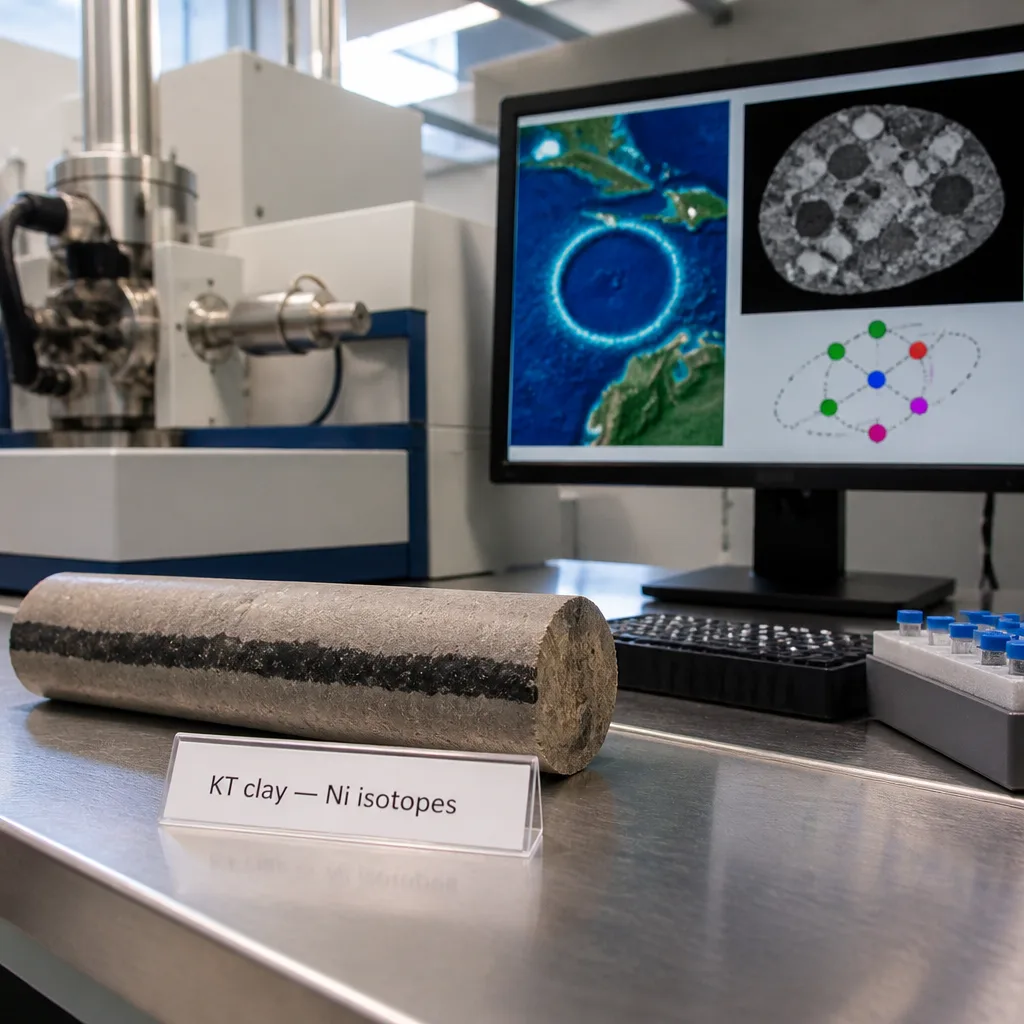
The team from UBC, Paris, Brussels and Vienna analysed nickel isotopes preserved in the thin, global layer of KT clay that formed immediately after the Chicxulub impact. That layer holds only trace material from the projectile because it vaporized on contact, leaving scarce but telling chemical fingerprints.
"Carbonaceous chondrites of the Ornans class are definitely not like the typical meteors you find in museum collections," says Dr. Philippe Claeys, who worked on the study as a visiting professor at UBC. "A CO contains much less volatile elements -- like carbon, zinc, water and particularly sulfur -- than other classes of meteorites we've discovered so far on Earth. It doesn't alter our theory of what caused the extinction event -- but it makes it less likely that sulfur contained in the impactor was the smoking gun. The fine debris thrown into the atmosphere would have the primary factor."
Scientists from the Institut de Physique du Globe and Université de Paris conducted highly precise nickel isotope measurements on samples gathered over many years. According to the researchers, those isotopic ratios align with a CO chondrite identity for the impactor, pointing to a composition that is poorer in volatile elements than other carbonaceous classes.
From sulfur to dust: a shift in mechanism
Because CO chondrites are characteristically low in sulfur, the study lessens the likelihood that sulfur contained within the meteorite was the dominant trigger for global climate disruption. Instead, the results favour a scenario in which massive amounts of fine particulate debris blasted into the atmosphere, reflecting sunlight and plunging the planet into prolonged cooling. That cooling, in turn, would have disrupted photosynthesis and ecosystems on land and in the oceans, compounding the extinction cascade observed in the fossil record.
The work, the authors note, does not overturn the prevailing impact hypothesis; rather, it refines it. By narrowing the identity of the impactor, the study helps constrain models of how much material was injected high into the atmosphere and for how long it persisted—key parameters for simulating climate effects in the aftermath.
Why a CO chondrite matters
- Rarity: CO chondrites are uncommon in terrestrial meteorite collections, highlighting an unusual source for a world-changing event.
- Volatile-poor signature: Lower abundances of volatile elements, including sulfur, shift attention to dust-driven cooling rather than sulfur-driven atmospheric chemistry.
- Isotopic fingerprint: Nickel isotope ratios in the KT layer offer a durable tracer linking the global boundary clay to a specific meteorite class.
Only a minute fraction of the original object persists in the boundary clay, making such isotopic work technically demanding. As Dr. Claeys—of Vrije Universiteit Brussel and currently visiting UBC’s Pacific Centre for Isotopic and Geochemical Research with Earth, Ocean and Atmospheric Sciences—put it: the material is vanishingly scarce, but it carries the crucial chemical clues.
Context: piecing together a planetary catastrophe
The Chicxulub impact is widely recognized as the catalyst for a rapid, global extinction that eliminated non-avian dinosaurs and reshaped the trajectory of life on Earth. Determining the impactor’s composition helps scientists estimate the quantities and types of aerosols and particulates injected into the upper atmosphere. Those inputs, in turn, influence the severity and duration of sunlight reduction, surface cooling and ecological stress.
The new study strengthens the case that fine-grained ejecta dominated the initial climate forcing, fitting with sedimentary evidence of a dust-rich, globally distributed layer. With a volatile-poor impactor, less sulfur from the object itself would have entered the atmosphere, focusing attention on airborne debris as the proximate climate driver in the critical months to years after impact.
At a glance: what sets CO chondrites apart
| Meteorite class | Relative sulfur content | Implications for impact climate forcing |
|---|---|---|
| CO (Ornans) chondrite | Lower | Emphasizes dust-driven cooling from fine debris |
| Other carbonaceous chondrites | Higher (relative) | Greater potential role for sulfur from the impactor |
By tying the KT boundary’s nickel isotope signature to a CO chondrite, the authors provide a clearer starting point for future climate and environmental reconstructions of the extinction interval. That clarity also sharpens questions about the impactor’s provenance within the solar system and the frequency with which such volatile-poor bodies cross Earth’s path—topics that will likely draw further geochemical and dynamical investigation.