
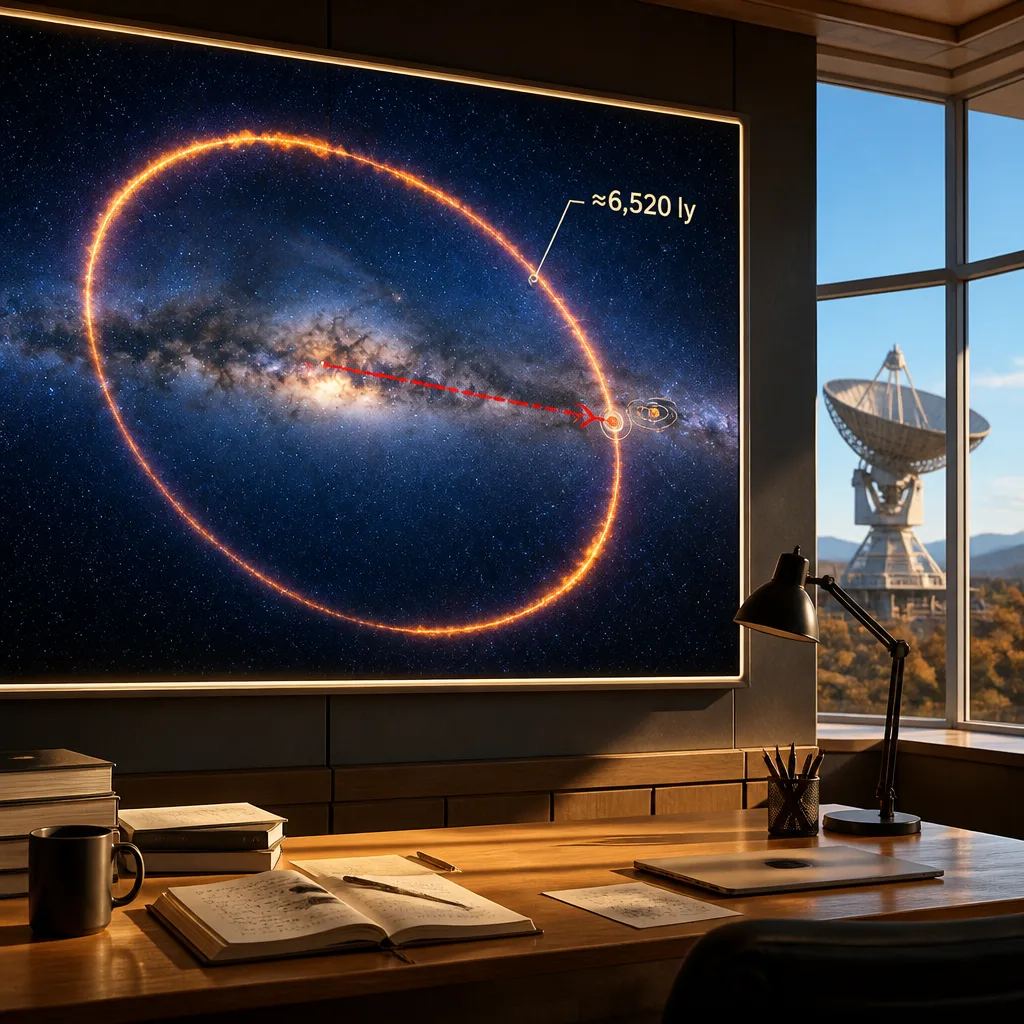
Researchers now say a striking radio structure long thought to rise from the Milky Way’s core is not a colossal outflow from the nucleus at all but a nearby, closed loop of material. The re‑interpretation, published in Astronomy & Astrophysics, places the object about 6,520 light‑years from Earth and significantly revises its physical scale and likely origin.
Background and new result
The feature, historically labelled the Galactic centre lobe (GCL) because it appears to balloon above the turbulent central regions in radio maps, has been debated for roughly 40 years. Explanations ranged from a supernova remnant to an ancient eruption from the Milky Way’s central black hole. A team led by astrophysicist Kathryn Kreckel of Heidelberg University reports that the object is neither at the Galactic nucleus nor a true lobe; instead it is a closed loop much closer to the Solar System.
“a Rorschach test for Galactic astrophysics.”
The closer distance reduces the implied size by a large factor compared with the assumption that it lay at roughly 26,000 light‑years — the approximate distance to the Galactic centre — and makes a dramatic central‑engine origin unnecessary. At the nearer location, the structure is consistent with a bubble carved and ionized by local stellar activity rather than a monstrous remnant of a supermassive black hole episode.
Why the confusion persisted
Untangling this long‑running puzzle required overcoming several observational challenges:
- Distance ambiguity: measuring distances along crowded sightlines toward the Galactic centre is intrinsically difficult.
- Line‑of‑sight overlap: the inner Galaxy is densely populated with stars, molecular clouds and dust that overlap in projection.
- Background contamination: parts of the lower half of the structure are projected against complex background emission, complicating morphological interpretation.
Implications
Reclassifying the GCL as a nearer closed loop changes how astronomers interpret other large‑scale radio features near the Galactic centre. Features once thought to trace extraordinary nuclear events may in some cases be foreground structures. The result highlights how projection effects can lead to dramatic misinterpretations when distance constraints are weak.
The study underscores the need for careful three‑dimensional mapping of the Galaxy when assigning large physical scales to visually impressive structures. While the object will no longer be treated as evidence for an enormous central eruption, it remains of scientific interest as an example of how stellar activity can sculpt the interstellar medium.
Comparative data
| Assumed location | Distance (light‑years) | Interpretation |
|---|---|---|
| Galactic centre (previous assumption) | ~26,000 | Massive lobe from nuclear activity |
| Revised location (Kreckel et al.) | ~6,520 | Closed loop, likely local stellar bubble |
The paper, and the proposed informal rename to the “greatly confused loop,” mark the close of a four‑decade struggle to separate genuine nuclear features from foreground objects. Future surveys that provide more precise distances and velocity information along the inner Galaxy will be essential to prevent similar misidentifications.