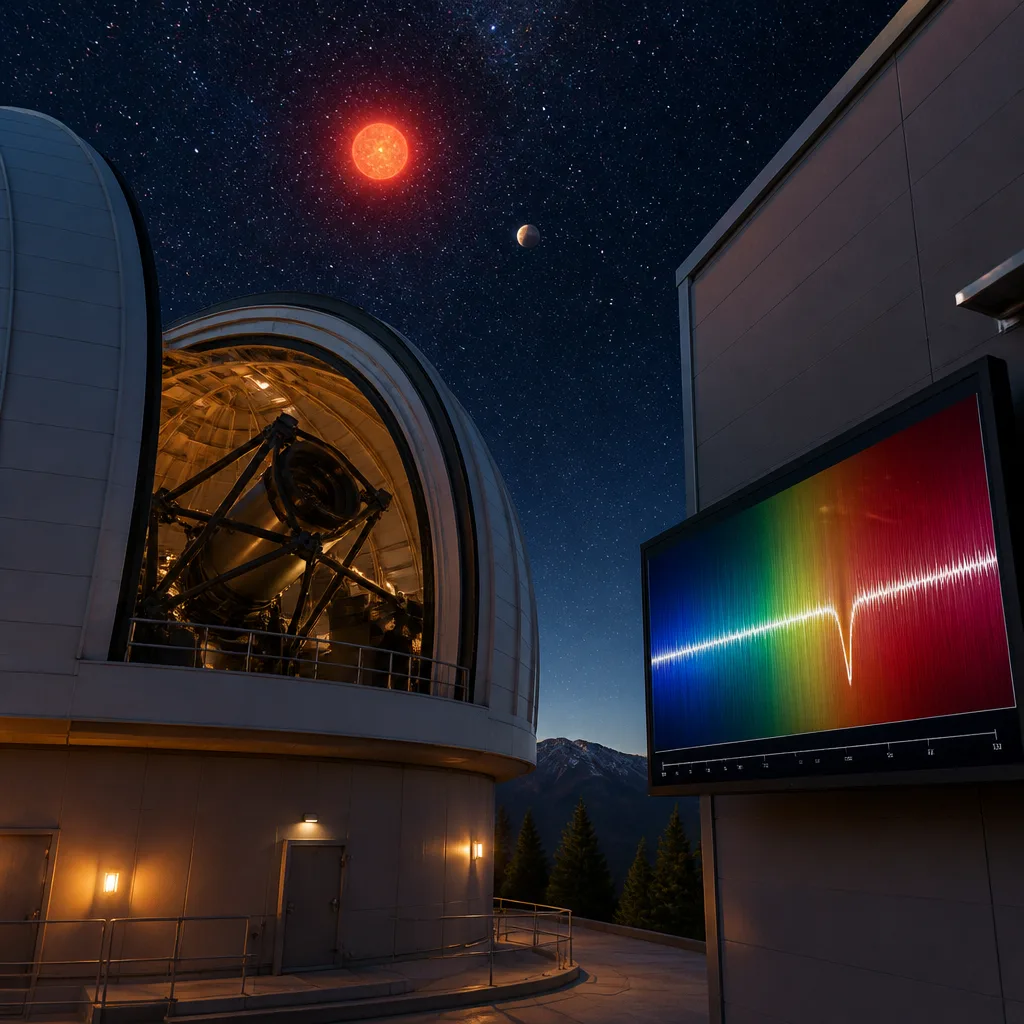
A team of astronomers reports the first direct detection of an atmosphere around a rocky planet in the habitable zone, announcing evidence of helium above the exoplanet LHS 1140‑b in a study published in Science. The finding, the researchers say, marks a notable step in assessing whether such worlds can retain atmospheres — a key ingredient for habitability.
What was observed
LHS 1140‑b is a rocky world roughly 5.6 times the mass of Earth that orbits a small dwarf star located about 48 light‑years from the Solar System. The new analysis identified spectral signatures consistent with helium in the planet’s upper atmosphere. According to the report, this is the first direct evidence that a rocky planet located in the habitable zone — where temperatures could permit liquid water — can host an atmosphere.
Why it matters
Detecting atmospheres on small, rocky exoplanets has been difficult because such planets are small relative to their host stars, complicating precision observations. The authors say previous indications that habitable‑zone rocky planets might have atmospheres were largely indirect, based on moderate day–night temperature contrasts that could be explained either by atmospheres or other planetary processes.
“For rockier Earth‑like planets, it has been a huge challenge in the field to detect any atmospheres at all,” said Collin Cherubim, a NASA Hubble Fellow at the University of Chicago.
Cherubim, who conducted the research while a PhD student at Harvard University, described the result as distinguishing itself from prior work: the claim is, in his words, the first of an atmosphere on a habitable‑zone rocky world that could potentially have liquid water and support life.
Approach and limitations
To make the detection, the team combined new observational techniques with theoretical work. Cherubim developed models focused on mass fractionation, a process that can affect atmospheric composition, and applied a novel observational strategy aimed at revealing tenuous upper atmospheres on small planets. The study emphasises that spotting atmospheres on rocky worlds remains technically challenging and that the interpretation depends on the robustness of spectral identification and modelling.
- Target: LHS 1140‑b
- Mass: ~5.6 Earth masses
- Distance: ~48 light‑years
- Detected gas: Helium (upper atmosphere)
- Publication: Study published in Science
| Parameter | Value |
|---|---|
| Planet | LHS 1140‑b |
| Mass | Approximately 5.6 Earth masses |
| Distance | About 48 light‑years |
The authors caution that while the helium detection is significant, further observations and independent confirmation are required to better characterise the atmosphere’s composition, extent and stability. Such follow‑up will be needed before drawing firmer conclusions about the planet’s capacity to retain surface liquid water or to support life as we know it.
The result nonetheless opens a new observational avenue: if rocky planets in habitable zones can possess detectable upper atmospheres, astronomers may be able to expand atmospheric studies beyond larger or more extreme exoplanets and refine assessments of which distant worlds are promising targets in the search for life.