
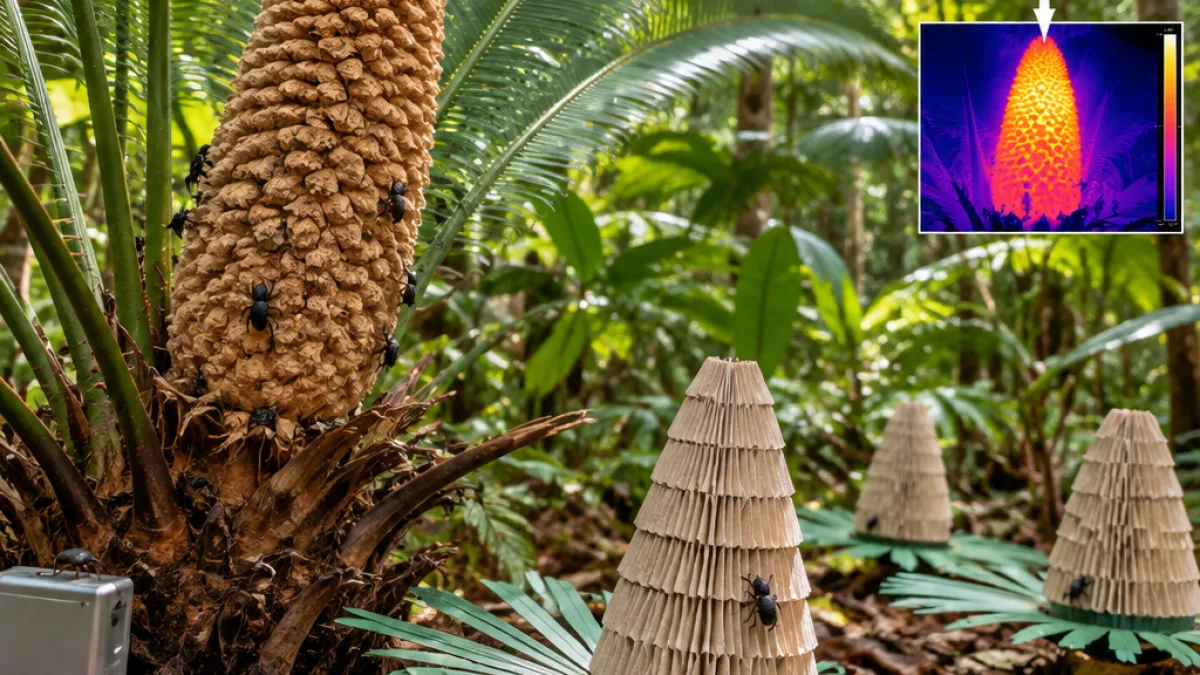
Cycads can use heat itself to guide their beetle pollinators, according to research by Wendy Valencia Montoya, whose essay on the work won the grand prize in the 2026 Science & SciLifeLab Prize for Young Scientists.
The finding challenges the long-standing view that heat-producing plants primarily warm themselves to help release scents that attract insects. Valencia Montoya’s research suggests that, in cycads, temperature is also a direct signal that helps determine where pollinators travel.
A question prompted by a warm flower
Valencia Montoya began pursuing the idea after touching a flower in the Amazon rainforest and noticing that it was unexpectedly warm. She focused on cycads, an ancient group of plants that first appeared in the late Carboniferous period, before dinosaurs emerged.
Her work centred on the cardboard cycad, Zamia furfuracea, and its principal pollinator, the beetle Rhopalotria furfuracea. The plants have thick, cone-shaped bases topped by feathery leaves. Valencia Montoya sequenced the cycad’s genome and identified a protein involved in burning starch to generate heat.
Different timing for male and female plants
Field observations showed that the plants’ warming was not random. Male and female cycads produced heat at different times, and the beetles consistently moved toward the warmer sex.
| Plant stage | Observed role |
|---|---|
| Male cycads | Warm first, attracting beetles that collect pollen |
| Female cycads | Warm later, encouraging beetles to deliver pollen |
To follow the insects, Valencia Montoya marked beetles with ultraviolet-fluorescent dye and tracked their movements from one plant to another. The sequence of warming supported a possible reproductive division: males attract insects before females, then females use the same type of cue when pollen must be deposited.
Separating temperature from scent
Tracking alone could not establish whether the insects were responding to warmth or to another feature of the plants. Valencia Montoya therefore constructed three-dimensional models of cycad cones that did not produce scent. Some models were warmed, while others were not.
The beetles favoured the heated models, indicating that temperature could influence their behaviour even when scent was removed from the experiment. Further analysis found that the insects’ antennae expressed a version of a gene linked to infrared heat detection in animals including mosquitoes and snakes.
“The gene is so old that it’s basically shared by all animals and has taken different functions in different groups,” Valencia Montoya explained.
Humans also possess a copy of the gene, she said, but it is not sensitive to temperature. That distinction underscores the evolutionary question raised by the study: an ancient gene can be retained across animal groups while acquiring different roles in their sensory systems.
The research does not suggest that every heat-producing plant uses warmth in the same way. Its significance lies in showing that, for these cycads and their beetle partners, heat can function as information rather than merely as a byproduct or a tool for spreading scent. The work adds another layer to the relationship between an ancient plant lineage and the insects that help it reproduce.
- Species studied: cardboard cycad, Zamia furfuracea.
- Pollinator: beetle Rhopalotria furfuracea.
- Evidence used: genome sequencing, field tracking, scent-free models and analysis of antennae.