A difficult growing medium
Scientists have produced potatoes in material designed to imitate the Moon’s surface, showing that a barren and chemically challenging growing medium can support a food crop when it is amended with vermicompost made by earthworms. The NASA-funded work was conducted at Oregon State University in Corvallis, Oregon, and the researchers reported that, at suitable proportions, the potatoes grew as well as those planted in fertile Earth soil.
The result is not evidence that astronauts could simply plant crops in undisturbed lunar dust. Lunar regolith is crushed rock and dust formed through billions of years of meteorite impacts. Unlike terrestrial soil, it contains almost no organic matter and essentially no nitrogen, an element plants require for growth. The material also contains potentially harmful concentrations of metals, including copper, as well as sharp, glass-like particles that can injure plant tissue.
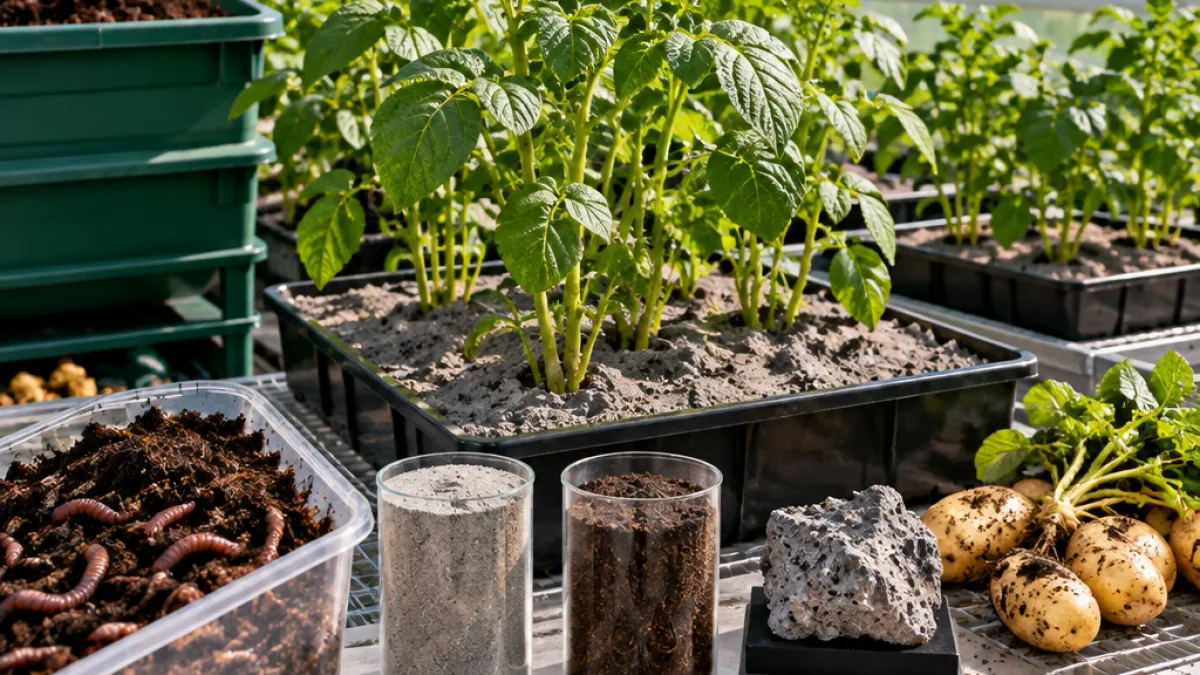
To address those problems, the Oregon State team mixed the simulated lunar material with compost produced as earthworms processed organic waste. The amendment supplied nutrients that the regolith lacks and changed the growing medium sufficiently for the potato plants to develop. Researchers tested different levels of vermicompost while growing Modoc potatoes, an early-maturing variety with red skin and white flesh.
Why potatoes are being considered
Potatoes are attractive to researchers planning possible food production away from Earth because they produce substantial calories from a comparatively limited area. They also provide several nutrients, including potassium and vitamin C, along with protein, and tend to be filling. Those characteristics could matter at a permanent outpost, where regular food shipments from Earth would be expensive and logistically difficult.
“Potatoes provide more calories per land area than many other crops,” Aymeric Goyer, a plant biologist at Oregon State University who led the research, told Reuters.
The study’s importance lies less in an immediate prospect of lunar agriculture than in identifying one possible way to close a biological loop. Future crews would need a growing medium that can hold water and nutrients, while also making use of organic waste rather than treating it solely as refuse. Vermicompost points to that kind of approach, although the source material does not establish how such a system would operate during a lunar mission or how much material would be required.
What the experiment shows — and what it does not
The findings demonstrate that simulated regolith can be made productive for potatoes under laboratory conditions. They do not remove the other obstacles to farming on the Moon. The experiment used a lunar-soil substitute rather than material collected from the lunar surface, and the report does not establish whether the plants could be grown safely through repeated harvests or whether potentially harmful metals could enter the edible tubers.
The basic challenge can be summarized this way:
- Regolith: provides a rocky structure but little organic matter or nitrogen.
- Hazards: metals and abrasive particles may damage plants or complicate cultivation.
- Vermicompost: adds nutrients and organic material through the breakdown of waste.
- Crop candidate: potatoes offer calories, potassium, vitamin C and protein in a compact food crop.
| Growing medium | Reported outcome |
|---|---|
| Fertile Earth soil | Reference condition for the experiment |
| Simulated lunar material amended with vermicompost | Potatoes grew comparably at suitable proportions |
| Unamended lunar regolith | Severely limited by nutrient shortages and physical or chemical hazards |
For lunar exploration, the practical question will be whether astronauts can supply enough organic material to make regolith useful without creating a new dependence on shipments from Earth. The potato experiment does not answer that question, but it narrows one part of the problem: with the right amendment, lunar soil simulant need not remain entirely sterile. That is a modest laboratory result, but it is also a reminder that future space habitats may depend on carefully managed exchanges between rocks, waste, microbes, plants and the people who maintain them.