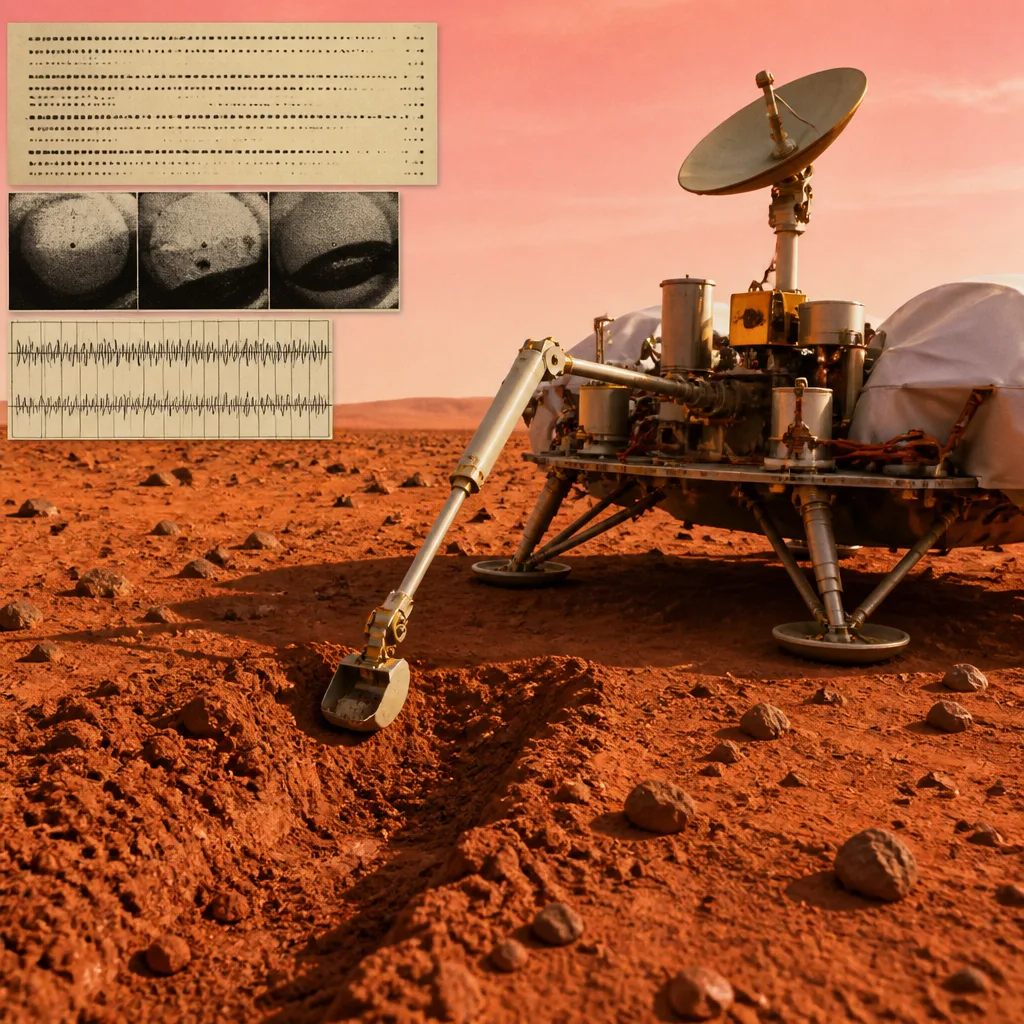
Fifty years after Viking 1 made history by touching down on Mars on 20 July 1976, a new challenge to NASA’s long‑standing conclusion that the mission found no definitive evidence of life is sharpening attention on what those first landers truly discovered—and how the science was interpreted.
The United States’ account of Viking 1 as the first successful Mars landing is itself nuanced. The Soviet Mars 3 spacecraft reached the surface in 1971 but lost contact within seconds, sending back a single fuzzy grey image before falling silent. Viking 1, followed by its twin, transformed that early foothold into a sustained campaign of observation. Over roughly six years, the pair returned more than 50,000 images and mapped 97% of the planet’s surface—data that continue to frame questions about Martian geology and habitability.
A landmark mission, a cautious verdict
At the time, the mission’s life‑detection experiments were interpreted conservatively. The programme’s chief scientist, Gerald Soffen, summed up the verdict with a stark phrase:
“No bodies, no life.”
NASA’s public record has echoed that caution, stating that Viking “provided no definitive evidence for the presence of living microorganisms.” That framing set expectations for decades: intriguing chemistry on Mars, yes; confirmed biology, no. The absence of unambiguous microbial “bodies” or repeatable biosignatures drove the institutional stance, even as the mission delivered a trove of environmental and imaging data at an unprecedented scale.
A claim that reopens the file
Now, chemist Steven Benner, a former Harvard professor, contends in a new book—Meet the Neighbours—that the evidence Viking gathered may have been read too narrowly. He argues that indicators consistent with life could have been present in the results and set aside, not for lack of curiosity, but because the bar for proof was set extremely high in the face of ambiguous signals. The repercussions, he suggests, are vast: if the data were misinterpreted, the first detection of extraterrestrial life might have occurred not in the future, but in the past.
Benner’s argument does not rewrite the historical record of what Viking did; rather, it interrogates how conclusions were drawn from the experiments relative to what the instruments could reasonably reveal. It is a methodological challenge as much as a scientific one—about how agencies communicate uncertainty, and how the scientific community weighs evidence that is intriguing yet inconclusive.
What Viking established—and what it left open
- First sustained surface operations with an extensive imaging campaign: >50,000 images.
- Global context for Martian terrain: 97% of the surface mapped by Viking 1 and its successor.
- Life‑detection experiments that, according to NASA, yielded no definitive evidence for living microorganisms.
The sheer scope of the Viking dataset made it foundational. Yet even a dataset of this size cannot compel a verdict that its instruments were not designed to provide with certainty. The caution captured in Soffen’s line—no direct bodies, no claim of biology—was a scientific posture that prioritized guarding against false positives when working on another world for the first time.
Why the debate matters now
Anniversaries can function as audits. At the half‑century mark, the Viking 1 legacy is being re‑examined not to diminish its caution but to assess whether that caution became doctrine. The question Benner raises—whether life‑like signatures were dismissed because they fell short of direct detection—goes to the heart of how frontier science is practiced. It is also a reminder that data and interpretation are not the same thing; the latter evolves as tools, frameworks and expectations change.
In practical terms, the discussion underscores three durable realities of planetary science: that extraordinary claims must meet stringent standards; that null or indeterminate results can be as informative as positive ones; and that the first generation of missions often defines baselines and blind spots alike. If subsequent readings of the Viking experiments argue for a more permissive interpretation of what counts as a viable biosignature, the consequence would not be rewriting the mission’s achievements, but reframing its questions.
Milestones at a glance
| Year | Event | Notable detail |
|---|---|---|
| 1971 | Mars 3 landing | Contact lost within seconds; one fuzzy grey image sent |
| 1976 | Viking 1 landing | First sustained surface mission on Mars |
| 1976–early 1980s | Viking operations | >50,000 images returned; 97% of surface mapped |
The anniversary does not settle the life question. It does, however, re‑centre the value of revisiting legacy data with fresh lines of inquiry. Whether or not Benner’s contention persuades NASA or the broader community, the renewed scrutiny reflects a healthy scientific process: revisiting old answers when new questions sharpen the view.