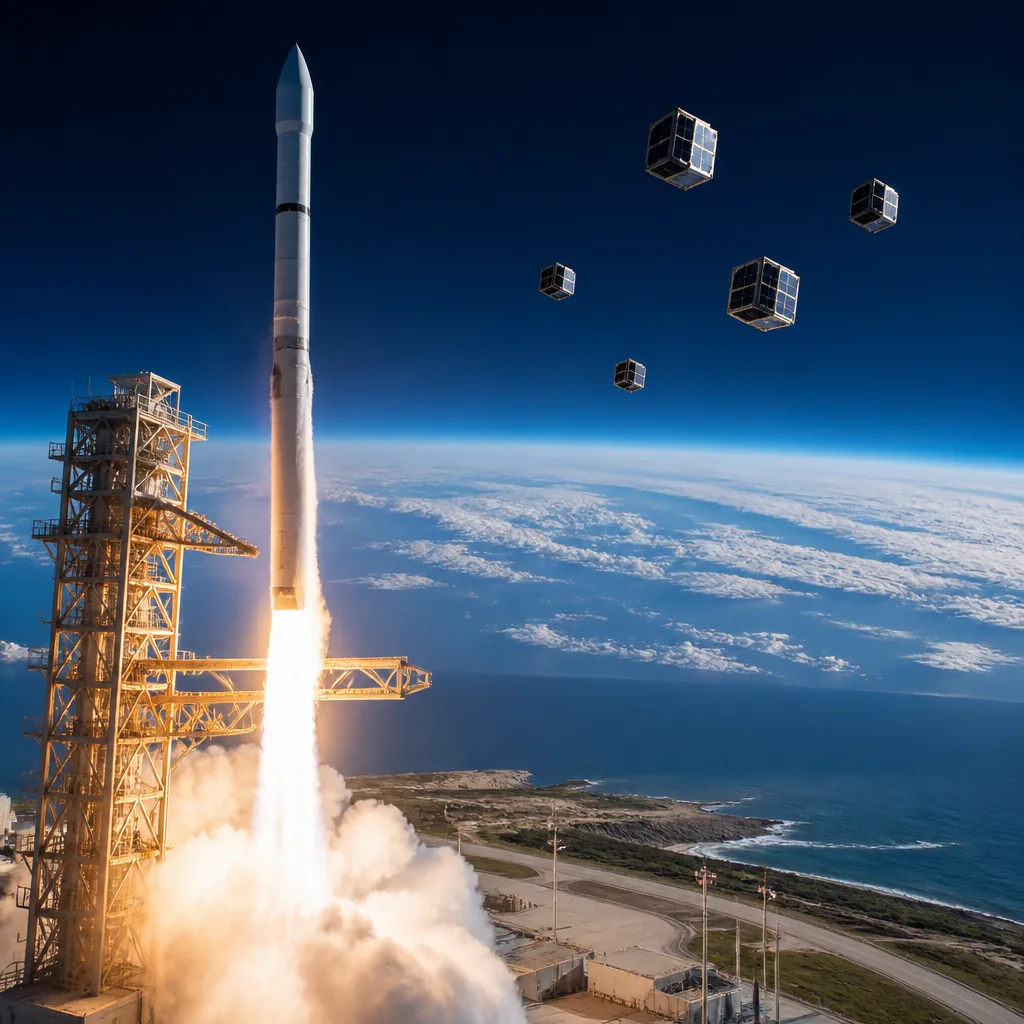
India’s growing commercial space sector marked a milestone when a private company’s three-stage orbital rocket successfully placed customer payloads into a 450-kilometre low Earth orbit. The mission, carried out from the Satish Dhawan Space Centre in Sriharikota, tested critical flight systems including propulsion, avionics, telemetry, guidance, navigation and control.
What happened
Skyroot Aerospace’s Vikram‑1, a 22‑metre launcher, performed an orbital insertion during the test flight and deployed customer payloads into a roughly 450 km altitude. The vehicle can carry up to 350 kg to orbit and is fitted with robotic arms designed to clear space debris. The launch follows an earlier suborbital flight in 2022 by the company’s Vikram‑S vehicle, which reached space but did not place payloads into orbit.
Political and industrial response
Prime Minister Narendra Modi framed the achievement as inspirational for young innovators. The manufacturer said the test validated the craft’s flight systems; Skyroot also signalled intent to conduct further test flights before commencing routine commercial operations. The company, founded in 2018, is among a newer generation of Indian space startups that gained momentum after liberalisation of the sector and has attracted global investment, at one point reaching a reported valuation of US$1 billion.
“The successful launch will ‘encourage countless youngsters to dream bigger and innovate fearlessly’.”
Practical details
The mission carried a mix of customer payloads and demonstrators, including experimental equipment, a lab-grown diamond and a miniature 18‑carat gold sculpture commemorating India’s national space programme. Skyroot described the launch success on social media with a celebratory message.
| Specification | Value |
|---|---|
| Vehicle | Vikram‑1 |
| Height | 22 m |
| Payload to LEO | Up to 350 kg |
| Target orbit | ~450 km low Earth orbit |
Why it matters
- This makes India the third country where a private company has achieved orbital launch capability, reflecting a shift from state-only missions to mixed public-private activity.
- Validating onboard systems — from propulsion to guidance — is a key step toward routine commercial launches and services such as small-satellite deployment and in-orbit demonstrations.
- Robotic features intended to address debris demonstrate an early attention to on-orbit servicing and sustainability considerations.
The flight is the latest marker of a broader trend: after policy changes that opened the sector to private participation, startups have attracted significant investment and rapidly matured technical capabilities. Skyroot’s declaration of further test flights and eventual commercial operations indicates the company plans to move from demonstration to service provision.
For governments, operators and customers, the test reduces technical uncertainty for a new entrant. For the space industry, it introduces another potential supplier of launch capacity — particularly for small satellites — at a time when demand for affordable, frequent access to low Earth orbit continues to grow.