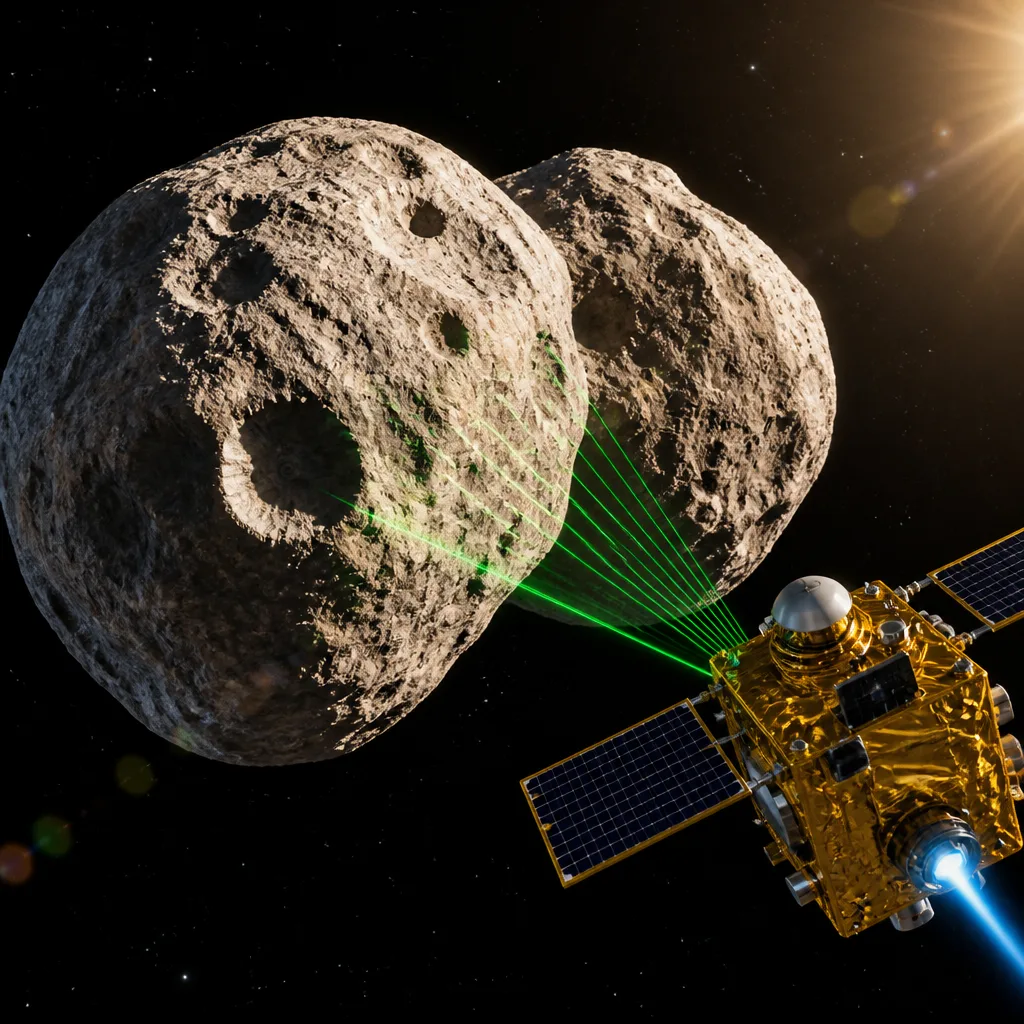
Japan’s Hayabusa2 spacecraft has returned sweeping, close-range views of the near-Earth asteroid Torifune after a July 5 flyby that mission teams described as both high-reward and high-risk — a manoeuvre approved only after intense scrutiny of what the spacecraft might encounter.
Image data began arriving the morning of July 6 in Japan for teams at the Aerospace Exploration Agency, capping weeks of preparations that hinged on navigating past an object whose size and shape were not well constrained. The team used a maximum credible size estimate of 1,400 metres by 400 metres to frame worst-case scenarios for spacecraft safety during approach.
Debate over risk yields a close look at an unexpected shape
Hayabusa2, launched in December 2014 and best known for collecting samples at asteroid Ryugu and returning them to Earth in 2020, detected Torifune on June 19. Controllers relied on terrestrial guidance up to three hours before the flyby, then executed the final approach sequence designed to keep the spacecraft out of harm’s way while maximizing science return.
The result was a series of detailed images of a dual-lobed body captured by the probe’s Optical Navigation Camera Telescope, revealing a configuration that mission leadership said they had not anticipated at such proximity. Speaking to scientists gathered at the Asteroids meeting, former Hayabusa2 mission manager Yoshikawa said the team had to reset expectations in real time as the encounter unfolded.
“We did not imagine such a contact binary,” Yoshikawa said. “Originally, we didn't think we could have such a very big image. Maybe we will take a very small one, but the image was much larger than we expected.”
New in-flight measurements and a long downlink ahead
Beyond imagery, Hayabusa2’s Near Infrared Spectrometer and laser altimeter added to the dataset. Yoshikawa described the laser altimeter results as the first successful demonstration of LIDAR ranging during an asteroid flyby, a capability that could inform how future deep-space missions characterise small bodies during fast encounters.
Mission control prioritized a small tranche of the most urgent data for early transmission. Approximately 25 MB were downlinked promptly, while teams expect to spend months retrieving the remainder of approximately 300 MB of science data from the encounter. That backlog reflects the realities of limited communications time, distance, and the need to balance downlink windows with ongoing spacecraft operations.
| Milestone | Date / Detail |
|---|---|
| Torifune detection | June 19 |
| Closest flyby | July 5 |
| First images received in Japan | Morning of July 6 |
| Urgent data returned | ~25 MB |
| Total science dataset | ~300 MB (months to complete) |
Why the close pass mattered
Close passes of small, irregular asteroids compress navigation tolerances and scientific opportunity into a narrow window. For Torifune, the unknown dimensions and the possibility of a complex shape raised collision and contamination risks. By adopting a conservative envelope for the asteroid’s size — up to 1,400 m by 400 m — the team could model trajectories that kept Hayabusa2 clear of potential hazards while still enabling high-resolution imaging and ranging.
The spacecraft’s navigation protocol, with ground-based guidance maintained until three hours ahead of the pass, reflects this balance: keep authoritative control for as long as communications geometry allows, then commit to a carefully pre-planned sequence that the spacecraft executes autonomously at speed.
Another target on the horizon
Although the Torifune encounter delivered a fresh trove of data, Hayabusa2 is not finished. The mission’s extended itinerary points to a rendezvous in 2031 with the tiny asteroid 1998 KY26 — described as roughly 36 feet wide and fast-spinning. In contrast to a quick flyby, a rendezvous would allow prolonged observations and operational experiments around a very small object, offering a different vantage on the diversity of near-Earth asteroids.
- Hayabusa2’s Torifune flyby produced high-resolution images of a dual-lobed asteroid.
- The mission logged a first in demonstrating LIDAR ranging during an asteroid flyby.
- Only ~25 MB of priority data are on Earth; the rest of the ~300 MB dataset will take months to downlink.
For small-body researchers, the Torifune pass offers a snapshot rich enough to refine models of contact binaries and inform how close-range sensing can be staged against uncertain shapes and sizes. For flight operators, it is a case study in how to weigh scientific payoff against operational margins — and win.