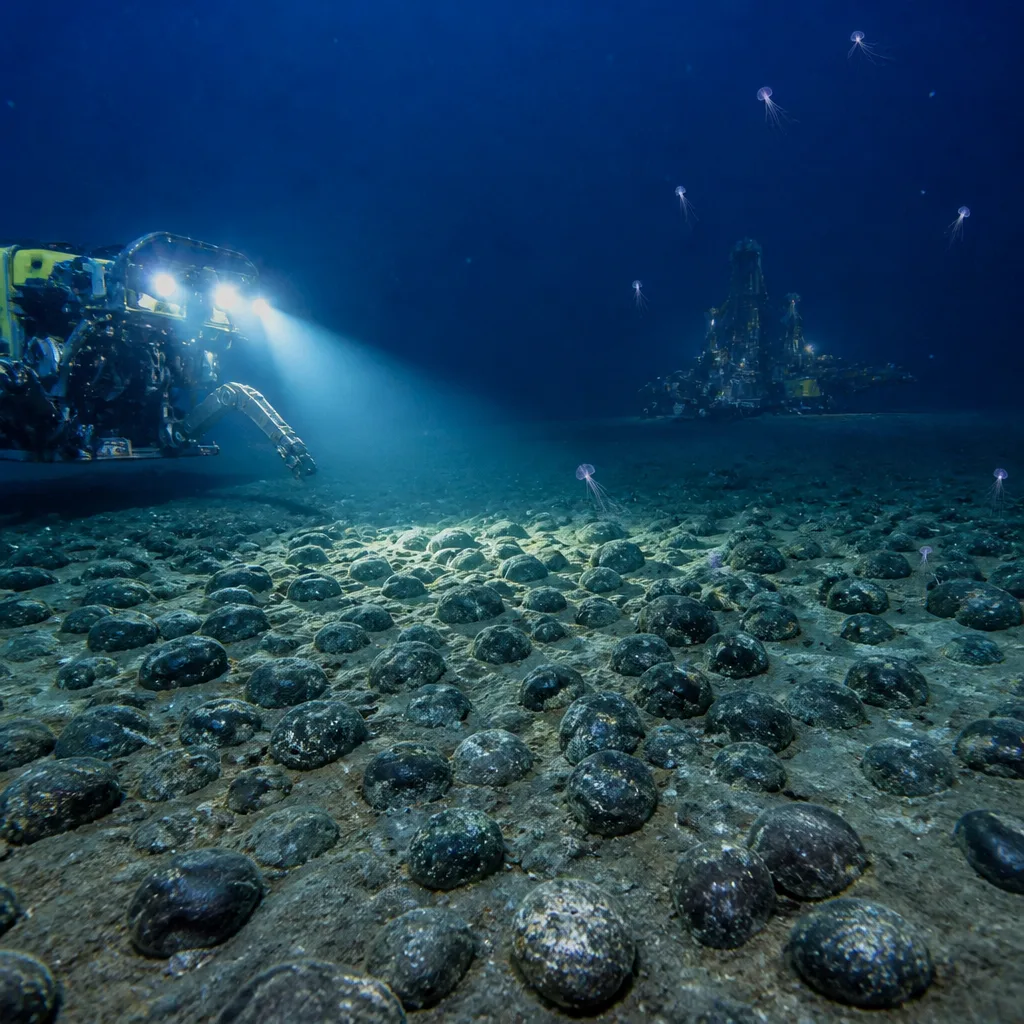
Four thousand metres beneath the central Pacific, an expanse the size of the contiguous United States is littered with fist-sized, potato-like rocks that contain more of certain battery metals than all known land deposits combined.
What lies on the abyssal plain
These objects, known as polymetallic nodules, are roughly the size of an apple or a fist and sit atop fine sediment that has remained undisturbed for millions of years. Each nodule is composed of a mixture of industrial metals, by weight approximately 25–30 per cent manganese, 1–2 per cent nickel, 1–2 per cent copper and 0.2–0.3 per cent cobalt. Scientists estimate there are about 21 billion tonnes of nodules in the Clarion‑Clipperton Zone, containing roughly 5.95 billion tonnes of manganese and 0.05 billion tonnes of cobalt — amounts that exceed currently known terrestrial reserves for those two metals.
How the nodules formed
The nodules did not grow through volcanic uplift or river deposition. Instead, they accreted over geological time as dissolved metals in seawater precipitated onto tiny hard particles such as shell fragments or shark teeth. Layer upon layer built up until the roughly fist-sized nodules observed today were produced.
Ecology and knowledge gaps
The abyssal plain that hosts these deposits is one of the least-explored habitats on Earth. Thousands of species inhabit the muddy seafloor and the spaces around the nodules — including corals, sponges, worms, small crustaceans and translucent fish — and researchers say more than 90 per cent of local species remain formally undescribed. That degree of ignorance raises difficult questions about the ecological consequences of any large-scale collection of nodules.
- Resource potential: nodules contain concentrated supplies of metals central to batteries and renewable-energy infrastructure.
- Environmental risk: extraction would disturb ancient, poorly known communities and long-settled sediments.
- Scientific uncertainty: the abyssal ecosystem’s biodiversity and functioning are not well documented, complicating impact assessment.
Numbers at a glance
| Characteristic | Value |
|---|---|
| Estimated total nodules (Clarion‑Clipperton) | 21 billion tonnes |
| Manganese contained | 5.95 billion tonnes |
| Cobalt contained | 0.05 billion tonnes |
| Typical nodule composition (by weight) | Mn: 25–30%; Ni: 1–2%; Cu: 1–2%; Co: 0.2–0.3% |
The combination of abundant critical metals and an environment that is both vast and poorly understood has prompted interest from mining firms considering deep-sea extraction. Proposals to harvest nodules raise immediate trade-offs: the potential to supply materials for electrification and clean-energy systems versus the risk of harming an ancient and largely undocumented ecological community.
For policymakers and researchers, the nodules pose practical and ethical questions. Environmental impact assessments will need to confront severe baseline data gaps. Regulators will be asked to weigh climate and industrial policy goals against the precautionary protection of a globally unique ecosystem. Scientists, meanwhile, underline that the abyssal plain is not a blank slate — it is a living system whose species and ecological roles are mostly unknown.
As interest in these deposits grows, so too will pressure to reconcile resource demands with conservation and scientific responsibility. The Clarion‑Clipperton Zone presents a rare and stark example of how the planetary transition to low‑carbon technologies may intersect with previously overlooked natural heritage.